
 Y is for Yeshua. Yeshua ben Joseph is the “reason for the season”! (The “ben” means “son of”) When I was growing up, I thought that his first name was Jesus, and his last name was Christ. It was actually not until I was studying the philosophy of religion in my under-grad years that I learned that “Jesus” is our translation of a Hebrew name which can also be expressed as “Joshua”. I say “expressed as Joshua” because in the original Hebrew writing there were only consonants, and the reader would have to fill in the vowel sounds. There is a whole group of variant ways to pronounce words that have the “J or Y” sound followed by the “S or Sh” sound, depending upon which vowel sounds we plug in. So we say his name is Jesus, but that is not a name that anyone who lived in his time would recognize.
Does it matter? Most people know who we mean when we talk about Jesus. What this minor revelation about names taught me is that it does not hurt to practice a little more humility when it comes to what we think we know, with certainty, about the founder of our faith.
The “Christ” part is not actually a name at all, but more of a description, or a title. Our English word “Christ” is derived from the Greek Χριστός “Khristos”, which means “the anointed”. When the Hebrew Scriptures (what we call the Old Testament was translated into Greek, this was the word chosen to translate the Hebrew מָשִׁיחַ which means “one who is anointed”. This Hebrew word is also translated as “Messiah”. Words are important!
The word “Christ” has taken on a meaning in Christian theology very different from what “Messiah” means in Jewish religious thinking. (The word Christ, in much of our theology, is used to refer to the 2nd person of the Holy Trinity, who in creeds is described as being both fully human and fully divine. The word Messiah in much of the Jewish literature, refers to a person who is fully human. In Jewish theology, only the one God is divine.)
When early Christian theologians began poring over their Greek translations of the Old Testament, they were not necessarily aware of what had been lost (or added, depending upon your view of things) in translation. So Old Testament passages about an anointed king or leader of Israel took on an air of prophecy, of appearing to foreshadow or predict the coming of Jesus, who later came to be called the Christ.
Scholars of religion, and particularly of Christian theology, have been debating for centuries whether or not there is a connection between the “messianic hopes” of the Jewish people, who were looking for a human leader to “save” their nation, and the earthly ministry of Jesus (or Yeshua)
Does this confusion over names, and the questions about the meaning of those names take anything away from our anticipation of the celebration of the birth of Jesus? Not for me. I think God is a mystery. It is not surprising our human languages, and our translation efforts, have not fully captured the truth.
When even our best efforts at using words to define or describe God fall short, there is always prayer. When we don’t know exactly what to say, it is good for us to listen.
The Advent Alphabet is a ministry offering from Rev. Darrow Woods, minister at Trinity United Church in Oakville, Ontario.
 X
X W is for waiting. Advent is a season of waiting.
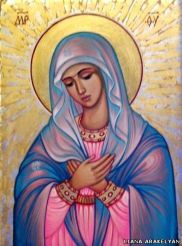 V is for Virgin. A word with volatile overtones of sexuality, judgement, and purity codes. In the western world at least, there is no time of year we hear that word more often than the season leading up to Christmas.
 U is for the United Church of Canada
 T is for theology. The first half of the word, “Theo” refers to God. The second half, “logia” (study) is connected to the word-family that includes “logos”, which means “word”, and “logic”, which suggests a system or method. We are doing theological reflection when we think about God, and the activity, the identity, the purposes of God. “What is God doing?” “Who (or what) is God?” “Can we understand God’s will, or plan?” “What does God have to do with me, or I with God?”
 S is for So what? (It’s also the title of my favourite track on the classic Miles Davis jazz album, Kind of Blue.)
 At our house on Christmas morning we have a tradition of reading about the birth of Jesus, usually from the Gospel of Luke, before we do anything else. At times it is enough to hear the story again, listen with the heart, and open our spirit to receive God’s gifts. (Then we move on to exploring our stockings, and tearing away at wrapping paper!)
 Q is for questions. I asked in an earlier letter if it was possible to have faith, and also have questions, even doubts about what we have been taught about God, and Jesus. I quoted a friend who makes the distinction between having faith in God, and believing everything put forward in our religious tradition. (His name is Rev. Del Stewart, and I had his book “Thinking About Christmas” with me as I wrote some of these letters.)
 P is for Palestine. That’s the name the Romans used to refer to the area between the Mediterranean Sea, and the Jordan River, that included Judea (land of the Jews), and Samaria (home of the famous Good Samaritan), and Galilee, the area that includes Nazareth, the town where Jesus grew up. The name Palestine may have origin with the Philistine people (Remember David and Goliath? Goliath was a Philistine.)
 Darrow Woods: Writer of Things