
Rabbis and Rainbows and daddies, oh my!

Teaching Time: Our Father: The Mystery of God My new favourite show on Netflix is called “Granite Flats”. Set in a small town in Colorado during the cold war, it is full of mystery, and spies, and nothing is quite as it seems. My favourite character is an English teacher named Professor Hargreaves. He is played by Christopher Lloyd, who also played the mad, time travelling scientist in the Back to the Future movies, and starred in Taxi, as Jim Ignatowski, one of the weirdest cabdrivers. He seems to do well with characters that are a bit out there. prof hargreaves Professjim in taxior Hargreaves character extols the mystical qualities of authors like Walt Whitman and William Shakespeare. In a private tutoring session he asks one of his students if they ever pray. It’s a great question. The student, whose parents are serious scientists, and have raised their daughter to be a secular humanist, says she never has. Hargreaves says, “Prayer is nothing more than the desire to connect with a power that exists beyond your little self.” That is a wonderfully expansive definition of prayer. I hope to explore this basic human activity, while we work with one of the best known prayers. We will look at the Lord’s Prayer one line at a time, over the course of five summer Sundays, beginning today with the first two words, “Our Father”. (We will run out of summer before we finish the prayer, but I am okay with that.) It was a huge step for Jesus’ first students and followers, to call God “Abba”. In Aramaic, the word that we translate as “Father” is actually “Abba’, which in the original carries the closeness and intimacy of “Daddy”. Daddy is different from Father. Daddy is a term of endearment, soaked in the feelings of a relationship. It implies tenderness, and open-heartedness. Father is more formal, points towards the authority of a father-figure, and obligations to the head of the household. In Jesus’ time the patriarch in a very real sense, owned, and commanded the obedience of the children, the servants, the animals, as property of the family. The patriarch ran the family like a little kingdom, or family business. So “Father” was a lot like King, or CEO, or Boss. Daddy has more of the flavour of home, of welcome, of the assurance of love. “Father” is about position, and role. “Daddy” is about the love. Before our worship service began today, Mary was telling us about her experience of being on the naval dock in Halifax, with the crowd of friends and family who were there to welcome home the officers and crew of the HMCS Fredericton. This Canadian Navy frigate had just returned from 7 months of active, and sometimes hazardous duty. She and her husband were there to welcome home their son, who is a navigator on the bridge of that vessel. Mary mentioned a little girl who was quite excited to be there.

HS2010-0194-001 04 May 2010 CFB Halifax  All the families of the sailoris wave as Her Majesty Canadian Ship Fredericton returns home after a deployment. HMCS Fredericton was deployed on a six-month mission to the Arabian Sea, Gulf of Aden and Horn of Africa to conduct counter piracy and counter terror operations alongside our NATO and Coalition partners. As part of Canadais ongoing naval contribution to NATO, HMCS Fredericton will integrate into Standing NATO Maritime Group 1 (SNMG 1), currently conducting anti-piracy operations.  While conducting operations against international terrorism, HMCS Fredericton will integrate with Combined Task Force 150 (CTF 150). Please credit: Cpl Johanie Maheu, Formation Imaging Services Halifax, NS. Mary, can you tell us more about the little girl on the dock? How old was she?

About two.

What about her hair?

It was bunched up in elastics and went in all directions.

What colour?

Blonde.

What about her eyes?

I think they were blue.

And the shirt? What colour?

White, with the words printed on the front.

Can you tell us again what they said?

Out of my way, my Daddy’s coming home today.”

That’s powerful. What colour was the printing?

The letters were in all colours, like a rainbow.

Wow. The rainbow. The promise of a new day, after the stormy waters.

The vessel has landed safely, and the flood waters have receded.

I can see the little girl, in the imagination of my heart. She’s on the dock, maybe her hand is in her mom’s. She is bouncing on her little feet, about to burst with impatience, excitement, joy. She’s waiting. Not for her dad. Not for her father. She is waiting for her daddy. I met a lot of rabbis this past week, at the writer’s conference. One night I came back to the apartment I was sharing with four other guys, a couple of them rabbis, and there was this gathering of men, mostly rabbis, and some wine, and some beer, and they were in the common area of the apartment. They were solving, at great volume, the problems of Israel. I think this was the same day, or the day after President Obama announced the signing of the nuclear deal with Iran. The debate, argument, conversation was polarized, and lively. I had planned to go up to bed, but I had ducked hanging with the guys the previous night, and I also figured there would be no sleeping in our apartment for some time. I sat in on the conversation. One of the men is preparing to move back to Israel, and has a son in the Israeli Defense Force- so he was a little louder than the others.

I learned a little over the week about this style of friendly, loving disputation. These guys argued, and got loud, and did not resolve, or compromise, but at the end of the night, thanked each other, and blessed each other for the time.

According to rabbinic tradition, every verse in the Torah can be interpreted in 70 ways. They don’t literally mean 70, but rather, many, many ways. This must encourage reading, and conversation, and interpretation of the text.  I love the humility, and the encouragement in this. We don’t know everything, we do not speak for everyone, and there is room to look at things in different ways.

This openness to not knowing the “one answer”, and leaving space for other interpretations is such a contrast with some Christian teachers, who seem to have the single right way to think about things, and are ready to tell you how wrong you are, because you don’t see the thing their way. There is no room for mystery, or questions, just a single right answer.

Life is confusing. Have you noticed? Life is mysterious. There is so much that is beyond us. I love the phrase in Paul’s Letter to the Corinthians “Now we see as through a glass darkly”. That’s from the King James Version. In The Message, the paraphrase is, “We don’t yet see things clearly. We’re squinting in a fog, peering through a mist. But it won’t be long before the weather clears and the sun shines bright! We’ll see it all then, see it all as clearly as God sees us, knowing God directly just as God knows us!” That line comes from the famous passage in First Corinthians about love. We often read this passage at weddings, and at funerals. I think part of what Saint Paul is telling us is that in the midst of our earthly lives, there is a lot about life, and about God, that will remain mysterious, so it is a good thing we can place our trust, our faith, our hope in love. “Out of my way, my Daddy’s coming home today.”

When I began my training to be a minister, in the mid-1980’s, students in mainline Protestant seminaries were struggling with a radical suggestion. We did not have to think about God as a grey haired old man who lived in the sky, and looked down on us, literally, and kept track of our mistakes, and mis-steps, and would hold us accountable. I still kind of get that god confused with Santa, and his list of the naughty and nice.

Feminist writers showed us this image of God was not only insufficient, but in a lot of cases, quite damaging to people’s ability, and willingness to approach God as an idea, or as a focus for their hopes and prayers. If we only talked about God as Father, we ran the risk of hurting, or leaving out people whose experience of earthly fathers was not loving, or wholesome, or life-giving. That was part of the rationale behind the movement towards more “inclusive language”.

We can see now, looking back, that a lot of the efforts to replace all the “fathers” in the hymn book with words like “parent” or “mother/father God”  were not only bad poetry, but they often also offended by simply trading one limited metaphor for God, for another.

I think a lot of that effort distracted from a deeper consideration, that the whole enterprise of trying to say exactly who God is, was never really the point.

I was at a poetry reading on Friday, offered by a man named Rodger Kamenetz, who describes himself as a JuBu, which is a name sometimes applied used by Jews who are also Buddhist. Rodger is a gifted teacher, and a mystic. He was talking to room full of rabbis, and priests, and pastors, who are all interested in writing- people who work a lot with words. At one point he asked us to remember that as important as words are, words are also symbols that we use, that someone has made up, to point towards what we mean. At an even more basic level than words, there is what we see, and smell, and touch, and what we hear, and what we feel.

“Out of my way, my Daddy’s coming home today.”

When my children were babies, and they were crying, I held them. In the days and weeks and months before they understood language and knew the names for things, they knew what it was to be held, and protected, and fed, and loved. In the time before they had any name they could say out loud, they knew that they were loved. This knowing that they were loved did not depend on getting my name right.

When one of my kids, or my wife, or a close friend, or someone in our church family is hurting, or confused, or feeling lost, or fed up, or angry at themselves, or life, or God, I often have no clue what the right words might be to help them. Probably because words come mostly from the head. Often what people need does not come from the head, but from the tenderness of hearts.

God is the mysterious force who is at work making the universe and giving us life. When Jesus called God, “Daddy”, I believe what he was saying was that we may not have all the answers to the mysteries, we may not know what God looks like, or what is on God’s mind, if God has anything like a mind- but we can trust, and love, and place our hope in God, who was known to Jesus as tender love.
My Argument with a Lectionary Text: Darrow Woods (from a writing prompt from Rabbi Rachel Rosenblatt)

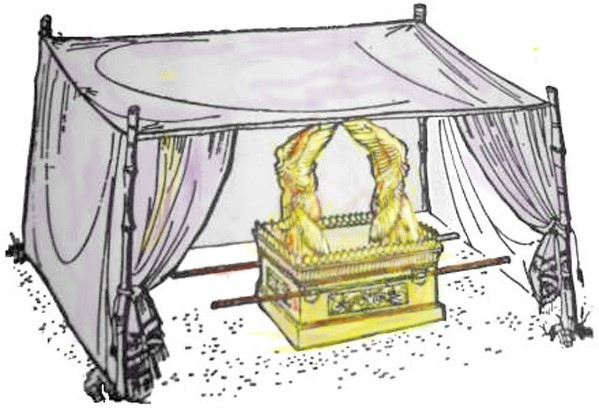
tabernacle in tent“But that same night the word of the LORD came to Nathan: Go and tell my servant David: Thus says the LORD: Are you the one to build me a house to live in?  I have not lived in a house since the day I brought up the people of Israel from Egypt to this day, but I have been moving about in a tent and a tabernacle. “(1 Samuel 7:4-6)

Does the ground of being, the source of the love that fills us and flows through us as we allow, really need a house to live in?

Nathan’s message from God to David is about an upgrade in accommodation from a tabernacle in a tent, to a house made of cedar. This suggests a permanent, stationary structure.

The biblical scholarship that lives in my memory wants to remind me this story may represent the transition for Israel, under David’s rule, from a nomadic, wandering tribe to a kingdom like the kingdoms that surround it, centered in one place. This may point to the development of a city, or at least a larger village or town, that becomes the place to live, from which governing happens, where people gather for religious celebration, and to which people come for commerce.

Setting that aside, I hear this passage as the pastor of small congregation in suburban Canada, in the first quarter of the 21st century. I serve a denomination that seems about 50 years past its stale, or stagnation date. The sociologists of religion have been telling us that we were at our peak, and best condition, at least in terms of numbers of people, and social influence, in 1965. I have some awareness that we have built many “houses for God to live in”.

trinity united oakvilleThe community where I serve as a pastor has a half dozen houses of our brand, and I don’t know how many of other brands, other “god-house” developers. My congregation struggles weekly, monthly, annually, to meet the costs of maintaining our little house, and to pay the staff.

Was it supposed to be that our mission to be people of God, with hearts open to love others in God’s name would be overtaken with the financial and practical demands of property management? Did I know, when I was ordained 25 years ago that so many of the conversations I take part in, would be about this little house?

I find myself thinking about the tabernacle in the tent, and asking myself, “What was the problem again?”

Welcome to Camp Happy Place

summer camp 2The highlight of my kids’ summer is the Ontario Mennonite Music Camp. Forty teenaged musicians and a half dozen staff members live in residence at Conrad Grebel College for two weeks every August. Campers attend master classes for their instrument of choice, and work together to present a scaled down Broadway musical for family and friends on the final night.

Each camper is part of a small group that meets daily for devotions, and conversation. There is great food in generous quantities. There are games, and mysterious traditions, and late night escapades in an atmosphere of generous, good-hearted fun. For the other 50 weeks of the year, campers talk, and text with new friends who share their love of music.

This week I am at “Beyond Walls,” offered by Kenyon College. The campus is in the tree-lined village of Gambier, Ohio, where the bookstore rents bicycles, walking is encouraged, and the speed limit is 25 mph. There are 84 of us clergy-types: rabbis, pastors, and priests representing a mixed bag of denominations. We came from several countries, and many American states, attracted by a shared desire to write about spiritual life. Most of us produce weekly sermons, but would love to move creatively beyond the walls of the worship service.

We are living in apartment-style residences, and being fed well in a beautiful dining room. Our days begin and end with meditation and worship. Our teachers are bloggers, op-ed writers, poets and novelists. We compare notes in small groups as we take on writing challenges.

It is invigorating to meet people with similar passions. It is a blessing to leave behind everyday occupations of work and home, and put time and energy into writing.

This is my summer camp. What would yours look like?

We can live boldly, or die sadly: Teaching Time for Pentecost Sunday, May 24, 2015

Imagine a battlefield in an arid place. A huge fight must have taken place, and horrifically, the casualties were left dead or dying where they fell. The sun and the wind and the animals of the wild all did their work, and the battlefield was littered with dry bones, the skeletal remains of warriors who had been strong and courageous enough to fight, but who died.

This is a dramatic image of defeat, of the mighty and proud struck down, of the plans of conquerors or defenders gone awry. A valley of dry bones represents disappointment, hopelessness,, despair. What good could come from visiting such a sad, sad place, even in a vision?

This description of the valley of dry bones can remind us of the dry, and dead or dying places within ourselves, and our own lives. Are there ways that we feel stuck? Are there areas of our own lives that feel beyond renewal, beyond new possibility? Do we believe that our lives can change for the better? Are we open to that?

Where does hope come from, in the times that feel dry, and dead, and beyond restoration? In this vision, the Spirit says : “Prophesy over these bones: ‘Dry bones, listen to the Message of God!'”

Then, God speaks directly to the bones. A vision must be something like a dream, in which weird things can happen, that have meaning and make sense within the context of the dream.

“God, the Master, told the dry bones, “Watch this: I’m bringing the breath of life to you and you’ll come to life. I’ll attach sinews to you, put meat on your bones, cover you with skin, and breathe life into you. You’ll come alive and you’ll realize that I am God!”

In this dream-like vision, the combination of God’s power, and Ezekiel’s prophesying, or preaching, has the effect of rousing the fragments of dried up skeletons. God’s power causes sinew and flesh to re-grow, and knit together the bones, to re-form and revive the dead.

If someone came to me for help in understanding their dream, which happens sometimes, and told me about a dream like this, I would ask them, “ What feels dead in your life? “

Last week we spent some time with a spiritual exercise called the Examen. You ask yourself two little questions. The first question is along these lines,” When did I feel closest to God today, or when did I feel most alive, or filled with hope, and joy, and love. “ The second question is kind of the reverse. “When did I feel the most distant from God, or the most despairing, or without joy? When did parts of me feel dead, or hopeless inside?”

In the terminology of Saint Ignatius of Loyola, who taught the Examen, we ask about moments of consolation, when we feel held in God’s love, and we ask about moments of desolation, when God seems impossibly distant, or disinterested in us, and we feel alone, or despairing, perhaps something like dry bones in a desert place.

The exercise of the Examen teaches that the dry times, when we feel that God is very far away, or that maybe there is no God, that even that feeling, that dryness, can be seen as a prayer. If we are thirsty for something, longing for relief from the dryness, that is a prayer deeper than words. It is a prayer we make, without even knowing we are praying, because our longing, our desire for a change, for hope, comes from such a deep place. It is good God can hear and see the prayer, because we ourselves may not know what our own soul has to say.

In Ezekiel’s vision there are both aspects of the Examen prayer exercise. There is awareness of desolation, of the dry desert, and there is also the consolation, when Ezekiel becomes aware that God is with him even in the terrible place. Ezekiel responds to God’s very strange instruction to prophesy, or preach to the dry bones, God becomes involved, and the bones knit, and grow flesh.

If this were a dream, we might ask the dreamer, what parts of your life are thirsting, hungering for God’s word, for a message of hope, encouragement, challenge?

The second story we heard is often spoken of as the birth of the Jesus movement, or the Christian church.

There was a very dry, and sad, and desolate time for the small group of Jesus’ original disciples. They were in Jerusalem, very likely back in the same upper room where they had gathered for Passover, and where they’d had that last Supper with Jesus, before he was arrested. Jesus’ friends were gathered because they believed they were supposed to be in Jerusalem for the Pentecost Festival, but the story says they were behind closed and locked doors, because they were afraid.

In the days after the first Easter, Jesus’ friends heard reports, and had their own experiences of Jesus still being with them, even though they had seen him die on the cross, and be buried. Somehow Jesus had overcome death. The word people use is resurrection, but a fancy word does not make this any less mysterious.

It must have been a great consolation to the disciples, to see and hear and feel Jesus with them. But the story we heard in church last week describes Jesus ascending into heaven, and leaving the disciples behind. However we make sense of the location of heaven, of the place that souls go when they leave the body behind, it was away from the disciples, and they would experience that as a loss, as grief all over again.

In their desolate condition, they returned to the upper room in Jerusalem. They may have gone there to hide. They may have gone there because they expected something to happen. They may have gone there because they did not know what else to do. The upper room was the location of the last supper, during which Jesus told them to remember him.

The story says while they were gathered in that place, “ Without warning there was a sound like a strong wind, gale force—no one could tell where it came from. It filled the whole building. Then, like a wildfire, the Holy Spirit spread through their ranks, and they started speaking in a number of different languages as the Spirit prompted them. “

God was in the midst of this situation, as God was in Ezekiel’s dream. Jews from many different places in the ancient world, gathered in Jerusalem for the Pentecost Festival were also aware something extraordinary was happening. No matter what nation or ethnic background they came from, these visitors all understood what was being said to them, as if it were in their own languages.

 “Their heads were spinning; they couldn’t make head or tail of any of it. They talked back and forth, confused: “What’s going on here?”

That was when Peter, backed by the other disciples stood where the crowds could see him- they must have left the locked room, and began doing what God had told Ezekiel to do in his vision. Peter started preaching. Peter told the crowd about Jesus’ message of God’s love. Peter told them about how Jesus had been betrayed, arrested, crucified and killed. Peter told him that not even death could stop what Jesus had started.

Peter was pretty fired up, and he held the attention of many, who accepted his invitation to be baptized that day as followers of Jesus. Soon the little group of Jesus followers, had multiplied into hundreds and thousands of people.

The disciples, like Ezekiel, found their desert time of desolation was transformed. They felt and heard and saw the presence of God in their lives, and it made all the difference. These early followers of Jesus now had new work to do, as leaders of the growing Jesus movement. They worked together with the new followers to share their belongings, to offer care and comfort to hurting and hungry people, and to organize regular worship and shared meals, for the new community of faith.

They picked themselves up out of their dusty sadness, a little like those old piles of bones in the other story. They became warriors in a new kind of army, with purpose, and vision, with hope, and joy. To use familiar words, God gave them the choice to live boldly or die sadly, and they chose to live boldly.

We all have dry, desolate times. We may have parts of our lives where there is need for hope, and change, and newness. It may be that we could do with a little Pentecost ourselves, in our own lives, and in the life of our church.

Let’s take a moment now for a guided prayer exercise. I invite you to close your eyes. Get comfortable where you are sitting. Imagine that the Holy Spirit is just above us, like a warm breath of wind. Imagine that it touches you, maybe on the top of your head, maybe on your shoulders. It is a loving, reassuring touch, to let you know that you are one of God’s beloved. Is there something that needs healing in your life, or a dry and dusty place that craves renewal? Ask God to be with you, and to transform what is broken or wounded within you. God bless you.

It may be that this blessing will lead to a deeper consolation, and to a slightly different vision for life. You may find something that needs doing, that you are meant to do. And God will be with you in it.  When you feel ready, open your eyes, and we will sing our hymn together.

Voices United 400 Lord, listen to your children praying

Lord, listen to your children praying,

Lord, send your Spirit in this place;

Lord, listen to your children praying,

send us love, send us power, send us grace!

Big Souls and Thin Places: Teaching Time from Ascension Sunday, May 17, 2015

Before I went away for a week of study leave, I asked you to try to start each day with a simple prayer, like this:

“Dear God;

Please show me what I can do today, for you.

I will do my best to do it, with your help. Amen. “

Does anyone has any stories to share, about what it meant in their lives, to pray this prayer?

I had a great email this week from one member of the congregation who took the challenge seriously, and it led them to do something that was difficult, and involved a level of emotional vulnerability. The email described the effect this had on a small group of people. This person saw a change in their own life, and they were able to help a few other people as well. The person who emailed me was glad they took the risk, and with God’s help, moved a bit outside their comfort zone.

I believe powerful, important things can result if we follow this practice of prayer, and ask God what we can do, and then ask God to help us to do it. We need God’s help, and great changes can happen in our lives when we look for God’s guidance. Ultimately, God is the one we end up relying on. God is permanent. God is always with us.

The scripture stories this morning all seem to be about what happens to a faith community when it is time for their leader, their teacher, to leave. The leave-takings are very dramatic. In the case of the prophet Elijah, he is walking and talking with his protégé, Elisha, when

“suddenly a chariot of fire and horses of fire appeared and separated the two of them, and Elijah went up to heaven in a whirlwind.”

Just before that, Elijah had asked Elisha what he could do for him, before he was taken away. Elisha had asked his teacher for a double portion of his spirit. Elisha wanted to know that somehow, Elijah would still be with him, helping him with the work of being a spiritual leader.

In the Gospel of Luke story about Jesus’ leave-taking, Jesus told his followers he would send them what his heavenly father had promised. They should stay together until they have been clothed with power from on high. That phrase “being clothed” is a kind of literary allusion to the story about Elijah and his follower Elisha, who picks up a cloak, also called a mantle, that belonged to Elijah.

In the reading from Acts the promise is a little more detailed. Jesus said his followers should stay in Jerusalem until they had received the gift of the Holy Spirit. (Next week we will hear the story of Pentecost, which describes this promised moment, when the Spirit touched and energized Jesus’ followers, and a great crowd of others in Jerusalem.)

In both stories about Jesus leaving, after Jesus has made his promise, he is described as being taken up into the sky. In Acts it says a cloud hid Jesus from the sight of his followers.

A few years ago, when I was teaching the story of Jesus’ Ascension, I showed a short clip from Mary Poppins. The movie is actually 50 years old. It has received renewed attention because of a more recent Disney movie, called “Saving Mr. Banks,” which is about the making of the first movie.

Mary Poppins is the story of a magical nanny who appeared in an upper middle class English household just when they needed her most. She came sailing in on the wind, literally, floating through the air, upheld by her umbrella.

With her messages of love, and adventure, and openness to new experience and new people, she nurtured Jane and Michael, the two children of the Banks household.  They are transformed from brattish hellions into loving, kind, and generous young people. Much of this transformation happened because of the effect Mary Poppins had on their Mother and Father. She helped them look upon their children with love rather than mere tolerance, and re-discover the delight of actually spending time with them, rather than being absorbed in themselves.

Along the way there is magic and singing and dancing, and humour. These provide the spoonful of sugar needed for the viewer to swallow the medicine, or the moral of the story.  If parents don’t actively love their kids, they can lose them.

By the end, the Banks family is getting along famously, having been transformed by the message of love. Mary Poppins sees her work is done, and it is time for her to leave. It is time for them to carry on, with all that she has taught them, and with the spirit of love that gave life to her teaching.

It is not easy for her to go. She has grown to deeply love this family, especially the children.

The visual effects seem pretty hoaky, compared with what could be done in our time. Mary Poppins flies above the smoky clouds of London, as the credits roll on the screen.

Where was she going? She was a kind of a magical figure in the movie. She was actually very much a Christ figure, one who brings a message of love, and reconciliation, and tolerance and openness to differences in people. So where does she go at the end? Up into the sky. Heavenward.

That works in the movie, as long as you don’t think too hard about it. It even kind of works in the stories about Elijah and Jesus, again, as long as you don’t think too hard.

In the ancient world, there were many stories of kings, heroes, prophets or holy men being taken up into the realm of the gods, at the end of their earthly lives. It was a way of saying that they were divinely blessed, and that their message would live on.

In the ancient world, people viewed the earth, and the universe around it very differently than we do. They had what I have sometimes called the “layer cake” view. Our world was the middle layer. Hell was the layer below, and heaven, the realm of the gods, was right above.

With this cosmology, this understanding of the architecture of the universe, it made perfect sense to talk about a hero descending into the depths of Hades, or ascending bodily into heaven.

But that is not how we see things in our day. When we talk about Heaven being up, and Hell being down, we are usually only being poetic. We live in a time when satellites orbit the earth, and rockets have pierced the dome of the sky, and gone to the moon. It is harder to imagine heaven as a physical place that is over our heads. It is harder to read these stories as literally true.

So how do we think about this? Where did Elijah go? Where is Jesus?  One of the downfalls of thinking of heaven as a physical place, above our heads, is that this literal-ness reduces reality to things we can see. It leaves out the possibility that there are things that are real, that we can’t see.

The Irish poet and mystic John O’Donohue once said that rather than thinking of the human body as the vessel that carries around a little thing inside us that we call a soul, it may be that instead, our human bodies are surrounded by something like a force, or energy, that is bigger than our bodies. Maybe instead of our body carrying around the soul, our soul actually envelops our bodies.

In a lovely book called “To Bless the Space Between Us”, O’Donohue quotes another mystic, a fourteenth century philosopher and theologian named Meister Eckhart.

“Meister Eckhart was once asked, Where does the soul of a person go when the person dies? He said, no place. Where else would the soul be going? Where else is the eternal world? It can be nowhere other than here. We have falsely spatialized the eternal world. We have driven the eternal out into some kind of distant galaxy. Yet the eternal world does not seem to be a place but rather a different state of being. The soul of the person goes no place because there is no place else to go. This suggests that the dead are here with us, in the air that we are moving through all the time. The only difference between us and the dead is that they are now in an invisible form. You cannot see them with the human eye. But you can sense the presence of those you love who have died. With the refinement of your soul, you can sense them. You feel that they are near.”

This may be just another form of poetic expression, but I find it sits a little better with me than the idea of chariot of fire carrying Elijah up into the sky. Scientists now tell us that nothing can ever really be destroyed. Things change form, but the matter and the energy that make up our bodies continue to exist, in one state of being or another. Perhaps we don’t really go anywhere physically when we die. The visible parts of us, our bodies, may change form, but the invisible parts of us, our souls, thoughts, feelings, still exist, held safely by God, in God’s universe, which is all around us.

So perhaps Elijah and Jesus never really left. Maybe these Bible stories about them mysteriously disappearing into the sky were the best poetry the people had in their time, to talk about how even when their bodies failed them, their souls, their spirits, carried on. Amen

Whispers of God: Teaching Time from May 3, 2015

Have you ever been surprised by the urge to do something out of the ordinary? Some might call it a whisper from God, or as in the story from Acts, like an angel is speaking to you. If you have had such a moment, did you follow the urge, and do the strange thing?

I have a story about one of those angel whispers. Almost thirty years ago, I was a student minister, in rural Manitoba. It was 9 pm, on a cold January night. I was home alone in the manse, the minister’s house beside the church. I had been out for a supper visit. As a young, single minister in farm country, I rarely ate at home.

I got this odd urge to go out again into the cold night, without knowing where. I warmed up my little silver-grey Chevy Chevette, and headed out. The village I lived in was very small, more like a place where two country roads crossed near a grain elevator. There were maybe 60 houses, one church, and a post office. It was only a short drive up the main street before it met the provincial highway. By the time I reached the stop sign, I knew I should turn left. That took me south on highway 59, but I did not stay on the highway long. I turned right on the road towards the ski hill, which led up into  rolling hills along the Manitoba-Saskatchewan border. You could stand at the top of the highest of those hills and be in two provinces at once.

The car seemed to know where I was supposed to go. I slowed and turned right, and up the long driveway to Eric’s house. He was a man in his forties who was very involved in the church. His lights were on, so I was hopeful it wasn’t too late to drop in. At harvest time a late night visit would have made more sense, because the odds would be good that Eric would have just been getting in from driving combine. But in the middle of the winter this was all very unusual.

Eric saw me coming up his drive, and light spilled out as he opened his mudroom door. The mudroom is the way you enter if you are not company. Company would use the front porch door. The mudroom is where you knock the mud or snow off your boots, remove your outer wear, and come in the back of the house to the kitchen.

Eric welcomed me, and had me sit at the kitchen table while he put on the kettle for tea. Seriously, two guys sitting down in a farmhouse kitchen to chat over tea! He ran water into the kettle, but before he could plug it in, the phone on the kitchen wall rang. Eric said hello, and then just held the receiver against his head, and stood, mouth open.

When I saw his face, I knew why I was there, why I had left my house so late at night, in the January cold, to show up unannounced at Eric’s door. There had been a tragic, unexpected death in his family, just around the time I climbed into my car. His brother-in-law was making the calls to let all the family know.

I sat with Eric for a few minutes, and went with him to the next farm over, where his mom and dad had already had their phone call. Eric’s older sister had died. The family, from different parts of the province, would all be coming home.

It happens. If we are open to being led by God’s spirit, then God’s spirit will lead us. I chose that dramatic example, because I will never forget that night. But little nudges, and good ideas, intuitions, and inspirations happen all the time. We notice a person who seems like they need a little attention. We get the urge to pick up a phone and check in with someone we have not talked with for a while. We do it and discover it was exactly the right time to call.

The whisper of God may ask us to go outside our comfort zone.  In the story from the Book of Acts, Philip responds to such a whisper, and sets out down a wilderness road. There was an Ethiopian eunuch on that road, a court official of Candace, the queen of the Ethiopians. He was in charge of her entire treasury, and was travelling from Jerusalem back to Ethiopia, in his own chariot.

Philip heard the Spirit whisper to him again, to go to the chariot. He ran over, and heard the court official reading from the prophet Isaiah, from a scroll of the Hebrew scriptures.

This is pretty interesting. Philip followed the Spirit’s urging to approach a total stranger, who turns out to be a foreigner. He is a non-Jew who had been to Jerusalem to worship, and who was apparently well enough educated, and wealthy enough, to have his own scripture scroll.

The Acts of the Apostles is essentially volume two of the Gospel of Luke. It tells stories of the development of the early church. In the days following the first Easter the small group of Jesus followers, mostly Jewish converts living in or near Jerusalem began to rapidly expand. Their movement spread into nearby communities. It also began to cross ethnic, and economic, and cultural lines, and cultural taboos.

In the encounter between Philip and the Ethiopian eunuch, we can see the early Jesus movement was radically inclusive, and incredibly welcoming. Philip heard the person in the chariot reading the Hebrew scriptures, and asked him if he understood what he was reading. The man in the chariot replied, “how can I unless someone guides me?”

Philip, who would have been taught from childhood to keep his distance from anyone outside of his class, and culture, and religion, stepped across all those boundaries to share his faith.

A eunuch was a man who’d been castrated as a boy. In some ancient cultures this was done to slaves before they reached puberty, with the belief it would make them docile, and trustworthy.  Eunuchs often served female royalty because they were not seen as a sexual threat to the women.

This man had climbed the ladder of respectability and trust, and was in charge of the treasury of the Queen of Ethiopia. He would have a lot of power and influence back home. But to most people in Jerusalem he be seen as ritually unclean.

Some foreigners were allowed to come to Jerusalem to worship, and even to enter the courtyard around the Jewish temple. Because This man would not have been welcome, because he had been castrated. According to the Book of Deuteronomy, no man who had been mutilated in this way could worship in the assembly of God’s people. He was a permanent outcast, made irredeemable by the abuse that had been done to him, without his consent, when he was a child.

When Philip joined the eunuch in his chariot, he had been reading the part of Isaiah that said,

“Like a sheep he was led to the slaughter, and like a lamb silent before its shearer, so he does not open his mouth. In his humiliation justice was denied him. Who can describe his generation? For his life is taken away from the earth.”

I can imagine those words would have touched him deeply. He might identify with someone who had been unjustly treated, and humiliated.

The eunuch asked Philip, “About whom, may I ask you, does the prophet say this, about himself or about someone else?” Then Philip began to speak, and starting with this scripture, he proclaimed to him the good news about Jesus. As they were going along the road, they came to some water; and the eunuch said, “Look, here is water! What is to prevent me from being baptized?”

He commanded the chariot to stop, and both of them, Philip and the eunuch, went down into the water, and Philip baptized him.

Philip followed a whisper of God, and stepped out of his comfort zone. The result was a man who was once a stranger felt so touched by God’s love he decided to be baptized, and become a follower of Jesus. His life was forever changed. I think it would also have changed Philip, left him more open to what can happen, if you listen to the Spirit’s whispers.

This is a great story. It challenges us to be like Philip, and to listen for God’s promptings, to step outside of our own comfort zones, and to share God’s love.

You may be wondering, does this story have anything to do with me? Is it possible that God is whispering to me? Am I supposed to step outside of my comfort zone? Can I share God’s love?

Are you wondering about any of those things? Is this story from the Book of Acts just ancient history, about spiritual superheroes, saints from the past? Or could these kind of things happen to us, in our time?

I want to offer you a challenge for the coming week- actually for the next two weeks, since I won’t be here next Sunday. I would like you to begin each day with a prayer. It’s very simple.

I will teach it to you now. I need you to repeat it after me:

“Dear God;

Please show me what I can do today, for you.

I will do my best to do it, with your help.

Amen. “

Collateral Damage

Mark’s Gospel said this about me:   “A young man, wearing nothing but a linen garment, was following Jesus. When they seized him, he fled naked, leaving his garment behind.”

I was in the garden that night, trying to get close to Jesus.  I’d heard he and his friends were in town.  They were amongst thousands who flocked to Jerusalem to celebrate the Passover.

I knew about Jesus and his teachings. Jesus spoke of a God who is actually interested in us, who cares what happens to us. When I went to temple with my parents, the priests and teachers of the law mostly wanted to make sure I was following all their rules, so I could be ritually clean. They were always on my parents, who didn’t have very much, to keep buying animals to be killed, and burned as sacrifices, so God would look more kindly on us.

We can’t afford a God like that, and we can’t afford to be clean, if that is what it takes. But Jesus said we are blessed if we are poor, or suffering, or in trouble.  I wanted to know more about the God he talked about, who blessed people like me.

I wanted to be close enough to Jesus and his friends to hear what was going on. I was working up nerve to step a little closer, to come out from behind the olive trees, and approach Jesus. I never made it, because suddenly there was a huge commotion in the garden.

I saw the one they called Judas, a friend of Jesus, walking towards him. Behind Judas strode a gang of rough looking people, all armed.  I recognized a few security guards from the temple.  Some carried clubs, others brandished swords.  They were loud, and looked ready for a fight.

Jesus opened his arms to embrace Judas.  Judas kissed Jesus on the cheek.  Behind Judas a man with a raised sword shouted, “He must be the one!  Grab him!” The disciples nearest Jesus looked frightened.  Then their fear turned into anger.  I was surprised to see one of them raise a sword.  He swung it wildly, like one not used to battle.  His blade slashed the side of the head of one of the men with Judas.

There was a lot of blood and screaming.  It was a terrible, confusing scene.  I can’t be sure but I think the sword took his ear off. Only then did Jesus raise a hand, but not in anger or defence. He tried to calm the scene.  He asked, “Am I leading a rebellion that you have come out with swords and clubs to capture me?”

Things got really crazy.  The guy who I think lost his ear, had blood gushing out the side of his head, and was calling out for help, but the people he came with ignored him.  They were too busy grabbing hold of Jesus.  Jesus friends were no better.  They didn’t try to help the injured man either.  They did not stand with Jesus.  They ran!  They fled off in every direction, some pushing frantically through the shrubs and trees.

I don’t know what happened in the garden after that. I decided I better get out of there too.  I tried to run.  Before I could escape someone grabbed at my tunic, and it was pulled off me. I did not look back, I just ran into the night.  I was vulnerable, I was afraid, I was alone. Looking back on that night, I realize I was not the only one.

Have you heard the old saying that when the only tool you have is a hammer, every problem looks like a nail? The people who saw Jesus as a threat sent out thugs with swords and clubs, under the cover of night, to grab Jesus and bring him before the chief priest. They flexed their muscle, and were eager to do violence, because that was how the game they understood was played. If you wanted to win, you used might and intimidation to put down those you saw as opponents.

It is easy to get sucked into that way of seeing the world. It happened pretty quickly that night to at least one of Jesus’ friends. The raiding party armed with swords and clubs appeared, and one of them pulled out his own sword, and struck out. But Jesus was having none of it. In one version of this story, found in John’s Gospel, Jesus healed the man with the severed ear.

Jesus asked the security force if they thought he was leading a rebellion. If he had been a terrorist, or a revolutionary, it might have made sense to send an armed party after him. But even in the midst of the raid, Jesus maintained calm, and responded peacefully.

People still got hurt. One lost their ear, another was stripped of clothes and ran off naked into the cold night. When people are ready to use violence, innocent bystanders will inevitably suffer. In war movies and news reports they call this collateral damage. Regular people have other words for it, and it is not limited to war zones.

Collateral damage can happen any time winning is all that matters, when other people are seen only as enemies to vanquish, and casualties the cost of doing business. Each of us can likely think of situations in which non-combatants, or innocent by-standers get hurt.

Some parents in custody battles treat their children as prizes to be won, or as pawns in a cruel  chess game.

Refugees leave everything behind them to flee violence and terror inflicted on them by warring factions motivated by politics, or economics, but wearing the mask of religion.

There are bullies with such low self-esteem they see no way to connect with people except to hurt them and make them afraid.

People have their careers and lives torn apart when a big corporation buys a competitor, then guts the workforce in the name of a slightly better bottom line. When winning becomes the only thing, people are treated as things, or worse.

We are called to resist these sword wielding ways, and be more like Jesus. To see all people as children of God, and worthy of love, and respect and care. We might feel that hopes of living with compassion for all are as flimsy as the linen tunic torn off the young man. How can we live in this world, and not get caught up in the deadly game of winners and losers?

Early Christians lived in fear of the kind of violence and brutality Jesus and the disciples faced in the garden. Saint Paul, who helped found the first church in Ephesus, wrote some words to them to encourage them to have courage, and not resort to the methods of those who would do them harm.  He reminded them the real struggle is usually not with the people involved, who in reality are usually not very different from us, but with the forces and influences that can overtake them. Paul reminded them that God offers all of us tools that can be of great help, as we resist evil in the world, without resorting to evil methods. He said,

“Put on the full armor of God, so that you can take your stand against the devil’s schemes.  For our struggle is not against flesh and blood, but against the rulers, against the authorities, against the powers of this dark world and against the spiritual forces of evil in the heavenly realms. Therefore put on the full armor of God, so that when the day of evil comes, you may be able to stand your ground, and after you have done everything, to stand.  Stand firm then, with the belt of truth buckled around your waist, with the breastplate of righteousness in place, and with your feet fitted with the readiness that comes from the gospel of peace. In addition to all this, take up the shield of faith, with which you can extinguish all the flaming arrows of the evil one. Take the helmet of salvation and the sword of the Spirit, which is the word of God. And pray in the Spirit on all occasions with all kinds of prayers and requests. With this in mind, be alert and always keep on praying for all the Lord’s people.” Amen

Speaking Truth to Power: Risk-taking Mission and Service

Do you remember the story of the Emperor’s New Clothes? I found a delightful version of it on YouTube, featuring finger puppets. Let’s watch!

https://youtu.be/HV9lJ4YMgck

The people around the King were did not tell him the truth. Some worked for him, and were protecting their jobs. Perhaps others were just too polite to tell him he had exposed himself to ridicule. Some may have feared the King would blame them for his embarrassment. Even the King’s closest confidantes and advisors lied, and pretended they could see the fancy suit of clothes.

The people who lined the parade route for the King’s procession all went along with the big lie. Everyone except the little girl, who just blurted out the words, “Mommy, the Emperor is not wearing any clothes!” Only then does the shell of lies crack, and the truth peck its way out, like a freshly born chick. The crowd began to excitedly peep the truth, that the Emperor was naked. If the story had been set in our time, the crowd would have whipped out their phones, to take photos. They’d be tweeting and snap-chatting and facebooking about catching the King with barely any dignity left.

The voice of truth in this story is a small child. I love that. It makes me think of the time people brought children to Jesus to be blessed, and some disciples tried to keep them away. Jesus said, “Let the little children come to me, and do not hinder them, for the kingdom of God belongs to such as these. Truly I tell you, anyone who will not receive the kingdom of God like a little child will never enter it.”

The story of the Emperor’s New Clothes is about the innocence of a child. She has not yet learned there can be consequences to saying out loud what she sees to be true. The story is also about the dangers of vanity, and pride. The King seems trapped in a false image of who he is, and who he can show himself to be. He does not have the courage to admit he could not see the new suit of clothes.

We could also see the story as a warning against unchecked consumerism. What emptiness inside the King was he trying to fill with fancy clothes, and the fawning compliments of his paid friends in court? Most of all, I think the story is about the foolishness, the danger, of going along with the accepted truths of society, even if you know they are big fat lies. Only the child dared to tell the unpopular truth. When she did, the crowd was quick to acknowledge what she said was true. The sad, vain king really was standing naked in the street.

Have you ever been in a situation in which you faced the power of a big lie? What did you do? Unless you are blessed with the innocence of a child, it takes courage to stand by the uncomfortable, inconvenient truth. What are the big lies of our time?

Today we heard the description in Mark’s Gospel of an encounter between Jesus, and the chief priest of the Jerusalem temple. Jesus was arrested in the Garden of Gethsemane, and brought before a gathering of the powerful leaders of the temple. They had been looking for a way to get rid of him. The Message says, “The high priests conspiring with the Jewish Council looked high and low for evidence against Jesus by which they could sentence him to death. They found nothing. Plenty of people were willing to bring in false charges, but nothing added up, and they ended up canceling each other out.”

The Chief Priest faced a choice. He could go along with the conspiracy to deal with Jesus, or he could admit out loud there were no real grounds to condemn him. There might be a case to be made that Jesus had disrupted things in the Temple when he chased out the money-changers. But could that really be called blasphemy, an offence punishable by death?

I admire what Jesus did in the Temple, on the day he knocked over the tables. Do you remember that story? Jesus objected to the money-changing in the temple. Devout Jews who came to buy animals for sacrifice in the temple, had to exchange their Roman coins, which bore graven images of Caesar, and were considered to be unclean. The money changers took those coins, and gave the equivalent in Jewish shekels, minus their commission on the deal. Then the faithful Jew could buy a heifer, or a goat, or a lamb, or doves, to be slaughtered by the priests, and burned as an offering, or sacrifice to God. Except that only the parts of the animal not fit to eat would be burned. These sacrifices were promoted by the priests as a way to win God’s favour, and to become once again, ritually clean. But the priests actually sold the parts of the animals that were not burned, and made great profits for the temple. Jesus called attention to these shady practices, by which the temple priests preyed on the faithful.

I think Jesus was doing what Quakers call “Speaking Truth to Power”. In 1955 a group of American Quakers first used that phrase in a pamphlet. They were proposing a new approach to the Cold War, the escalating stock-piling of weapons of mass destruction that ate up so much of the energy and money of the American and Soviet economies in the years after World War 2. They offered a powerful truth to the elected leaders of the United States, and to the American people. Their pamphlet said: “Our truth is an ancient one: that love endures and overcomes; that hatred destroys; that what is obtained by love is retained, but what is obtained by hatred proves a burden.”

The Quakers challenged the idea that peace could be achieved by the threat of more violence. Jesus challenged the idea that God’s love must be bought, and that it was acceptable to make a profit from people’s fear of a judging God. It takes courage to reject the big lies, especially when vested powers need those lies to be upheld, to protect their interests.

The Chief Priest, who had the power to release Jesus, instead went along with at least two big lies. The first was that Jesus was sinning against God, in how he lived, and in what he taught. The second was that any good would come of handing him over to the Romans to be killed. If the Chief Priest had the conscience of any normal human being, like you or I, it must have caused him deep inner conflict to ignore the little voice inside, that spoke the truth. Maybe it was a childlike voice, innocent of evil plans, like the little girl who said, “Mommy, the Emperor is not wearing any clothes.”

Near the end of the conversation with Jesus, the Chief Priest asked if he was the Messiah. Jesus said,  “Yes, I am, and you’ll see it yourself: The Son of Man seated At the right hand of the Mighty One, Arriving on the clouds of heaven.”

The Chief Priest’s response was complicated, and I think it shows that he was conflicted- that deep inside he was arguing with himself. Should he do what was politically expedient, or listen to the little voice of truth? The story says he lost his temper. Not a good thing to do when acting in an official role, to pass judgement on another human being. He ripped his clothes, which is a traditional way of expressing grief, rather than anger. It sounds like his anger, his frustration is tinged with sadness. As if he is not so sure. In the end, he does not actually make a decision. He backs away from responsibility, and goads those around him, the lesser priests and temple officials, to get them to make the call.

He yelled, “Did you hear that? After that do we need witnesses? You heard the blasphemy. Are you going to stand for it?” They condemned him, one and all. The sentence: death.    Some of them started spitting at him. They blindfolded his eyes, then hit him, saying, “Who hit you? Prophesy!” The guards, punching and slapping, took Jesus away.”

I imagine that as Jesus is hauled off to the Roman officials, the Chief Priest just stands there, not knowing what to do. There is no way he can take back what he has said, and no way to prevent what is about to happen. He stands there, weakly, in his torn clothes.

I wonder how naked he felt. Amen

Judas and Us (March 1, 2015, Lent 2)

Teaching Time: “Someone at the table…”

I loved comic books when I was a kid. Batman was my favourite. Superman was less interesting to me. He was too perfect, and too powerful. For characters to be interesting, they need a basic humanity. They need to have weaknesses, character flaws, ambiguities.

My kids and I watch Marvel’s Agents of Shield together. Who here is a fan? For the uninitiated, Shield is the Strategic Homeland Intervention Enforcement Logistics Division, a kind of secret super-spy police force,that has unimaginable high-tech, and deals with really big threats, like aliens, and monster robots, and mutants that use their power for evil.

The agents of Shield look and act like regular people. They don’t wear capes, or even name tags that identify them as heroes. Early in the series it was established Shield had been infiltrated and taken over by evil-doers, except for a few small, scattered groups. Of course, the episodes of the series give a lot of attention to our good guys. But they don’t always behave like good guys, and there is a changing cast of characters, and enough double and triple crossing going on that it can be very difficult at times, to tell who is on what side. It’s not like watching a hockey game, where both teams act pretty much the same, but you can tell the teams apart by the colour of their jerseys.

Most of the time, whether it is Shield, or real-life, the players in the human drama are not wearing team jerseys. It is not always easy to tell who is on what side.

It’s that way for me when I read about the people around Jesus. When I look closely at the stories, I see characters with good qualities who make big mistakes, and I also see characters who we might expect to be bad guys, but who have more to them just schemy fingers and an evil laugh.

There is comfort in that for me, to be reminded people are more complicated than comic book heroes and villains. Life is not always black and white; right and wrong; good guys and bad guys.  Sometimes we are people who choose life and sometimes we are people who make poor choices.

This morning we are looking at Judas. In the gospel reading we heard Jesus say, “Truly I tell you, one of you will betray me—one who is eating with me.”

Many of us have heard the story more than once over the years, and know Judas is the one who takes a bribe from some temple officials. We may assume Jesus is talking about him, and that Judas switched sides, and traded in his Team Jesus jersey for one from the temple priest’s team.  Judas accepted thirty pieces of silver for his role in the plot of the temple priests. But did Judas know the implications of what he was doing?

The story in Mark’s Gospel moves on from the Last Supper, to the moment in the Garden of Gethsemane when Judas pointed to Jesus, so the guards could arrest him. It moves to Jesus’ conversation with the high priest Caiaphas, and his temple cronies, and leads to the moment when Jesus is handed over to Pontius Pilate, the Roman Governor. Pontius Pilate allows the crowd to decide Jesus’ fate, and it is the crowd who call for Jesus to be crucified.

We who have grown up with the story may connect the dots and make a straight line from Judas pocketing the bribe to Pilate handing Jesus over to be crucified. But we can look at the beginning middle and end of story all at once. For Judas, at the beginning of the story, there was no way to know how things would play out. He can only see what is happening right around him, in the moment it happens.

Perhaps Judas thought it would be a good for Jesus and Caiaphas to have a conversation. Maybe he hoped they could clear the air, resolve some differences, and find a way to work together. Maybe Jesus could have ended up with Caiaphas as a disciple. Judas had seen Jesus attract, and befriend Roman soldiers and Jewish tax collectors, and demon-possessed raving lunatics. People from many backgrounds had been surprised, and changed by the love that shone through Jesus.

If Jesus had been able to reach Caiaphas’s heart, who knows what changes could have happened at the Jerusalem temple. The Jesus movement could have received official recognition. Maybe the high priest would have put them on the temple payroll, or issued them team jerseys!

Thinking in those terms, what harm would it do for Judas to accept a small fee for arranging the meeting? Judas is often portrayed as the disciple’s treasurer, and managing their money could not have been an easy job. Maybe he took the money, and meant to give it to the common purse.

We don’t know what Judas was thinking, or feeling, or what his hopes, and dreams, his illusions and self-deceptions might have been. Only he knew what story he told himself about his own life, to guide his decisions, and help him live with his choices.

Perhaps Judas was trying to do something good and it went terribly wrong.  Maybe he was afraid for his own life and thought if he pointed his finger at Jesus he would be protected.  Maybe Judas was impatient thinking that Jesus needed to be doing more… at a faster rate.

We don’t really know enough about Judas to judge him. Can he really be held responsible for what happened to Jesus? Did the high priest really need Judas to point out which one was Jesus? Lots of people would have known Jesus. It was his growing fame and influence that was the problem, and the reason he had the attention of the temple authorities.

Judas would not be the first or last person in human history to get into something, and think they knew what they were doing, and then discover they were in trouble. A danger with scape-goating Judas, and labelling him as the evil one who caused all the problems, is that it lets everybody else off the hook. Scape-goating allows us to be judgemental, and feel superior to another human being. No real good comes of it.

The temple priests might have looked at Jesus the same way, thinking life would be better for them if they could just get rid of him. Life is far more complicated. Every person is a complex mix of motives and ideas and emotions. There is no such thing as a person who is totally evil, or totally good.

Jesus knew that. On the night described in today’s gospel, when Jesus said one of those gathered at the table would betray him, he did not send anybody away. Jesus welcomed them all, and shared the cup of blessing and the bread of life with each of them.

That’s really good news. Jesus welcomes all complicated and mixed up people to his feast, to share in God’s love. You, and me, and Judas, and everyone else. Amen

Characters with Passion: The Woman Who Anointed Jesus (Sunday, February 22, 2015)

During the season of Lent, our teaching times are focussed on characters from the stories in Mark’s Gospel, chapters 14-16. This morning we hear from the woman who gave Jesus an extravagant gift. Why did she do that?

I was an outcast and alone, and was welcomed to the banquet. Simon, the one they so unkindly called the Leper understood life on the fringe of things. He had filled his house with close friends and any neighbours willing to enter the home of a man like him.

In our world people walked a wide circle around people with skin diseases. They called them lepers, a catch-all phrase for a variety of ailments, some serious, some just unsightly. People worried about the disease spreading to them. More than that, they saw the scars, or rash, or leaking wounds as outward signs of some moral sickness or spiritual rot, inside the person. You might catch what they had, and the temple priests would look at you funny, or worse, avert their gaze as they passed you by. There was a cost to being seen with the wrong sort of people.

That’s me. I was the wrong sort. My outcast status was harder to cure than a skin rash. I lived in a culture in which there was room for me only if I was a good daughter or a wife- with some man to care for me. I had no public voice and no rights. Women and children were considered property of the eldest male of their household.

A woman on her own, without a man to shield her from lustful eyes, and to rein her in, was a threat. If she had her own money, dark rumours clouded around her. How did she get her money? I did not have a man. I had my own money. Never mind how I earned it. They never ask a man that question!

Some people talked about me, and wrote stories about me, as a woman painted with shame. The kind overlooked by parents seeking a suitable wife for their sons. It is hard to wash off the stink of rumours and gossip.

I was made welcome in the house of Simon the leper, but that didn’t last. I’d brought a gift for Jesus, the guest of honour. I knew about Jesus. I’d heard him speak. I had seen something in his gaze. He did not look at me, or anyone, with an eye to judge our worth. He told us we were each of infinite value. He told me we are all children of the One who made the earth, the sky, all the creatures that live. Jesus said the life within us surged from the source of all life.

I loved hearing Jesus talk about God as being closer than close. He mocked priestly efforts to enforce rules about who was worthy to approach the holy of holies. How dare they keep us away from the temple, when the kingdom of God is within us?

Jesus chuckled at their feeble logic. I loved when he laughed. That laugh, and those loving eyes gave me hope. Jesus gave me courage to love God without fear, and to love this beautiful world, in spite of all the darkness and cruelty that people inflict on it, and on each other. He showed me God loves each of us with endless generosity. There is no worry God will run out of love.

I wanted to give Jesus something wonderful. Something extravagant and ridiculous, with no purpose except to be beautiful. His laughter had pointed me toward this truth that changed my life.  God made beauty. God makes each of us, and sees us as beautiful. I wanted to give Jesus a gift, in gratitude for all he gave me.

I had to act soon, because when Jesus looked at the world with loving eyes, and laughed out loud, not everyone was laughing with him. There were some who wanted Jesus out of the picture even more than they wanted to keep out the likes of Simon and me.

I hoped there wouldn’t be any of those cold eyed scowlers at the party. And such a party it was! The table richly laden with roasted lamb and quail, and vegetables and grains. The luxuriant smell of the olives, and the bread, and the wine. I ate and drank my fill, and perhaps a little more.

I looked around the crowded room as I made my way to the head table. Jesus was at the centre of things. I knew most of the other people by sight. There was joy in the air, and I loved feeling welcome at the feast. But as I said, the welcome turned out to be temporary.

The only strangers were in a group of men sitting close to Jesus. One of them glared at me as I came close to the teacher. I remember he held a drink to his lips with one hand, and his other hand tightly gripped a money pouch. Here was a man who could not enjoy the party for fear of what it cost.

Jesus greeted me warmly, and nodded approval of my gift. He saw what I meant to do. I cracked open the perfume bottle, and poured the loose, oily liquid into his hair. I wiped at it with my hand as it dripped on to his brow.

As my fingers combed through his hair, I remembered the words of the psalm we sang at the synagogue when I was a girl, “how wonderful it is when people get along, it is like oils running down the beard of Aaron.”  That would be the real joy, the real glory of God, if we could just love each other, and see each other as God does.

I heard a gasp in the room when I touched Jesus, but I tried to ignore it. I’d heard that sound before.  The sound of callous judgement. The snide whispers were not long in following.

“Why didn’t she sell the oil and give the money to the poor?”

They were so quick to condemn. They had no way of knowing what I shared with the poor.

Tears welled in my eyes.  Why were they so critical? Did my generosity shame them? Was it easier to judge me than to face their own poverty of spirit? Some people hold on so tight to what is in their grasp, like that man at the head table with the money bag. They can’t bring themselves to give anything away unless they have enough for themselves. How much is enough?

Should I stay or go? Jesus looked into my eyes, and gave me his warm smile. He then turned his gaze towards the grumblers, and used the moment to teach. His words washed over me like oil running down the Aaron’s beard.

He said, “Let her alone. Why are you giving her a hard time? She has just done something wonderfully significant for me. You will have the poor with you every day for the rest of your lives. Whenever you feel like it, you can do something for them. Not so with me. She did what she could when she could—she pre-anointed my body for burial. And you can be sure that wherever in the whole world the Message is preached, what she just did is going to be talked about admiringly.”

In spite of Jesus words, I did not stay much longer at the party. I felt poured out, and just wanted to go home. As I was leaving, I saw the man with the money bag out in the courtyard, deep in conversation with some officials from the temple. They did not know me, but I recognized them. They’d not been at the feast. They would not have been caught dead in Simon’s house.

I heard the rattle of coins changing hands. A lot of coins. Even that did not bring a smile to the bag-man’s face. What would be enough for him?