
Moving from Illusion to Prayer

I officiated at a surprise wedding yesterday. The couple planned a pig roast, combined with a murder mystery role-play, with their wedding ceremony mid-way through. As guests arrived they received special envelopes containing their instructions. They knew ahead what character they would be playing, and most came dressed in costumes to help them live out their part.  Guests were to mix and mingle in character, and work into the conversations their pieces of information, the clues that would lead towards the killer. Before long, there was a horrible scream. The victim, the character of the obnoxious party planner, was found dead, and it was time to start searching for clues.

This was my cue to sneak away with the bride and groom, and set up on the patio, which had been transformed into a “courthouse”. The guests were led by the clues, and by a few very directive characters, to the courthouse, for the next surprise.

Once the guests were all seated, Pachelbel’s Canon began to play over the speakers, and flower girl, bridesmaid, witnesses, and the couple appeared, to the happy surprise of the guests. I welcomed everyone to the wedding, which I felt, even after being part of several hundred weddings over the years, was touching, and poignant, and very beautiful. The couple had both been married before. She was widowed, and he had been divorced after a very difficult first marriage. They each have grown daughters who stood with them as witnesses. Two people who despaired of ever finding another person to share their lives, celebrated with great joy, their decision to marry.

I really like this couple. They are both about my age, and have lived long enough to grow out of some of the pre-occupations and confusions of younger years. They seem to have their focus on the right things. Their wedding day was about love, and commitment, and sharing their joy with the people closest to them, in a creative, and fun way. I felt when I asked the friends and family to join me in asking God to be with them, and bless them, the couple really wanted blessing.

That the setting was a mystery role-play gave me great material to work with for the wedding sermon.  I talked about how the real mystery that gathered us together was not the pretend murder, but the mystery of life. How are we supposed to live? What is true? What is worth giving ourselves to? In terms that fit with what we are about here, “Who are we, and who or what is God?”

I have noticed over the last decade as I have worked with wedding couples choosing their vows, there is a real aversion to using phrases like “as long as we both shall live”, or “til death do us part”. Couples tell me they don’t want to talk about death or dying on their wedding day. They don’t want to bring the mood down, or make anybody who has lost a mate feel sad. Some couples just plain don’t want to think about the fact that they will not be young forever. But as Ecclesiastes said thousands of years ago, “there is a time and purpose for every matter under heaven”, including “ a time to live and a time to die”. We know this is true, but we live in a culture that conspires to deny death, and encourages us to act like we are going to live forever. I think it is part of our consumerist way of living- that depends upon acquiring more and more, and ignoring the truth that there are natural limits.

Presiding at weddings where we are not supposed to talk about death, I see that in the name of keeping a happy mood, we sacrifice the opportunity to go deeper into meaning of the moment, and of our very lives. We have to face, and live with the discomfort of pondering our own death, in order to really grasp what is happening when a person promises themselves to another, for life. We have a limited number of days on earth. What we do with them, and how we spend them, is a big deal. If we choose not to think about it, and cushion ourselves with the illusion that we will always be young, even our biggest commitments and choices have a hollow, disposable tone to them.

This morning is the third and last in our series based on “Reaching Out”, by Henri Nouwen, a Roman Catholic priest and author of more than 40 books about Christian spiritual life. His writing was rooted in deep and honest reflection on his own life, in light of his own experience of God as a living, transforming, healing presence. He modeled the insight that we come to know God more profoundly as we are look with loving eyes at the depths of ourselves.

Nouwen invites us to look at our Christian spiritual lives in terms of three movements. The movement from Loneliness to Solitude involves accepting a degree of separateness, aloneness, as a human reality. Each person is unique, and individual, and carries with them a certain mystery- there is no one just like them. If we are uncomfortable, or unwilling to be alone with ourselves, then we may never actually discover who we really are. We may never see ourselves the way God sees us. But if we begin to know, and to trust that we are loved by God, and that our value is rooted in that love, and not in all the other messages we have bought into about ourselves, we can grow to be more appreciative of the gift of ourselves.

The second movement is related to the first. If we are growing in our capacity to love and know ourselves as unique, and precious children of God, whose lives matter, then out of that more sure and secure sense of ourselves, we are free-er and more able to love other people. This is the movement from Hostility to Hospitality. Less afraid of the judgments and opinions of others, we become more secure in the knowledge of God’s love. Our relationships with others can be more generous, and less selfish.

The third movement, the one we are looking at today, is perhaps the hardest to talk about, and is the foundation for the other two. It is about our relationship with God. Nouwen calls it the movement from Illusion to Prayer.

We allow ourselves to live with comforting illusions, like the one about immortality. The illusion that we will never face death, so we don’t need to think about it, provides short term relief from anxiety and fear.  But to the extent that the illusion allows us to escape reality, it also stops us from growing up, from becoming spiritually mature.

When we act like we will live forever, we also buy into the illusion that we are very powerful- we must be, if the laws of nature don’t apply to us. If we buy into the idea that we are powerful, and largely self-made, and self-sufficient, we may live as if we are the centre of our own little universe. We don’t really need anybody else, except to satisfy our appetites. With this exaggerated sense of ourselves, there is very little room in our hearts for other people, or for God. There is nothing like the anxious awareness of mortality, of the raw and painful fact we will die someday, to tune us into our basic human dependence. We depend upon God, and other people, for our very lives.

This seems to be the way it works. The journey to spiritual maturity takes us right into the midst of feelings we might prefer to avoid, in order to get to the God way of seeing things. On the other side of our fear of the unknown reality of death, is the invitation to place our trust in God, and God’s love. Beyond our fear of dependence on others, is realizing they are also dependent upon us, and that we are part of something so much bigger than ourselves.  We need people, and they need us to. We feel the pain of others, because we admit to our own basic neediness. Another word to describe that awareness of mutual need is compassion, or love.

All of these movements are about moving through the pain, and from anxiety about ourselves, and our own existence, towards God, and the love that comes from God.

The third movement, from Illusion to Prayer, is also about our illusions concerning God. Feeling insecure and confused about ourselves, and life, we might long for religion that presents a simple, knowable, manageable God.  As we move through these illusions, and closer to reality, each journey through our own fearfulness brings us to a place of greater love, and real comfort.

As we give up the idea that we can know everything about God, we move towards humility, and can realize, to our great relief, we don’t actually have to have all the answers. That is God’s job. We don’t have to try to be God.

We can let go of the idea that we can totally understand God, and therefore control God. God is not manipulated by our prayers, or our piety. God’s love is not conditional upon us getting the words right, or making all the right choices. We can move towards a deeper trust that the One who is actually in charge is God, and not us. We are not as powerful or as responsible for everything as God. That takes a huge weight off of our shoulders.

All of Nouwen’s insights about Christian spiritual life are about relationships. How we relate to ourselves. How we relate to other people. How we relate to God. In each of these areas, we may begin with our tendency to feel insecure, and unsure, holding on to our easy answers and illusions. We may hesitate, and resist letting go of the easy answers, and resist going deeper, because it means facing and experiencing some pain. But that journey takes us to a profound awareness of the love that is at the heart of all things.

Solitude, our time alone can become looking at ourselves with soft loving eyes, with gratitude for life. Life with others can become richer for the love that flows through each person, love most deeply felt in the face of each other’s vulnerability. Our prayer time, our intentional time with God, becomes less about finding the right words to talk to God, and more about simply resting in God’s loving presence. God’s love is answer enough for all the questions, all the mysteries of life. Amen
Moving from Hostility to Hospitality

Last Sunday I began a three part series based on the book Reaching Out, by Henri Nouwen. Henri Nouwen was a well-known psychologist, teacher, author, and Roman Catholic priest. After a successful career as a teacher and author in the area of Christian Spirituality, that took him many places around the world, Nouwen settled into life as a member of Daybreak, one of the L’Arche communities founded by Jean Vanier. Daybreak is in Richmond Hill, and since his death in 1996, Toronto has become one of the major centres for the study of Nouwen’s writing, which includes over 40 books.

Reaching Out is one of Nouwen’s earlier works, published in 1975, and is still a best seller. Nouwen wrote about three movements in our spiritual lives. Last week I talked about the movement from loneliness to solitude. That movement involves accepting a degree of separateness, aloneness, as a human reality. It also involves the idea that each person is unique, and individual, and carries with them a certain mystery- there is no one just like them. If we are uncomfortable, or unwilling to be alone with ourselves, then we may never actually discover who we really are. We may never see ourselves the way God sees us.

We might think about a continuum or line with polar opposites on either end. At different times of our lives, we are more or less comfortable with ourselves, and then it is more possible to be alone, to be in solitude, without being overwhelmed with loneliness. If we are able to get to know ourselves, and value ourselves as beloved, unique children of God, then as Nouwen wrote, “our changing relationship to ourself can be brought to fruition in an ever-changing relationship to our fellow human beings”.

This makes sense to me. As I am more able to accept and love myself, and be comfortable in my own skin, and with my own inner life, I am less encumbered with anxiety, and fear of judgement. I feel less compelled to compare myself to others. If I am looking at myself with softer eyes, with something closer to the way God sees me, I am freed to look at others more for who they really are, and less as strangers who may pose a threat to my well-being, or self-image.

I am on call this week at the hospital while the staff chaplain is on vacation. On Friday afternoon I was called in to visit with a woman who is dying. Two things happened on that trip to the hospital that for me, seem to be about how I am learning about the second movement in Nouwen’s book, from Hostility to Hospitality.

The first thing I noticed was that when I came on to the hospital ward that had asked for a chaplain to come and visit a patient, the staff basically ignored me for 5 minutes while I stood at the nurse’s station. Twenty minutes before this, I had been at home, lounging in a t-shirt and shorts when the call came, and had quickly cleaned up, dressed up, and rushed to the hospital. Part of me felt like I was doing them a favour, and I was feeling a little annoyed. When I did get someone’s attention, and they were bringing me to meet the patient, I started to look around and see how many very ill people were being cared for by a small staff, and realized I might not be the first priority. I needed a little humbling, to get over myself, in order to see how things were for these people.

The second learning moment was that when I did get to the room to see the patient, she was not all that interested in conversation. She seemed happy to hold my hand, and nodded her head when talked with her, and when I made a prayer- but did not seem to want to speak. But her room-mate really wanted to talk! Each time I asked the one lady a question, the room-mate would call out the answer from the other side of the curtain dividing the room. At first I just wanted her to be quiet, so I could connect with the person I had been asked to see. And then I figured it out. I told the room-mate that I would like to come over and visit with her next, and she said that would be lovely, and she stopped interrupting. I sat in silence for a few minutes holding the first lady’s hand, and then left a note for her family to say that I’d been there. Then I went to the other side of the room to have a visit with the other lady, who was quite lovely to chat with, and who was also very ill, and feeling lonely and afraid. So rather than having one frustrating, interrupted visit, I had opportunities to meet two people where they were, just the way they are.

Those experiences reminded me of the video I want to show you this morning, which was made a couple of years ago by an American hospital called the Cleveland Clinic. It is moving and beautiful piece, that gives a glimpse inside people’s hearts.

The Cleveland Clinic video

Our first Bible reading this morning, from the Book of Hebrews, contained the advice that we should “Keep on loving one another as brothers and sisters. 2 Do not forget to show hospitality to strangers, for by so doing some people have shown hospitality to angels without knowing it. “ This advice is also a reference to the high value peoples of the ancient world placed on opening your home, and offering hospitality to travellers. The Jewish people’s ancestors were nomadic, and lived by a code that insisted that you must always offer care to strangers, bearing in mind that there could be a time when you would depend upon the same generosity of spirit. There is a story about Abraham and Sarah, the patriarch and matriarch of the Jewish people, in which they offer the hospitality of their home to three strangers, who turn out to be messengers from God, who bring them the news that Sarah will become pregnant and bear a son who will be the first in a long line of descendants, who eventually become the nation of Israel.

Our second reading was about two followers of Jesus in the hours after the first Good Friday. They were witness to Jesus’ dying on the cross, but have now left Jerusalem, and are travelling on the road to Emmaus. They meet a mysterious stranger, who engages them in conversation about what they have experienced in Jerusalem. At the end of the day’s journey, they invite the stranger to join them for a meal.

“Stay and have supper with us. It’s nearly evening; the day is done.” So he went in with them. And here is what happened: He sat down at the table with them. Taking the bread, he blessed and broke and gave it to them. At that moment, open-eyed, wide-eyed, they recognized him. And then he disappeared.”

This story of an appearance of the resurrected Jesus can also be a parable for us of the possibility that when we open up a hospitable space in our hearts, in our lives, that transforming things can happen. The risk, and the promise of hospitality is important for us not only as individuals, but as a faith community- can we imagine being open to people who are very different from us- without harbouring a quiet hope that they will learn our ways- and how to fit in with “us”?

I am not picking on Trinity in particular– most congregations are just not very good at going beyond friendly to being truly hospitable. We are at our best with people who are most like us. The irony, the problem is that most people are not like us, in the sense that they do not value being here in church the way we do. If our mission is to reach people with the message of God’s love, we need other strategies than to wait for them to appear here on Sunday morning.

For a couple of months now I have been involved in discussion about a new experimental form or ministry, that Trinity has been invited to host. Trinity United Church is part of Halton Presbytery, which includes 36 congregations in Burlington, Oakville, Mississauga, Milton, and the area around those communities. The Mission Development Officer of the Presbytery has gathered grant money together, that can be used to pay the costs of a half time minister, who would have an office at Trinity, but whose focus would not be on our congregation, but on people moving into the new housing developments north of Dundas Road.

The North Oakville Satellite Ministry will also be looking for ways to meet, and build relationships with people who do not, and maybe never have, gone to church. Jim Greer and Liz McLean are with me on the support committee for this new ministry, and we are also actively seeking to have representatives from the Munns and Palermo, and Glen Abbey congregations, whose churches are actually closer to the focus area than Trinity. (We could also use a couple more people from Trinity to be on this committee. You will hear more about this in coming months.)

Jim and Liz have both been great members of the support committee, and have contributed good thoughts as we develop a sense of our mission. One of the tasks we have been working on is something like a job description for this new ministry position. That’s hard to do, because this is a new experiment.

At one of our meetings, we began to talk about what qualities we would like to see in the person who takes on this challenge. Liz wrote an amazing list, which we have adopted, because it so wonderfully captures the spirit of what we feel God is calling for. I want to read some of the qualities to you now, because they fit so well with the topic of moving from hostility to hospitality.

We are looking for a person with these kind of qualities:

1)Ability to listen and honour others life stories and experiences, even if they contradict their own experience and ways of knowing.

2)Ability to see the inherent worth and dignity in people of different genders, sexual orientations and lifestyles, and help guide them to greater peace, joy and knowledge of God’s work in their lives.

3)Someone who is more interested in conversation than conversion.

4)Someone who wants to serve the needs of the community using Christ’s example of radical welcome and generosity, who wants to genuinely be a part of the community and not above it.

5)Someone who encourages safe space, openness and support among church members regardless of topic.

Liz listed 5 more, but I think you can get the idea. Amen

Moving from Loneliness to Solitude

Henri Nouwen was a Catholic priest, and a gifted teacher in the area of Christian spirituality. He was also a restless soul who lived and worked around the world. He wrote over 40 books, which in a powerful way, trace the path of his personal quest for wholeness, peace, and meaning.

One of his most read books is called “Reaching Out: The Three Movements of the Spiritual life”. In his foreword, Nouwen said he wrote it as a personal response to the question, “What does it mean to live a life in the Spirit of Jesus Christ?”

This is a question worth wrestling with. How are we to live? How does our faith inform, and shape, and bring meaning and purpose to our lives? What is worth our time and attention?

Early in the book, Nouwen said about himself, “When after many years of adult life I ask myself, ‘Where am I as a Christian?’ there are just as many reasons for pessimism as for optimism. Many of the real struggles of twenty years ago are still very much alive. I am still searching for inner peace, for creative relationships with others and for the experience of God…..”

The book’s sub-title refers to “three movements of the spiritual life”. Nouwen said “we are called to reach out, with courageous honesty to our innermost self, with relentless care to our fellow human beings, and with increasing prayer to our God.”

The movements Nouwen wrote about are inward, in deeper relationship with our true selves, outward, in loving relationship with others, and “upward” or “God-ward”, in prayerful connection to God. In each of these areas of the spiritual life- our relationships with ourselves, and others, and with God, we live in tension, and we move back and forth on a continuum. We don’t always feel the same sense of connection to ourselves, to others, to God. Part of consciously living a spiritual life is to grow in our awareness, and acceptance of the fact that each of us live in these tensions, with these polarities, all the time.

Today we are looking at the inward dynamic, our relationship with our true selves. Nouwen suggested that each of us live somewhere in the range between crying loneliness, and the desire for true solitude. In the way that poverty might make us long for wealth, or prison might make us value freedom, it may be that our experiences of loneliness have given us a glimpse of the importance of solitude. When we have felt the pain of loneliness, it may lead us to imagine, and hope for a way to feel at peace, and satisfied, even joyful in solitude.

Loneliness is not something we like to talk about, or think about, but it is a universal human experience. I think the Beatles song, Eleanor Rigby, written by Paul McCartney reminds us of that truth. View video clip of Eleanor Rigby.

(I am especially touched by that line about Father McKenzie, writing sermons that no one will hear.)

Loneliness is normal. We all have a natural instinct towards connection, towards relationship, and we feel a lacking, a discomfort unless that need is met. We also need to learn how to be alone with ourselves, to accept and love ourselves –to look upon ourselves with soft eyes.

Nouwen wrote, “Too often we will do everything possible to avoid the confrontation with the experience of being alone, and sometimes we are able to create the most ingenious devices to prevent ourselves from being reminded of this condition. Our culture has become most sophisticated in the avoidance of pain, not only our physical pain but our mental and emotional pain as well…. We have become so used to this state of anesthesia, that we panic when there is nothing or nobody left to distract us. When we have no project to finish, no friend to visit, no book to read, not television to watch or no record to play, and when we are left all alone by ourselves we are brought so close to the revelation of our basic human aloneness and are so afraid of experiencing an all-pervasive sense of loneliness that we will do anything to get busy again and continue the game which makes us all believe that everything is fine after all.”

Nouwen wrote that in 1975, well ahead of the technological advances that allow us to carry a complete entertainment system in our pocket.
The movement from loneliness to solitude involves accepting a degree of separateness, aloneness, as a human reality. It also involves the idea that each person is unique, and individual, and carries with them a certain mystery- there is no one just like them. If we are uncomfortable, or unwilling to be alone with ourselves, then we may never actually discover who we really are. We may never see ourselves the way God sees us.

If we never come to know ourselves, and see ourselves through God’s loving eyes, we may continue to crave the distractions of the world, that allow us to avoid feeling the loneliness we fear. We may also fall into the pattern of using the people in our lives as part of our distraction strategy. There is something unfair in this, if the value we place on a person has less to do with their uniqueness, and more to do with our fear of being alone.

Earlier this month I was on retreat with a group of 20 people who are training to become spiritual directors. This was a bit of a reunion, as the same group was together last year. Last year, as part of the retreat experience, we arranged a 24 hour period of silence. From 7 pm on Monday evening, to 7 pm on Tuesday evening, we lived in silence. We ate our meals together in silence, but for the rest of the day, we encouraged people to be on their own. We provided art materials, quiet spaces to sit and reflect, books to look at, trails to walk- but everything was in silence.

The only exception to the rule of silence was that staff people on the retreat were available by appointment for spiritual direction sessions. A person could talk about whatever was on their heart, and the spiritual director would deeply listen, and try to reflect back how they were hearing God at work in the person’s story.

One person I met with that day suffered from anxiety attacks, and was quite concerned about the day of silence. She said she didn’t know whether she could go twenty-four hours without calling home and checking in with her kids. I assured her that she could make her own choice about that- but that it might be good to try to live through the time. My hope for her was that she would get a glimpse of her own worth, and value, and giftedness, unique and separate from the people in her life, and that underneath the fear, the pain, the anxiety, she might sense God with her, within her.

The scripture we heard this morning says, “God is love. When we take up permanent residence in a life of love, we live in God and God lives in us. This way, love has the run of the house, becomes at home and mature in us….” The passage goes on to say, “There is no room in love for fear. Well-formed love banishes fear. Since fear is crippling, a fearful life—fear of death, fear of judgment—is one not yet fully formed in love. We, though, are going to love—love and be loved. First we were loved, now we love. God loved us first.”

The woman did live through that day of silence, without calling home, and in the year that followed, actually went away two more times for silent retreats. She survived, and thrived, and recognized that her children and her husband were in their own ways, quite able to live a few days without her. They actually seemed to cherish her more when she returned, because of her short absence. She also said that while she was away from them, she was able to pray for them, and trust that God was with them, just as she knew God was with her.

This year she did not dread the day of silence. She made an appointment with me to talk about how the year between these retreats had been for her, and it was absolutely delightful to hear that she was getting to know herself, and appreciating who she was getting to know. I was not altogether surprised to learn that her anxiety attacks were diminishing, and happening less often.

Henri Nouwen wrote about what he called the conversion from loneliness into solitude. He said that “instead of running away from our loneliness and trying to forget or deny it, we have to protect it and turn it into fruitful solitude. To live a spiritual life we must first find the courage to enter into the desert of our loneliness and to change it by gentle and persistent efforts into a garden of solitude. This requires not only courage but also a strong faith. As hard as it is to believe that the dry desolate desert can yield endless varieties of flowers, it is equally hard to imagine that our loneliness is hiding unknown beauty. The movement from loneliness to solitude…. is the movement from the restless senses to the restful spirit, from the outward-reaching cravings to the inward-reaching search, from the fearful clinging to the fearless play.”

As I was preparing this teaching time, I felt very aware of who might be hearing it. I realize that for some of us, time alone is not so much a choice, but a daily reality. It is something we all face, at different stages in our lives. The other day I was at the Queens Avenue Residence, and I taught the group gathered for communion my favourite new way to pray. I learned it while on that retreat I mentioned, and I have been calling it the “heart prayer”. Let’s try it.

Teach and practice the heart prayer. End with Amen.

Reflections on 2 Samuel 11 and 12 for Father’s Day

This week I helped with Fred’s funeral. Fred was in his 100th year when he died. In the last while he had been quite ill, and there was little that could be done to alleviate his discomfort, or to relieve the sense of helplessness felt by his family. This is when it easier to see death as a blessing.

I felt blessed by was seeing how Fred is loved and respected by his family. His daughter and son gave eulogies. Love shone through in what they said. Today is their first Father’s Day without their dad. My prayers are with Kent, and Diane, and all others whose fathers have died. I pray for those who never knew their fathers, and for those whose father-child relationships have been difficult.

I recently helped with a very different feeling funeral for another man who lived into his nineties.  Neither the son or daughter wished to speak. They could not think of anything to say. The daughter told me her last positive memories of her father happened before she was 10 years old. What a sad and powerful statement for a woman in her 60’s.

I wonder how my son and daughter will remember me. You can hear my pride and ego speaking. I hope to live on in good memories. But at a deeper level I recognize we have an obligation to the people in our lives- our children, our partners, our extended family, friends, all those we meet. We have a responsibility to help them believe that love is real. That is our real legacy to our children, to the generations that follow us, to the world.

Every child is born with basic needs for survival and security, affection and approval, power and control.  A child needs to feel safe, and loved, and that world we live is predictable, reliable, and not ruled by chaos.

We are not born into perfect families, and it is not a perfect world. In fact, for many children, for many people, the world is a dangerous and difficult place in which to grow up. There is a connection between how the child’s basic needs are met, and the child’s success at establishing a meaningful relationship with God.

If trust in God is not established and encouraged in a healthy, life-giving way, the child may end up, in the words of the old country song by Johnny Lee, “Looking for Love in all the Wrong Places”. They may seek solace, even meaning, in the misuse of alcohol, tobacco, and other addictive substances. They may confuse the fleeting satisfactions of power, wealth, fame, or sex, for real love.

That may be what happened in the bible story I want to reflect on today. David was one of the first kings of Israel.  There were people in Israel who did not want a monarchy. They feared the abuses of power they had seen in other places. Others wanted a king, so Israel would be more like its neighbours.  Kings provide a central government and a command structure for times of war.

It was during a time of war that David got into trouble. The story in the Bible begins this way:

In the spring, at the time when kings go off to war, David sent Joab out with the king’s men and the whole Israelite army. They destroyed the Ammonites and besieged Rabbah. But David remained in Jerusalem.

One evening David got up from his bed and walked around on the roof of the palace. From the roof he saw a woman bathing. The woman was very beautiful, and David sent someone to find out about her. The man said, “She is Bathsheba, the daughter of Eliam and the wife of Uriah the Hittite.” Then David sent messengers to get her. She came to him, and he slept with her….  Then she went back home.

This is not a love story. David, the powerful king was attracted to Bathsheba, and commanded that she be delivered to him, the way we might send flowers, or order a pizza. This is not a respectful way to treat another person, and this is not a consensual relationship between equals.

Bathsheba might have wanted to forget this up close and personal encounter with raw and brute power, but that was not going to happen. She discovered that she was pregnant. David’s choices set in motion a chain of events. Bathsheba sent word to David that she had conceived. Soon there would be living, breathing evidence of his bad behaviour. If it had been any kind of secret, it would not be for long.

So David sent this word to Joab: “Send me Uriah the Hittite.” And Joab sent him to David. When Uriah came to him, David asked him how Joab was, how the soldiers were and how the war was going. Then David said to Uriah, “Go down to your house and wash your feet.” So Uriah left the palace, and a gift from the king was sent after him. But Uriah slept at the entrance to the palace with all his master’s servants and did not go down to his house.

10 David was told, “Uriah did not go home.” So he asked Uriah, “Haven’t you just come from a military campaign? Why didn’t you go home?”

11 Uriah said to David, “…My commander Joab and my lord’s men are camped in the open country. How could I go to my house to eat and drink and make love to my wife? As surely as you live, I will not do such a thing!”

12 Then David said to him, “Stay here one more day, and tomorrow I will send you back.” So Uriah remained in Jerusalem that day and the next. 13 At David’s invitation, he ate and drank with him, and David made him drunk. But in the evening Uriah went out to sleep on his mat among his master’s servants; he did not go home.

14 In the morning David wrote a letter to Joab and sent it with Uriah. 15 In it he wrote, “Put Uriah out in front where the fighting is fiercest. Then withdraw from him so he will be struck down and die.”

16 So while Joab had the city under siege, he put Uriah at a place where he knew the strongest defenders were. 17 When the men of the city came out and fought against Joab, some of the men in David’s army fell; moreover, Uriah the Hittite died.

26 When Uriah’s wife heard that her husband was dead, she mourned for him. 27 After the time of mourning was over, David had her brought to his house, and she became his wife and bore him a son. But the thing David had done displeased the Lord.

When those entrusted to govern and lead, and protect the interests of their country use their position to take what they want, everyone suffers. That was true 3000 years ago, and it is true today.

When our leaders lack integrity, and when people in power seem to be able to make or break the rules at their convenience, it becomes harder to trust. This is true on a national scale, and it is true in our own homes. We may feel little secrets, our quiet selfishness, our cutting of corners are okay. We may feel we deserve a little something, and that if nobody knows about it, it’s not that bad. But our ethical and moral choices have an effect on those around us. Part of how we love each other, is to live in loving, honest, respectful ways, and to call each other to account when necessary.

God is always at work, nudging, whispering, encouraging us to live out of love and compassion rather than out of greed and unrestrained self-interest. There was a man in Israel named Nathan, who the people recognized as a prophet of God. When the previous king had died, and David was chosen to succeed him, it was Nathan who presided at his installation, in the way that the Archbishop of Canterbury crowns the British monarch.  Nathan paid a visit to the king, and told him a story.

 “There were two men in a certain town, one rich and the other poor. The rich man had a very large number of sheep and cattle, but the poor man had nothing except one little ewe lamb he had bought. He raised it, and it grew up with him and his children. It shared his food, drank from his cup and even slept in his arms. It was like a daughter to him.

“Now a traveler came to the rich man, but the rich man refrained from taking one of his own sheep or cattle to prepare a meal for the traveler who had come to him. Instead, he took the ewe lamb that belonged to the poor man and prepared it for the one who had come to him.”

David burned with anger against the man and said to Nathan, “As surely as the Lord lives, the man who did this must die! He must pay for that lamb four times over, because he did such a thing and had no pity.”

Then Nathan said to David, “You are the man!

Nathan goes on to tell David his mistakes, his corruption, his self-centered choices will change the course of Israel’s history, and have profound effect on the lives of the people closest to him. He even tells David that this child Bathsheba conceived while still married to Uriah will die an early death. This fits with the way people saw things back then, that the sins of the fathers truly were visited upon the children, that a child would pay the price for their parent’s offenses.

While we might cringe at this notion of God punishing children this way, there is a message here. Our actions affect the people we love. Our whole lives matter, and it does not work to try to have a secret part of our lives where we make up our own rules.

Thank God for Nathan, and for the voices in our time, who call us to account, and who remind us of how God would have us live, and love each other. Amen


God loves each of us works in progress (June 2, 2013)

From 1995 to the year 2000 I served as the minister at a church in Old Walkerville, in Windsor.  Old Walkerville was originally a company town, built and owned by Hiram Walker and his family. They made their fortune in the distillery business, producing whiskey and other spirits. They owned the streets, all the houses, and even the generating station that provided electricity for the homes, and the street lights. They also employed the local garbage collectors, and a private police force that kept the peace.

It may not be a coincidence that the distillery, that is still operating today, was built on the Canadian side of the Detroit River, which forms the border between Ontario and Michigan, between Canada and the U.S. In the days of Prohibition, when the production, sale, and consumption of alcoholic beverages was illegal in the United States, that distillery produced a lot more whiskey than was sold on our side of the border.

Old Walkerville has a colourful history. It is no longer a company town. The city of Windsor took over the public services decades ago. The Walker Estate, which included the family mansion, is now a public park, and their home, Willistead Manor, is rented out for art shows, weddings, and other fancy catered events.  There are two churches very close to Willistead Manor.  One is Chalmers United Church, where I worked.

The other nearby church is Saint Mary’s Anglican Church. The Walker family built the church and gave it a lot of financial support. It was originally a Methodist church, but after 2 years it was close, and latered re-opened as an Anglican church. Community lore has it that the Walker family preferred the more lenient attitude of the Anglicans about the use of alcohol.

In my first year at Chalmers, which was a former Presbyterian congregation that became part of the United Church in 1925, I got to know an older man named Jerry. He came to see one day to ask if it would be okay if he came to church on Sunday.  When I assured him he would be absolutely welcome, he told me that years before, he and his family had been active in the church. They were living just down the street in one of the former company houses that Hiram Walker had built, long since sold to private owners, and Jerry worked at the distillery, helping to maintain the huge boilers.

Jerry had grown up in the church, and because he wanted the same upbringing for his family, he had volunteered first to teach Sunday School, and then to be the Sunday School superintendent. But when a new minister arrived on the scene, and learned that Jerry worked for Hiram Walkers, he had decided that Jerry could not be involved with the Sunday School, or any longer be an elder in the church. He was still welcome to attend, and make his weekly offerings, but he could not be seen as a leader.

Jerry and his family left the congregation. They went down the street to St. Mary’s Anglican Church, the one that whiskey built. He and his wife raised their kids in the Anglican church, and that was where Jerry stayed until a year or two after his wife died.  Then he began “keeping company” (Jerry’s way of saying living together) with a woman who was separated from her husband, and the Anglican minister told him that didn’t look right. So Jerry asked if he could come back to the United Church.

He wondered, and worried whether or not he and his new friend would be welcome. She had faced similar disapproving looks in her Roman Catholic parish, partly because her ex was still quite involved in the Knights of Columbus. He would have nothing to do with an annulment of their marriage, and certainly not entertain a divorce. Jerry and Margaret, these two lovely lost souls, cast adrift by their communities of faith, found their way into the church where I served, and were warmly received. Jerry and Margaret never did get married, but a few years later, when Margaret died, we had her funeral at our church, and Jerry sat in the front pew, with his children, and hers.

It is at times like that I am most proud to serve, and be a member of the United Church. It is sometimes said about us that we take anybody. I hope that this is true. Because I think that as far as we are able to be accepting and welcoming, we are being like Jesus.

Our Gospel story this morning is a great illustration of how God’s love can work its way into a situation, and bless and transform people, and relationships, even when from the outside looking in, there are plenty of reasons to write the people off as lost causes.

Jesus was visited a town called Capernaum. He is approached by some local Jewish leaders, who want a favour. They want Jesus to go to home of a Roman centurion, a military official, who was probably in command of the local garrison, and help one of his slaves, who was dying.

The Roman Empire controlled all of its provinces, and conquered lands, with a military presence. The Roman army had the job of keeping the peace, ensuring safe transport routes for trade, and enforcing the collection of taxes. As representatives of a foreign ruling power, they were often hated and feared.

This Centurion seemed to have a different reputation. The Jewish elders appealed to Jesus on behalf of the centurion, saying, “He is worthy of having you do this for him, for he loves our people, and it is he who built our synagogue for us.”

At first glance, the centurion reminds me of old Hiram Walker, who built a town and named it after himself, and who built a Methodist church, and then shut it down and turned it into one that better suited his purposes. These Jewish leaders sound like they are impressed with the wealth and power of the centurion.

“Jesus went with them, but when he was not far from the house, the centurion sent friends to say to him, “Lord, do not trouble yourself, for I am not worthy to have you come under my roof; therefore I did not presume to come to you. But only speak the word, and let my servant be healed. For I also am a man set under authority, with soldiers under me; and I say to one, ‘Go,’ and he goes, and to another, ‘Come,’ and he comes, and to my slave, ‘Do this,’ and the slave does it.”

When Jesus heard this he was amazed at him, and turning to the crowd that followed him, he said, “I tell you, not even in Israel have I found such faith.”

When those who had been sent returned to the house, they found the slave in good health.”

It is not the centurion’s power as a Roman military commander that impresses Jesus, or even the esteem in which he is held by the leaders of the local Jewish community. What Jesus looks for, and sees in the man, is his faith. Jesus looks under the surface, to see what is happening in the person’s heart and soul. Jesus looks for what is real.

Jesus’ willingness to look deeper can inspire us to do the same. We can notice that this Roman military officer had genuine compassion and concern for one of his slaves. We can also notice that he sought the help of an itinerant Jewish preacher and healer. Jesus’ reputation must have reached him. Perhaps some of his teaching has also reached him. He had reason to believe that Jesus would be willing to help a Gentile- a non-Jew.

We might also notice that the Roman centurion was able to recognize that as powerful as he was, he did not have authority over everything.  He was open to the possibility that a power greater than him had influence in his life, and in the life of his slave.

These are all ways to say that God was at work in the soul of this Roman centurion. He may have been one of the most unlikely people to be a follower of Jesus.

What does that say to us? I hope it is a reminder to us that our mission, as a community of faithful followers of Jesus, is not only to reach out to people who seem most likely to be hungry and thirsty for the Good News of God’s love. We are here to show God’s love, God’s encouragement, God’s acceptance, even to people who seem unlikely to want it, need it, or believe in it.

Every person is a child of God. Every person is also a work in progress. God finds ways to work within us, to help love grow. Our transformation, our re-creation may be mostly invisible from the outside, but that does not matter. God knows us from the inside, and God knows who we really are, and who we can be. Thanks be to God. Amen


Beginner’s Wisdom

After our worship service last week, I heard someone comment that we’ve had baptisms two weeks in a row, and that next week, meaning this morning, we would be back to “normal”. I can understand what they might have been feeling- after the joy, the delight, the wonder of new life that we witness when we baptize a little one, things do seem a little quieter today.

A baptism works on our hearts, our souls, our minds in deep ways. We listen as the parents promise to raise their child in faith, and to give prominence to God in their lives, and in the life of the child. We make our own prayers asking for blessings upon the child. There is something about asking God to bless a person- remembering that our lives are in God’s hands that inevitably arouses thoughts of mortality. Hopes and dreams, gratitude and fear, joy and anxiety are all in the room with us. In the beautiful moments of a baptism, we can also have an encounter with mystery- with things bigger than the words we have to talk about them.

Deep things can get stirred up. Deep things like our own, deeply personal questions about life, and death, and the meaning and purpose of our existence, and the reality of God. It’s good for us to come together in this safe, welcoming space and allow those big questions and wonderings float up from our inner depths. It is good to be part of a community where those questions can float around, even if we don’t always talk about them, and don’t claim to have all the answers worked out. We need places in our lives where we are encouraged to encounter mystery.

A few years ago I was out for a walk with our son Joel, and I noticed on the path ahead of us the amazing sky blue of a robin’s egg. I was about to point it out to him, but stopped myself as we got closer, and I saw that within the broken halves of the egg there was the tiny dark form of a partially formed baby bird, shiny and wet, and being devoured by insects. When I realized what I was seeing, I experienced a powerful lesson about the beauty and brutality of creation- the shortness and uncertainty, the potential, and the utter vulnerability of all life, including ours.

In the face of that deep mystery, there is a real temptation to try to pin God down- to define God and how we relate to God, so that we can feel safe and secure.

When we baptise, and often when we offer a blessing, the words used will include reference to God the Creator, Jesus the Saviour, and the Spirit as Guide or Comforter. In my training for ministry I was taught that in order for a baptism to be “official”, and so that it would be recognized as such by other Christian churches, we have to make sure to use what is called the “Trinitarian Formula”. God described as “Father, Son and Holy Spirit”.

This uniquely Christian teaching, that there is only one God, but that God is known to us in these three ways, is the called the doctrine of the Trinity. This congregation is called Trinity United Church in deference to this historic idea about God.

Today is Trinity Sunday- the only special Sunday in the church calendar that is devoted to a theological teaching about God. It’s a teaching that gained official status in the Christian Church back in 325 A.D. at a meeting called by Constantine, the ruler of the Holy Roman Empire. He was in the process of making Christianity the official religion of the empire. With his military background, it seemed to make sense to him that all Christians be taught to believe the same things- similar to the Standard Operating Procedures military units follow. He called all the bishops and prominent leaders and teachers of the faith together for the Council of Nicea, and tasked them with writing the manual for Christian faith.

While I understand, and appreciate the importance of being on the same page with people, it also seems to me that it is problematic to define God, and then become totally invested in a particular set of words, or names, or ideas about God. It does not leave a lot of room for mystery, and for humility- the awareness that we are human and mortal, and limited, and that God, and God’s ways, are actually quite beyond our understanding. Once the words and names for God were set down in the Nicene Creed, other ways of imagining God, of talking about God were frowned upon.

Some important things were lost, or at least set aside, for a long time. The Old Testament reading we heard from the Book of Proverbs describes God the Creator as enjoying the company of a feminine figure, that is sometimes called “Lady Wisdom”, or “Sophia”, which is the Greek word for wisdom. She is the voice in Proverbs who says:

” The LORD created me at the beginning of his work, the first of his acts of long ago. Ages ago I was set up, at the first, before the beginning of the earth. When there were no depths I was brought forth, when there were no springs abounding with water. Before the mountains had been shaped, before the hills, I was brought forth– when he had not yet made earth and fields, or the world’s first bits of soil.

When he established the heavens, I was there, when he drew a circle on the face of the deep, when he made firm the skies above, when he established the fountains of the deep, when he assigned to the sea its limit, so that the waters might not transgress his command, when he marked out the foundations of the earth, then I was beside him, like a master worker; and I was daily his delight, rejoicing before him always, rejoicing in his inhabited world and delighting in the human race. “

So who, or what is this Wisdom figure? She seems to be something not quite God-like, because she was created by God. But she is not human either. This ancient poem preserved in the Book of Proverbs speaks of wisdom as a playful, creative, feminine figure, made by God before anything else was made, and leaving her mark on everything God made, like an apprentice in a Renaissance master’s studio, trusted to fill in details on a painting after the artist laid out the plan.

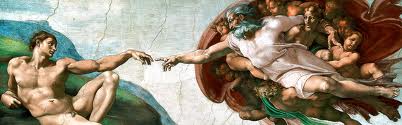
I am glad we had a chance to look at the Creation of Adam, a detail from Michelangelo’s work on the ceiling of the Sistine Chapel. Art scholars say that the Pope who commissioned Michelangelo was so keen to have him do this massive work, he pretty much allowed the artist to paint whatever he wanted. Scholars also believe that the artist read and re-read the Old Testament as he planned the project, and drew his own conclusions, rather than relying on the official theology of the church to guide his designs.

creation of adam

As we heard in the introduction to the reading from Proverbs, when Michelangelo designed the scene of the Creation Adam, he included the amongst the little babyish cherub angels floating around the figure of God, a very mature female figure. God’s right arm is outstretched towards Adam, and God’s left arm literally embraces Lady Wisdom.

I wonder how the history of the Christian church would have been different if the human leaders of the faith had embraced Lady Wisdom, and held her as close as God does in the painting. If the church had taught it’s people, and its priests, bishops, cardinals and popes to hold her in high regard, maybe the role of women in the church could have been different over the centuries. It remains a harsh reality that in many churches, women are stilled looked upon, and treated as second-class, not qualified, simply because of their gender, to serve as leaders.

Michelangelo’s painting seems to take its inspiration from the passage we heard from the Book of Proverbs. He offers us a picture of God that may surprise us. God has a friend, and delights in her company. This gives us a different way to think about God.

I don’t take Michelangelo’s picture of God literally. When I pray, I don’t imagine God looking like a half-naked bearded man floating in the sky, with a beautiful woman under his arm. But I am drawn to the image of Wisdom leaving her mark on all things that God creates. I think we can learn about God, and our relationship with God, as we pray about, and ponder deeply what we see, and experience here in the created world. There is wisdom present, even and especially in moments of mystery, which cannot be easily talked about or explained. Amen

More of the past, present and future

This Sunday I ended the sermon halfway through my prepared script. I suspect that only the people who follow along with their printed copies of the sermon would have known the difference. This edition of the fifth page follows this weeks sermon blog entry, which can be found at: http://wp.me/2WJ8e

Our choices are important. In Lord of the Rings, not even Galadriel’s magical mirror can show exactly what will happen in the future, because events are shaped by choices people make.

We heard another tale this morning from the Book of Acts. These adventure stories were preserved feature some of the heroic figures of the early Christian movement. These early followers of Jesus were on a quest to spread the word about Jesus to all who would listen. The stories were passed on to remind people that God’s work did not stop when Jesus was no longer seen walking the earth.

Paul, one of the first Christian missionaries, travelled the Roman trade routes all the way to Europe. In a town in ancient Greece called Phillipi he taught about God’s love, and offered baptism, and many people chose a new path for their lives.

One day Paul was walking with companions to a place of prayer. They were met by a female slave who earned money for her owners as a fortune teller. She began following Paul and the others, shouting, “These men are servants of the Most High God, who are telling you the way to be saved.” She kept this up for many days. Finally Paul became so annoyed that he turned around and said to the spirit, “In the name of Jesus Christ I command you to come out of her!” At that moment the spirit left her.

The fact that Paul commands the spirit of prophecy to leave the young woman reflects the belief that such a gift was evidence of demonic possession. Paul did an exorcism. He commanded the spirit in the name of Jesus to come out of her.

We don’t know what happened to the young woman, except that she no longer seemed to have fortune-telling ability. Her owners were not very happy about that! Paul’s act of exorcism sets off a whole chain of events that perhaps not even the fortune-telling slave girl could have predicted. The story says,

19 When her owners realized that their hope of making money was gone, they seized Paul and Silas and dragged them into the marketplace to face the authorities. 20 They brought them before the magistrates and said, “These men are Jews, and are throwing our city into an uproar 21 by advocating customs unlawful for us Romans to accept or practice.”

22 The crowd joined in the attack against Paul and Silas, and the magistrates ordered them to be stripped and beaten with rods. 23 After they had been severely flogged, they were thrown into prison, and the jailer was commanded to guard them carefully. 24 When he received these orders, he put them in the inner cell and fastened their feet in the stocks.

25 About midnight Paul and Silas were praying and singing hymns to God, and the other prisoners were listening to them. 26 Suddenly there was such a violent earthquake that the foundations of the prison were shaken. At once all the prison doors flew open, and everyone’s chains came loose. 27 The jailer woke up, and when he saw the prison doors open, he drew his sword and was about to kill himself because he thought the prisoners had escaped. 28 But Paul shouted, “Don’t harm yourself! We are all here!”

29 The jailer called for lights, rushed in and fell trembling before Paul and Silas. 30 He then brought them out and asked, “Sirs, what must I do to be saved?”

31 They replied, “Believe in the Lord Jesus, and you will be saved—you and your household.” 32 Then they spoke the word of the Lord to him and to all the others in his house. 33 At that hour of the night the jailer took them and washed their wounds; then immediately he and all his household were baptized. 34 The jailer brought them into his house and set a meal before them; he was filled with joy because he had come to believe in God—he and his whole household.

I wonder if those who were baptized that day, more than two thousand years ago, could have imagined that in our time, we would still be doing what they were doing. Looking for God’s presence, and God’s light, to help us as we move from our present towards the future. Amen

Past, Present and Future

Are there any Lord of the Rings fans here this morning? I want to show a brief scene from the first movie in the series, “The Fellowship of the Ring”.

The regal looking woman in white is Galadriel, the elf queen. It is interesting how her mirror ritual resembles baptism. She fills her silver pitcher from a living stream of water, and pours into a basin that looks very much like a baptismal font.

This is not totally surprising. J.R.R. Tolkien, the creator of the Lord of the Rings was a committed Christian. He was also a close friend of C.S. Lewis, whose Chronicles of Narnia use themes and elements drawn from Christian faith. In Lord of the Rings, and in Narnia, we are presented with fantasy worlds, and stories that deeply touch the human heart, because they are about loyalty and love, about life and death, about hope and despair, and about the conflict between good and evil. They are about falsehood and truth, and the importance of being able to discern the difference. They are about the importance of knowing who you are, and who you are meant to be.

Galadriel invites Frodo to look into the mirror, which will show him, “Things that were, things that are, and some things that have not yet come to pass.”

Our baptismal font is not Galadriel’s mirror- but it does give a glimpse into the past. For over two thousand years Christians have been baptizing and blessing, and welcoming people into our own travelling fellowship- our community of those who seek to follow the ways of Jesus. Gathering, and praying, and hoping and blessing are ancient practices of faithful people.

Our actions at the font also offer us a glimpse into each other’s hearts in the present time, as we join with the child and her family in a moment of blessing. We pray for this young life, and for those who are responsible for her. We offer support, and encouragement, and we make promises. We promise to continue to be here as a church- to keep being a community that takes seriously the message of Jesus, the love of God, and the ongoing guidance and direction of the Holy Spirit.

Gathered at the baptismal font, we may also get a glimpse of ourselves as God sees us- beloved members of God’s family. God sees our worth, our purpose, our identity, differently than we do ourselves, and differently than the world does.

In the midst of a world that seems ruled by darker forces- by economics and politics, by selfishness, and lust for power, and by insecurity and mistrust- we promise to represent another path- a way of life rooted in light, and love and hope, in compassion and fairness, in openness and gentleness.

As we gathered at the font, our attention was also on the future. Maeve is at the beginning of her earthly life. She has so much ahead of her.

As a parent, I can remember standing at the font with our babies. Filled with hope and pride, and desire to do the right things, to help direct and shape a young life. A bit fearful that I did not really know what I was doing. Grateful to have a community of faith around me, and loving and wise friends and family standing with me.

Our font does not work exactly like the mirror in Galadriel’s cave. We don’t get to see how Maeve will grow up, or exactly what her life will be like, or who she will love, or what she will see and do. We can’t see what journeys she will go on, and what battles she will fight. We may crave those details, but they are not forthcoming. What we are offered instead is a glimpse of the promise that wherever her life’s journey, her quest takes her, God will be with her.

God’s promise to always be with us can offer us hope and comfort, even, and probably especially in times of uncertainty. When we don’t know exactly how things are going to turn out, it is important to know who we are, and who is with us. God’s presence with us can help us make the right choices.
Amen

In the bulb there is a flower…

On Easter morning I enlisted the help of the children at church in planting sunflowers in a number of small and large pots. They each had the opportunity to push little black hard-shelled seeds into the loose brown potting mix soil. We planted small pots so that each child could bring one home, and three large pots, with numerous plantings have stayed at the church. My job in the weeks that have followed has been to watch over the pots. I transfer them outside, to a sunny spot near the main doors during the days that I am at the office. Each Sunday I have help moving the pots from the main entrance into the sanctuary.


IMAG0616

I have been enjoying watching the new life emerge. The plan is to transplant the sunflower plants outside the church building. We have a number of flower beds that were lovingly developed by devoted members of this congregation, and they are a legacy that deserves to be honoured, cared for, and renewed.

IMAG0617

I am excited at the prospect of these sunflowers thriving in the churchyard, a symbol of new life, of resurrection, of the absolute wonder of God’s creation.

I had coffee this morning with Richard and Nancy, senior members of the congregation, who now live in a retirement home. They each invested a great deal of passion and effort, and were leaders in the initial development of the church gardens. I told them about the sunflowers. Richard’s eyes shone as he talked about what he sees in a flower. He spoke of the arrangements that are on the dining room table each day in their retirement home, and about the delight he takes in their colour and form. ” To think that all this beauty emerges from a minor seed, puts one in mind of the wonder of God’s creation. It is life, and there is life in so many forms.. the animals, the plants, and in all the people… ”

Richard’s words touched my heart, and reminded me to open my eyes. When I returned to the church this afternoon I checked in on the sunflowers, and walked the church grounds. There is work to do, to nurture and care for all the flower beds, to clear away the detritus of last fall and winter, and help life thrive.

IMAG0618

Hallelujah! Thank God for KD Lang!

The highlight of watching the Juno awards last week was when KD Lang was inducted into the Canadian Music Hall of Fame, as a recognition for her lifetime achievement. She has a terrific presence, and voice, and used her acceptance speech to say important things. Rather than focus on herself, she showed gratitude for her family, and friends, and collaborators and supporters. She also showed gratitude for Canada, as a place where, in her words, a “freak” like her could have the career and success that she has had. She went on to encourage every person to be themselves.

I was so happy to be watching this with my 11 and 14 year old children!