
The Advent Alphabet: K is for Kite?

star-kiteK is for kite. No really, it is. I need to do a little stretch here. H was already for Herod, so I’m not doing King.

Said the night wind to the little lamb, “Do you see what I see? Way up in the sky, little lamb, Do you see what I see? A star, a star, dancing in the night With a tail as big as a kite, With a tail as big as a kite.

http://www.christmas-carols.net/carols/do-you-hear.html (you can listen to the tune and read the lyrics here)

“Do you hear what I hear” is a lovely seasonal piece, a favourite since it was written in 1962. It became a hit the following year when Bing Crosby recorded his version, and many other artists have since sung it. It is a good example of what story-tellers often do. They take elements from a well-known tale, and use them like a painter uses the colours on their palette, to create something new.

The “new” story may remind us enough of the old one to ensure that we pay attention, and take the new piece seriously. Sometimes this is done quite deliberately, to gain an audience for a message the writer wants to get across. In this case, the composers, Noel Regney and Gloria Shayne Baker had a definite agenda, that is revealed in the line “pray for peace people everywhere”. They wrote their song at the height of the Cuban missile crisis, when they feared a nuclear war was very possible.

The casual listener to this song can easily grasp the message, and is likely not too concerned about the factual details. We know that in the “real” Nativity stories from Matthew and Luke there is no talking wind (or lamb!) no shepherd boy, and that Herod is not much like the King in the song. We also know they have gone beyond the biblical text in describing the star with a tail as big as a kite, dancing in the night.

“After Jesus was born in Bethlehem in Judea, during the time of King Herod, Magi from the east came to Jerusalem and asked, “Where is the one who has been born king of the Jews? We saw his star in the east and have come to worship him… Then Herod called the Magi secretly and found out from them the exact time the star had appeared. He sent them to Bethlehem… the star they had seen in the east went ahead of them until it stopped over the place where the child was. When they saw the star, they were overjoyed.” (excerpts from Matthew chapter 2)

At this time of year there are often articles putting forward plausible scientific explanations for the appearance and behaviour of the star. The “tail as big as kitecomet-ison-tail-142x200” is from the theory the Magi had spotted a comet. I have also heard versions that involved a distant star going nova, or some alignment of planets that together reflected an unusually bright light. I will say more about the star when we get to Z is for Zoroastrian.

I wonder if 2000 years from now there will be commentators taking time to analyze the words of “Do you hear what I hear?”, and putting forward plausible explanations of how a message could be passed from the wind, to a lamb, to a shepherd boy, and then to a mighty king? If they go to all that trouble, I hope they also get the message, and pray for peace.

The Advent Letter is a ministry offering from Rev. Darrow Woods, of Trinity United Church in Oakville, Ontario.

J is for Joy

J is for Joy. On the third Sunday of the Advent season, we light the candle for Joy. What do we mean by Joy?

“ joy is the intersection between the human and the divine, and that’s why at some points, when you experience joy you throw your hands in the air, you laugh, you dance, but at other times you experience joy you cry, and you like release in this other way, and it’s the same thing, and its coming from this place of letting go…”

That came from a hip-hop artist named Michael Franti, who leads a band called Spearhead. I heard him interviewed in a podcast of the CBC radio show Tapestry. Franti is a deeply spiritual person who was raised Christian, and is now a Yoga teacher. He uses music as a way to work for peace and unity.

He produces some incredibly joyfilled music. Here is a link to one of my favourites:

https://youtu.be/ehu3wy4WkHs

https://youtu.be/ehu3wy4WkHs

I am attracted to Franti’s idea of joy being found at the intersection of the human and the divine. During my training for ministry I worked and studied with Quakers for two years. Many Quakers say every moment, of every day, is potentially sacramental. (God is equally present with us at all times, everywhere, but there are times when we are more open, more able to accept what God is offering us, which is Presence.)

I don’t think God ever “goes away”. God is everywhere, in everything, including us. But we do not seem to sustain that awareness of God’s Presence all the time. There are times when we feel like God is very far away, or that God is just an idea, and not a reality.

The image that comes to mind is of feeling so weighed down with the pain and grief that we all experience, that we are not able to look up. Our head is downcast, and our eyes are pointed at our own feet. All we can see is the patch of ground where we stand. It becomes hard to imagine that we might ever feel different, or better.

In our culture there is such a tendency to avoid feeling bad. We have medication and distractions available. There are all manner of short-term highs we can use to numb our feelings, or mask them, or allow us to feel something other than what is real. But these do not lead us to joy.

Our spiritual path must take us through the sadness, through the famous “valley of the shadow of death”, before we can come out the other side.

Michael Franti talked about this in musical terms: “in the history of African-American music we have the blues, which is this expression of deep sadness, and sorrow, and struggle, and then once you have passed through the blues you come to funk, which is the same chords, just played faster, and now you have music that is celebration, and it is that transformative quality of music…”

 When we find ourselves open again to God’s presence, there is a transforming power. The song of sadness can become one of celebration. Our slow sad shuffle through life can become a dance of joy.

The Advent Alphabet is a ministry offering from Rev. Darrow Woods, minister at Trinity United Church in Oakville, Ontario. Each day during Advent, a different letter of the English Alphabet will be a jumping off place for a reflection.

I is for Incarnation

carnation-milk-boxI is for Incarnation. Another name for Christmas is the “Feast of the Incarnation”.
When I was a child, money was tight. My mother prepared milk by mixing water with flakes poured from the red and white box of Carnation powdered milk. On special occasions, like Christmas, she splurged and bought ”real” milk- the good stuff!

Years later, when I began to study theology, it was hard to keep a straight face when the seminary professors spoke of the “good news” of the Incarnation. Growing up, good news meant “no-carnation”- I hated the pale bluish, thin fluid. The manufacturing process began with milk, freeze-dried it, powdered it, and boxed it, to be reconstituted later by well-meaning moms. The result was a literally pale imitation of the real thing.

“Incarnation” comes from the latin for “flesh”- caro. It means that Jesus, is “God in the Flesh”.

There are times I find that idea as hard to swallow as I did the milk mixed from powder. Don’t get me wrong. I believe God sent Jesus to help us understand the incredible depth of love, and compassion that God has for us. I believe God wants each of us to know we are loved, and cherished, and vitally important to God’s hopes and dreams for the world.

But after Jesus’ earthly life, some people who passed on the Good News did not just deliver the message, they “processed” it. They broke it down, and put it back together, packaged as they saw fit. (A bit like the Carnation people do with milk!)

In the process they diluted the message from a call to follow Jesus’ way of actively sharing God’s love and acceptance, to our need to “accept Jesus”, and be saved. I find no evidence in the Gospels that Jesus sought that kind of prominence. Jesus wanted everyone to feel free to approach God with the confidence of a child who knows they are loved, and to pass that love along- to “flesh it out” with our own actions.

I believe we are invited to look at every person, including ourselves as members of God’s family, as our own flesh and blood. All humans are our flesh and blood family, no matter where they live, and what their culture or religion might be.

The powdered milk people have a vested interest in convincing us their product is the best. Well-intentioned followers of Jesus, living in a world of competing religions, made similar claims- that Jesus was the best, and perhaps only way to experience God’s goodness. This has too often de-generated, and been corrupted, and reduced to message that says “God will love you, if you become more like us.”

We understand when an advertiser claims one brand is better than others. It’s the game they play, to capture market share. But this behaviour is offensive when it comes to faith.

I believe the way to follow Jesus, is to offer people the same radical love and acceptance he offered. We begin by acknowledging all people are already God’s people, and our human ideas about who is “in” and who is “out” cannot limit divine love. We should not water down the incredible gift of God’s love. We should share the “good stuff” and proclaim Jesus, who as it says in our United Church Song of Faith,

“ announced the coming of God’s reign—a commonwealth not of domination but of peace, justice, and reconciliation.

He healed the sick and fed the hungry.

He forgave sins and freed those held captive by all manner of demonic powers.

He crossed barriers of race, class, culture, and gender.

He preached and practised unconditional love—love of God, love of neighbour,

love of friend, love of enemy—

and he commanded his followers to love one another

as he had loved them.

The Advent Alphabet is a daily offering of meditations during the Advent Season, from Rev. Darrow Woods of Trinity United Church, in Oakville, Ontario.

H is for Herod

H is for Herod. We remember him as the evil King of the Jews who tried to coerce the Magi into telling him the location of the Christ-child. Matthew’s Gospel says:

“When Herod realized that he had been outwitted by the Magi, he was furious, and he gave orders to kill all the boys in Bethlehem and its vicinity who were two years old and under, in accordance with the time he had learned from the Magi…. After Herod died, an angel of the Lord appeared in a dream to Joseph in Egypt and said, “Get up, take the child and his mother and go to the land of Israel…  So he got up, took the child and his mother and went to the land of Israel. But when he heard that Archelaus was reigning in Judea in place of his father Herod, he was afraid to go there. Having been warned in a dream, he withdrew to the district of Galilee and he went and lived in a town called Nazareth. So was fulfilled what was said through the prophets: “He will be called a Nazarene.” “ (Matthew 2:16-23, excerpted)

The name Herod is a short-hand way of pointing to a villain. I remember a James Taylor song in which he used the images of the Magi and Herod as poetic archetypes for heroes, and for the evil they face. He sang:

“But Herod’s always out there

He’s got our cards on file

Its a lead pipe cinch,

if we give an inch

Old Herod likes to take a mile” (James Taylor, Home by another way)

Stories need a villain to give the hero someone to oppose, and to further the plot. (Can you imagine how tedious it would be to watch a detective show in which there wasn’t actually a crime,  a “bad guy” to catch? The villain gives the story the necessary conflict, and drama.)

Matthew tells us Herod ordered the death of all boys in Bethlehem under the age of two, in the same way that Pharaoh ordered the death of all the Hebrew males who were born in the time of Moses. Moses escapes death when he is discovered in his hiding place, floating in a basket amongst the rushes. He is adopted by the Pharaoh’s daughter, and raised to be a Prince of Egypt. Moses grows up to be a leader of his people in their struggle against slavery.

Matthew’s Gospel often draws parallels between Jesus, and important figures in the religious history of the Jewish people. It is part of how he does his theological work, to identify Jesus as the culmination of thousands of years of “salvation history”. (Being like Moses is poetic short-hand for saying Jesus has been sent to save his people.) Jesus is another miracle child who narrowly escapes death.

There is ample evidence that Herod, who was appointed by Rome as “King of Judea” was a genuine villain. Sources outside the Bible document a history of abuse of power, of murder, and mental instability. However, there is no evidence the “slaughter of the innocents” ever happened. If it didn’t, it is possible Matthew crafted the story to suit his theological purposes, to say something about Jesus. It is also possible that Matthew needed this element in the nativity story to help him resolve another plot issue, which I can say more about when we get to N is for Nazareth. (Advent does involve waiting!)

The Advent Alphabet is a ministry offering from Rev. Darrow Woods, minister at Trinity United Church in Oakville, Ontario. Each day a different letter is a jumping off place for a reflection.


G is for Gold

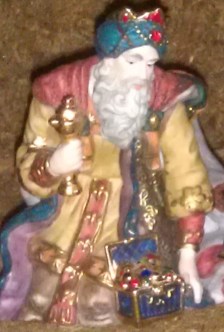
magi-and-goldG is for gold. When the Magi  “saw the star, they rejoiced exceedingly with great joy. And going into the house they saw the child with Mary his mother, and they fell down and worshiped him. Then, opening their treasures, they offered him gifts, gold and frankincense and myrrh.” (Matthew 2:10-11)

Another time I want to discuss the Magi finding Jesus in a house. Today I want to talk about gifts.

Do you ever wonder why it is the Magi gave Jesus gifts to honour his birth, and now we celebrate his birth by gifting each other? An article I referenced the other day http://en.wikipedia.org/wiki/Christmas offers insight into the development of the gift giving tradition. It also discusses the importance of holiday spending to the first world economy. (G is for Gold!)

Many retail businesses in Canada depend upon December sales to make their profits for the year. I remember a few years ago, in the wake of an economic downturn, we heard political leaders encourage spending as a way to make things better. The suggestion was we had a patriotic duty to shop.

I can remember living in the United States and being warned by friends to stay away from stores on Thanksgiving weekend- the beginning of the annual shopping frenzy. Sadly, there are stories every year about people in stores being injured in disputes over “bargains”. This extreme behaviour should serve as a warning for the rest of us- like the canary in a coal mine.

There are good reasons to look carefully at our spending and giving patterns at Christmas time. The first may be the one I eluded to earlier- that we may have got off track from the start, by giving each other gifts, when it is Jesus we intended to honour. There are other reasons.

We may want to consider the ecological impact of all the goods that are transported here from around the world (mainly Asia, as far as I can tell!), the packaging, and the wrapping. How much “stuff” do we truly need? Do the things we buy actually convey the message, and communicate the feelings we have for our loved ones? We may want to consider the morality of exchanging expensive (and often un-needed) gifts while other people struggle for the basics needed for life.

One year, my family hosted a pre-Christmas open house, and served baked goodies and hot apple cider. We accepted donations for World Vision, and together with our contributions, we raised enough money to buy sheep, and farming implements, and classroom supplies, for people in the developing world. Our kids loved the project, and the memory provides a good balancing effect against some of the media-induced “needs and wants” that appear on our Christmas lists.

Have you finished your planning and shopping for this season, or is there still time to make some changes? Here is a good website to look at: http://www.buynothingchristmas.org/alternatives/index.html

The Advent Alphabet is a ministry offering from Rev. Darrow Woods, minister at Trinity United Church in Oakville, Ontario.

F is for Frankincense

magi-and-frankincense

F is for frankincense (and myrhh), from the story of the Magi who visited Jesus, and presented him with gifts. From a master gardener’s article: at

Frankincense is a gummy resin from the non- descript Boswellia Thurigera. The deciduous tree is a low twisted, thorny shrub without a central branch. Today, almost all frankincense comes from Somalia, where the trees grow along the coastline, without soil, growing out of rocks. The young trees give the best gum while the older trees yields are less desirable. To harvest frankincense, a deep cut is made into the bark and a 5-inch strip is peeled off. A milk-like juice exudes and is hardened by exposure to air. In 3 months the resin hardens into “yellowish tears” which are then scraped off and harvested.

Frankincense is highly fragrant when burned; it was used in worship where it was used as a pleasant offering to God. Medicinally it is seldom used now, though formerly it was much sought after. It was thought to be an antidote to hemlock!

Myrrh is also a gummy resin. This pale yellow resin, which dries to brown even black, is from the Commiphora shrub. The Commiphora shrub is a large shrub or tree found in East Africa, Yemen and the Red Sea countries. The shrubs yielding the resin do not grow more than 9 feet in height. The shrubs are sturdy with knotted branches that stand out at right angles. There are ducts in the bark, which fill with a granular secretion that drips when the bark is wounded or has natural fissures. The myrrh drips from the gray bark, forming irregularly shaped grains of resin. Dried myrrh is hard and brittle with a bitter taste.

Myrrh was one of the ingredients of the holy anointing oil and also of incense. It served as a fumigant in the temple and was a burial spice. Myrrh was valued as a perfume as well as for its medicinal properties. It served as local anesthetic and was given to both mother and child for postnatal care, perhaps one reason the Wise Men brought it to Jesus.”

http://www.emmitsburg.net/gardens/articles/adams/2005/frankincense.htm

Frankincense resin hardens into “tears”. Myrhh was a burial spice, and taken to relieve pain. The symbolism is hard to ignore. Even at the beginning there is the scent of death in Jesus’ story. Whatever else we believe about Jesus, he shared with us the condition of being mortal. We are born to this life in which there is pain, and death.

What would it have been like for Mary and Joseph to receive visitors from the East, who bore such extravagant, and disturbing gifts? As a parent, I still check on my kids every night, before I go to sleep, to make sure they are still breathing. We want to protect our children, and save them from harsh realities.

The infant mortality rate then was much greater than in our time. How many children survived their first few years? (The story of the visit of the Magi is intertwined with the story of the “slaughter of the innocents”- that describes Herod, King of the Jews ordering the death of all male children under the age of two.)

As I get older, and experience loss and grief, and work with families who have buried loved ones, thoughts of death are more a part of this season. I think of those who face their first Christmas, or their twentieth, without their loved one. I think of the people I have shared Christmas with, who have died. I also think of changes to life, and relationships that happen over the years. I tell myself these losses underline the need to acknowledge, and cherish what I have in life. I believe those who have died are safe with God. It does help to think of that. But even so, grief is painful, and loss and death are hard to accept. We might on occasion enjoy the exotic odours of all that frankincense and myrhh. There are also times when it just stinks.

As part of your Advent preparations for Christmas, give yourself time, and space, and permission to grieve. Light your candle, and remember, and give thanks for people, and places, and times in life that you have loved.

The Advent Alphabet is a ministry offering from Rev. Darrow Woods, at Trinity United Church in Oakville, Ontario. Each day in Advent, a different letter of the English Alphabet is a jumping off place for a reflection.

E is for Everlasting

“For unto us a Child is born, unto us a Son is given: and the government shall be upon His shoulder: and His name shall be called Wonderful, Counsellor, the mighty God, the everlasting Father, the Prince of Peace.”

That’s from Isaiah 9:6. Many recognize it as part of Handel’s Messiah. It may be that Handel has done as much as any preacher or teacher to reinforce the connection between these words from the 8th century B.C.E. and the birth of Jesus. To be fair, Handel followed the lead of the early scholars of the church, who scoured the Hebrew Scriptures (what we tend to call the Old Testament) in search of references which seemed to look forward in hope to a Jewish Messiah.

The poetry in the Isaiah passage is beautiful, and it is easy to see why it came to be used in reference to Jesus. After the destruction of the Jewish temple in Jerusalem at the hands of the Romans in the year 70, relations between the Jewish Christians and the Jewish leadership were more than strained. Leaders of synagogues began to expel the followers of Jesus, and declare some of their teachings to be heretical. In response, and in defense of their faith in Jesus, the early Christians looked to the Jewish Scriptures to fortify their claim that Jesus was the long-expected Messiah.

Scholars ask hard questions about whether or not all the passages that were caught in the net of this fishing expedition should be applied to Jesus. When history is read backwards, and assumptions are made about the meaning of a text, the original meaning, in the original context is simply ignored, or set aside as unimportant.

The words from Isaiah 9:6 were most likely, in their original setting, meant to refer to the hope of Israel for an actual king, a military/political figure who would take the throne, and run the country: “the government shall be upon His shoulder”. In context, this passage was probably aimed at King Hezekiah. Isaiah the Prophet was calling upon the new king to remember his sacred responsibilities to God, and to God’s people, to govern faithfully, and fairly, with righteousness and justice.

That’s mostly what prophets in the Old Testament were about. We have this mistaken idea that prophets were like oracles or seers, or wizards, who somehow saw the future. Prophets in Israel’s history tended to be more like a “loyal opposition” in the house of commons. Their role, ideally, was to support the legitimate government, and at the same time remind them of their commitment to be faithful. The prophets also admonished the people of Israel when it seemed that they were losing their way.

For the most part, the closest the “prophets” came to predicting the future would be to say “If you carry on this way, there will be trouble to come” or “if you can mend your ways and return to God, things will get better”. Which I guess is a bit like what Jesus came to tell us.

These Letters from the Advent Alphabet are a ministry offering by Rev. Darrow Woods of Trinity United in Oakville, Ontario.

D is for December

december-candleD is for December. Why do we celebrate Christmas on December 25th? It is not as if we can check Jesus’ birth certificate! There are a few (mostly negative) references to the early Christians to be found in histories written within a century of the earthly life of Jesus, but outside of the New Testament, there are no documents that tell us anything about him.

The contents of the New Testament, as we have it today, were collected about 300 years after Jesus’ earthly life. Scholars think the earliest parts of the New Testament were written at least 40-50 years after the first Easter. The Gospel stories do not indicate the date or the season of Jesus’ birth. All of which is a long way of saying we don’t have much to go on, to determine the actual birthdate of Jesus.

What about the census? You may remember that Luke’s Gospel says, “In those days Caesar Augustus issued a decree that a census should be taken of the entire Roman world. (This was the first census that took place while Quirinius was governor of Syria.) And everyone went to his own town to register.” (Luke 2:1-3)

The Roman Empire had a well-developed bureaucracy, which left detailed documents historians find incredibly helpful. There is no record of the census that Luke mentions. (Scholars question whether the Romans ever had a census that required people to travel to their places of origin.)

I would highly recommend an article found at http://en.wikipedia.org/wiki/Christmas for a detailed summary of the history of the celebration of Jesus’ birthday on December 25. It offers a depth and breadth of discussion on the topic I can’t duplicate here.

Another site I recommend is:  http://www.interfaith-calendar.org/2016.htm

This link will take you to an interfaith calendar, which lists many of the diverse religious and cultural celebrations that happen this time of year. What strikes me is how many of them are about light. It seems like people all over the world have need of a hopeful celebration in the season of the Winter Solstice.

The December 25 date for Jesus’ birthday is not historically supported, and not even biblically suggested. Does that in any real way diminish our celebrations?

God is at work in the world every moment of every day, helping give birth to love and hope and new possibility. Every day that we open ourselves up to the presence of God can be for us a holy day.

I continue to encourage you to take two minutes each day for silent prayer, and open yourself to the living presence of God. If it helps you to settle in, light a candle, and think of Jesus as the light of the world.

The Advent Alphabet is a ministry offering from Rev. Darrow Woods, minister at Trinity United Church in Oakville, Ontario.

C is for Carols

C is for carols. Do you have favourite carols? As I edited this “Letter”, my children were at the piano, practicing their duet of “Angels We Have Heard on High”. This is one of my top five favourite carols. As they play the instrumental part, I can hear the words in my head:

Angels we have heard on high

sweetly singing o’er the plains,

and the mountains in reply,

echoing their joyous strains.


Gloria, in excelsis Deo!

Gloria, in excelsis Deo!

When we get to M is for Magi I will write about how “We Three Kings” perpetuates the myth that baby Jesus had royal visitors. I think a fair amount of what people think they know about the birth of Jesus is drawn from carols, and pageants (and the Peanuts Christmas special). Is there anything wrong with that? Maybe not. As long as we pay attention to the way that additions are made to the story (stories) we find in the gospels (more about the different stories in another letter).

Angels “sweetly singing o’er the plains” is a wonderful image, but it came from a writer’s poetic imagination, and not the Bible. In the second chapter of Luke you will find angels praising God and saying, “Glory to God in the highest, and on earth peace to men on whom his favor rests.” (Luke 2:14) The text does not say the angels were singing. It also does not tell us that they were speaking Latin. (Gloria, in excelsis Deo!)

 Does the Biblical story suffer because of all the additions, and filling in of the scenes that have happened over the centuries? (Innkeeper and his wife, cattle, singing angels, and a drummer boy come to mind.) I would love to strip away the extra brush strokes of all the artists who were eager to make the painting more beautiful, and just look at the original sketches.

It can do us good to just read the stories as we find them in Matthew and Luke. The challenge may be to read what is there, and not what we expect to be there.

But here is something else about the stories about Jesus’ birth. Where did they come from? We don’t have Mary’s diary, or Joseph’s memoirs- we have Gospel accounts written at least a generation after the events. Did the Gospel writers take oral history they had gathered, and then exercise artistic license in how they shaped the story, and what elements and characters they included?

The Gospel writers faced the challenge that any of us face when we have had a profound experience, or been witness to something amazing. How do we use words to convey the meaning and the power, and mystery of a direct encounter with God?

Take some extra time today. After your silent prayer, read the second chapter of Luke’s Gospel. Follow this link: http://www.biblegateway.com/passage/?search=luke%202%20;&version=31;

The Advent Alphabet is a ministry offering from Rev. Darrow Woods, minister at Trinity United Church in Oakville, Ontario. 

B is for Bethlehem

B is for Bethlehem. There are, I think, at least 2 Bethlehems. The one we know best is a fairly romanticized place, the setting for pageants and Christmas specials. The other is a place where Israelis and Palestinians live as uneasy neighbours, under the watchful gaze of religious tourists and other visitors from around the world. Here is a prayer written by the Very Reverend David Giuliano, former Moderator of the United Church of Canada.

Bethlehem Prayer

O Mystery as grand as the universe

O Mighty Force of all creation,

O Power beyond all our power,

You have come to us as an infant.

Vulnerable, fragile, beautiful.

You have come to us

in the midst of poverty,

powerlessness and longing.


Come again, O Promiser of Peace.

Come again, to the city of your birth

mired in fear, oppression and injustice.

Come again, where bullet holes

still pock the walls of Sanctuary.

Come again, where Children dream

of homes they have never seen.

Come again, where a single key

or the number 194 cry out again

of forced journey to Bethlehem.


Be born again in the camps.

Be born again in stables and homes.

Be born again in many cities and languages.

Be born again among nations.

Be born again in places of injustice.

Be born again a promise of hope,

a sign of love and joy to the world.

Be born again in our hearts,

that we too might be called

Makers of peace

and Children of God. Amen

Notes:

The “single key” refers to the many Palestinians in Bethlehem who still have keys to homes from which they fled in 1948.

The number 194 appears in many places in Bethlehem, and refers to United Nations Resolution #194 granting Palestinian refugees the “right of return” to their home villages.

The Church of the Nativity is still pocked by Israeli bullets that ended a 42-day siege in 2002 after Palestinian soldiers had taken refuge there.