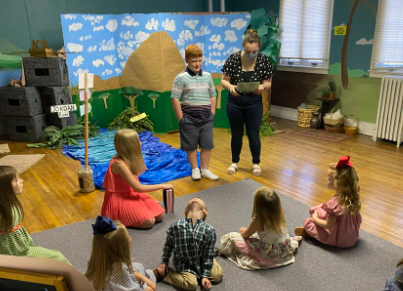
Learning Time for Sunday, March 19, 2023 at Harrow United Church

“Shepherds and Sheep”

When my kids were growing up we lived in Oakville. My wife Lexie and I both worked as ministers, always in different churches. For part of that time she was a minister of Education and Pastoral Care, so it was natural our kids went to her church. It was also natural, that because our kids and their mother were very involved in the life of that congregation, that I would help when I was available. 

I did a lot of gathering craft materials, and cutting out bits and bobs, gluing, and painting, and generally getting stuff ready. I also helped set up Sunday School rooms, and lay out costumes. A lot of this would happen on Saturday nights.

The best years of that Sunday School were when they worked on the Rotation Model. The kids were gathered in groups according to age or grade level, and the groups would take turns at a series of stations that brought a Bible story to life in different ways. There was often a kitchen unit that involved making or baking something good to eat. There might be song time, a story time, a time to act out the story, or a craft time to make something connected to the story. 

The kids would explore and learn the story in several different ways, over the course of a few weeks. I know a lot of those kids as adults, including our own, and they remember their time in Sunday School.

Learning the stories provides a great foundation for when the child grows up. They can think about the stories, and the stories may help them develop their own ideas about faith, and life, and God. Beyond the stories, the kids have this experience of being loved, and cared for, fed and played with, and feeling at home. That’s a feeling that can be important in later years, when life becomes more complicated for them, and the questions get bigger and more confusing.

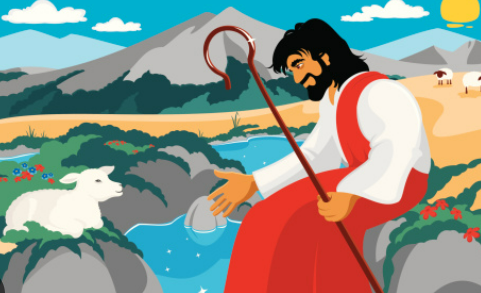
Something I thought was absolute genius, that my wife did with the Sunday School, was create a role she called “Shepherd”. A shepherd was a person responsible to help a group of kids make their way from one activity area to the next.

It was a big church building, with music happening in the auditorium, cooking in the kitchen, woodworking in the basement, puppet show in the library, science lab on the stage in the gym. Groups of kids needed to be escorted from one exciting venue to another, perhaps with a bathroom break along the way.

The shepherds were more than tour guides. They really had to shepherd the kids. Make sure they didn’t get distracted or lost along the way. Kind of like what actual shepherds do with actual sheep, except they did not have those big staffs to help them herd the little lambs.
My wife, the genius, recruited shepherds from that group of people who’d say, “You’re doing such great work with the children. I would love to help, but I’m not a teacher, I don’t know the bible and I can’t sing, draw or do crafts.” 

Every church seems to have people who cheer from the sidelines, or have ideas about what programs a church needs to offer, but don’t necessarily step up to make them happen. Some may feel they aren’t qualified. 

From this large pool of people who claimed they had nothing to contribute, Lexie and her Sunday School Superintendent recruited a whole crew of shepherds. There was no age limit to who could be a shepherd, and no particular skill set required. She’d sign them up on a big sheet where they could each commit to a certain block of weeks. They weren’t signing on to be there always and forever. They could take turns.

I noticed over the years that some of the shepherds became repeat customers. They’d come back and help again and again. Some would also volunteer to be shepherds, or serve snack and juice at Vacation Bible School in the summertime.

Some also discovered they liked being around the kids, got over some of their anxiety and inhibitions, and realized they did have talents, gifts, and skills to offer. They could demonstrate a craft they enjoyed, or talk about one of their hobbies. Almost everybody could read a story book out loud. Even those who didn’t like to read, could just be there, as another friendly face.

I saw some older folks become transformed by the experience of helping out. It was a reminder that the mission of a church should include the ongoing education of people of all ages.

It’s not just the kids in Sunday School who learn and grow. We are all works in progress. We can all learn by doing, and by growing into new roles, and accepting new challenges. As long as we are alive, we can learn, and grow, and we can help. We can find ways to contribute.

The people my wife recruited had opportunities to learn through lived  experience what it means to be a shepherd. It gave them glimpses of how God loves and shepherds us. 

They were reminded that we all get to be God’s sheep, and also be a shepherd to others at the same time. 

Today we baptized the amazing, delightful Mia. I had the folks stand up as a congregation, and promise to be there for her, as a community of faith. 

We stood in support of Mia and her family, her god-parents and grandparents and in-laws and out-laws and neighbours and friends of her family. We did that because we know that none of us can do well on our own, at the awesome, huge, and wonderful, overwhelming job of raising, guiding, teaching, inspiring a child.

It’s a cliche’ to say it takes a village to raise a child. During the land acknowledgment today I talked about the Wendat people. In their tradition, all the children were the shared responsibility of all members of the community, not just the biological parents. 

There was a shared understanding that everyone has a stake in instilling the knowledge, values, survival skills, and spirituality that sustain each child, and also help ensure the long-term survival of the people.

It’s common sense. We should take care of everyone in the community, so there can be a community.

I take my wisdom where I can find it. I enjoy mystery novels, and one of my current favourite writers is Michael Connelly. 
Connelly has a character called Harry Bosch, who is a homicide detective. I like characters who, although they are basically broken and faulted human beings, like everyone I know in real life, also have a strong sense of purpose, or a moral code that guides them.

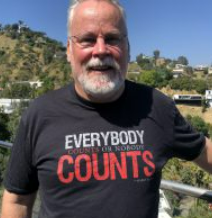
The fictional Detective Harry Bosch, who is relentless in his pursuit of truth, and never gives up until he finds the killer, has a good motto. He says, “Everybody counts, or nobody counts.” 

It’s simple, and to the point, and I think, very much like Jesus. Everyone counts. No one should be left out. We treat everyone with equal love and respect, because each child, each person matters.

The flip side of that is that everyone can be counted, and counted on, to have something they can contribute, to add to the life of the faith community. To be the community God dreams we can be, everyone has something to contribute. We actually need everyone. Everyone counts. Amen

Here is a link to the Youtube video of this week’s worship service, which includes this learning time:

Jesus Baptism and Ours

Dennis Graham, the producer, director and post-production guru said that the worship video for this weekend is one of the best we have ever done.

We looked at the story of Jesus’ Baptism in the Jordan River, and also reflected on what it means to be beloved child of God.

Here is the link to the Youtube video:

Here is the text of the Learning Time:

Learning Time: “Jesus’ Baptism, and Ours”

Jesus joined a crowd of people who went to the bank of the Jordan River to hear John the Baptist preach his fiery sermons, and to be baptized. They were not baptized into the Christian church, because that did not yet exist. They were Jews called to a life of faithfulness, and offered a way to have a fresh start.

Jesus was about thirty at the time of his baptism. He had lived a lot of years since being a newborn in a manger, and from that time when he was twelve, and hung out in the Jerusalem temple, talking about God with the teachers of religion.

What did he do for those 18 years, from that time in the temple, to this moment in the Jordan River? There has been a lot of speculation about that over the centuries, and books written about the possibilities. John Prine wrote a song called “Jesus, the hidden years”, which is worth checking out on YouTube. It’s a lot of fun.

Is it possible that like the escaped convict in the little clip from “O Brother Where Art Thou,” Jesus felt like he needed a fresh start? That would make him seem a lot more human than he is usually described. 

Where were you at age thirty? What were you doing? Were you ready for a washing clean, a fresh start? Did you have a clear sense of who you were, and what God wanted you to be? Do you have that now?

A few years ago I heard a story about a young man who had led a kind of wild life. He had a lot of money, and many grown up toys. He didn’t have to work, and had more free time than many people. He was also very lonely, and at times, drank too much.

He was also had a deep spiritual hunger and curiosity. His search for more in life, and led him to walk into a church one Sunday. It was a non-denominational congregation led by a husband and wife team of co-pastors.

This very small congregation, made up mostly of seniors, met in a building that used to be a United Church. When the co-pastors saw a man in his late twenties walk in, they were thrilled. One of them actually said out loud, “Thank God, someone to help.’

The young man stuck around. Before long he was teaching Bible study, and helping with the sound system at the church, and going to Haiti on mission trips. Something in him responded to being needed to help, and he blossomed. He found himself.

That is an important and powerful thing, to discover who you are meant to be, who you are in God’s eyes, and to find your purpose in life.

This congregation practiced baptism by full immersion, and the old church building they were renting did not have running water, never mind a baptismal tank. The young man invited the congregation to use the pool at his condo for a baptismal service.

Have you ever seen that kind of baptism? It’s like what we saw in the video clip. The person walks in, or is standing in water that may be above their waist. The candidate for baptism is literally dunked under. In some traditions they are pushed in backwards, and totally submerged in the water. They are not held down, but they go all the way in, so that they are completely under water.

As a person who does not even like to put my head in the water when I swim, I would find this terrifying. If you are able, and willing, try an experiment with me. I am going to use my watch to time us for 20 seconds as we hold our breath.

That’s not very long. But it is about long enough to remind us how it feels to not breathe. I prefer to breathe. My body resists holding my breath. It instinctively knows what it needs.

You would have to hold your breath if you were being baptized by John in the Jordan River. You might also close your eyes, in case the water wasn’t clean. A lot of other people may have been dipped in that part of the river.

The experience, and the symbolism would be powerful. A total rinsing off of the dust and dirt, and messiness of life up to that point, and a rising up out of the water, with a commitment to live a new kind of life. Terror, and then relief, and perhaps joy, as you rose up out of the water.

The story says that after Jesus was baptized, and rose up out of the water, the heavens opened, the dove of the Holy Spirit came down, and a voice said to him , “You are my Son, whom I love; with you I am well pleased.”

One of the ways the church has understood baptism is as a way to participate in the mysteries of Jesus life, his death, and his resurrection.  The person totally submerged for baptism is for a moment, cut off from life around them.  They are like an unborn child, in those few seconds, except without the umbilical cord to provide all they need for life.

There is at once a hint of death, or the risk of it, and the reminder of what it is like for each of us, before we leave the safety of the womb, and enter the world. The water is at the same time, a womb, and a reminder of the tomb in which Jesus was laid, after he was killed on the cross.

Then the person rises up out of the water breathless, and is able again to breathe, and it suggests coming back to life, or being born. There is a lot of powerful symbolism there, that we may only catch a glimpse of in the way we tend to do baptisms.

But back to the story of the young man in the pool at his condo. I heard about it from his father, who is not a regular church goer, but who came to the condo pool that day. When his son had been baptized, and was getting out of the pool, he slipped on the wet deck, and almost broke his leg.

The father said his son was sore for a few days, but not seriously hurt. It could have been a lot worse. That little story, of falling on the wet deck is a reminder that this business of baptism, of life, and death, and new life, is risky.  You never know what’s going to happen. Did Jesus know what would happen in his life, after he submitted to John’s baptism?

The father told me this story of his son’s baptism, 4 years ago, while we stood together at the reception after his son’s funeral.  There was a great deal of sadness over this young man’s death. But in the midst of this, I also heard that the happiest, most fulfilling part of his short life began when he joined that little church, was baptized, and grew into a new understanding of his purpose. He found his identity as a beloved child of God, when he began to live a life that was about serving God, by helping others. It is so good that he found that little church, and found out who he was meant to be.

In the 1700’s there was an Anglican minister named John Wesley, who found the church he grew up in, and in which he had been ordained, to be a fairly dry, lifeless, and ineffectual institution, that was failed to reach the people who most needed it. The industrial revolution in England had made some people very wealthy, but it had also displaced many people from traditional rural lives, and pushed them into the cities in search of factory work. The cities were filled with the casualties of poverty, and poor education, and alcoholism, and child labour. Some evangelical ministers had begun preaching on street corners and holding open-air meetings to try to reach people who had no connection to a church.

Wesley became one of those people who brought the church to people where they were. He organized people into small groups, or classes, of 12 or so people, who would meet regularly to learn and pray together, and hold each other accountable for how they were living. The members would minister to each other, in between the visits from travelling preachers who would each watch over a number of these local classes. This system came to be called Methodism, and the Methodist Church in Canada was one of the denominations that joined together as the United Church in 1925.

John Wesley believed it was helpful to offer people them the opportunity to re-new their covenant relationship with God, and with their fellow believers. He called them “Covenant Services”, and I have borrowed some parts of a service he wrote, for our service today. Near the end of his life, Wesley tended to have these services around New Year’s- it seemed like a good time to offer people a fresh start.

So at the end of this service we have the opportunity to renew our faith commitments.  You can dip your fingers in warm water, and make the sign of the cross on your forehead.

This is not a baptism- but a symbol of your faith in Jesus, or at the very least, your desire to believe. This is a chance to say to ourselves, and to God, that we are choosing to live as beloved children of God.  Amen