
Advent Alphabet: O is for Oakville

oakville-place-parking-lotO is for Oakville, a town in Ontario. If you don’t live in Oakville, think about the place where you live. At Christmas time, whatever our theology, whatever our reading of the biblical stories, we celebrate God’s intimate engagement and involvement with the human race, in the places where we live. We are both comforted and challenged by the message of universal love, extended to all people.

When I wrote G is for Gold, I tackled questions related to our materialism, and raised the possibility of celebrating Jesus’ birth in ways that are closer to the values he represents. Sojourners Magazine, (https://sojo.net/about-us) long a voice in the wilderness, calling for justice for all of God’s people, sent an email a few years ago with this seasonal reminder to their readers:

“A popular Christmas song says “let your heart be light,” and that “our troubles will be out of sight.” Even though Christmas is a time of wonder and excitement at the birth of our Savior, a troubled economy, violent conflicts, and extreme poverty weigh on our spirits and require our attention.

So instead of just the feasting and presents, what if we all take action this Christmas? Let’s not just sing about God’s love when we can commit to actions that will bring love, peace, and justice for our neighbours far and near.

In the spirit of a joyful, Christ-centered Christmas, we’ve even written a carol for a subversive sing-along. Who said doing justice had to be boring or serious?! So, clear your throat and join us in a rousing chorus of: “Have Yourself a Peace and Justice Christmas” (to the tune of “Have Yourself a Merry Little Christmas”).

Have Yourself a Peace and Justice Christmas

Have yourself a peace and justice Christmas,

Set your heart a-right.

Flee the malls and focus on Christ’s guiding light.

Have yourself a peace and justice Christmas,

Give your time away.

Share God’s love,

And serve “the least of these” today.

Here we are, as we pray for peace,

We’ll live simply and give more.

We care for those far and near to us,

Which brings cheer to us, once more.

God brings down

The haughty from high places,

And lifts up the low.

God cares for the hungry and the humble, so –

Forget the stress and let the peace and justice flow! “

The Advent Alphabet is a ministry offering from Rev. Darrow Woods, minister at Trinity United Church in Oakville, Ontario.

Advent Alphabet: N is for Nazareth

nazarethN is for Nazareth, Jesus’ home town in Galilee. But wait, what about that other little town? Why did the gospel writers make a point of telling us he was born in Bethlehem?
The earliest versions of the Gospels from Matthew and Luke were written at least thirty to forty years after Jesus’s death. This was about 70 A.D., around the time Roman forces destroyed the Temple in Jerusalem. In the midst of great upheaval and persecution, the Jewish leaders clamped down on the Jesus followers. There was bitterness and name-calling, reflective of the tension between the traditional followers of Judaism, and Jews who were following the way of Jesus.

A major challenge to the claims Jesus was the Messiah was that he came from Galilee, which was in Gentile territory. Some argued that according to the Hebrew scriptures, the Messiah had to be of David’s line, and come from Bethlehem in Judea.

Nazareth was a backwater village, and the butt of many jokes. John 1:46 quotes the insult frequently thrown at Christians: “Can anything good come out of Nazareth?”

The Gospels according to Matthew and Luke each dealt with the “Nazareth problem” in their own ways, which also served their theological aims.

Matthew provided a geneaology that traced Jesus’ descent from the family of King David. Matthew also described Joseph and Mary and the baby living in a house in Bethlehem when the Magi came to visit. Perhaps as a plot device, Matthew told the horrific story of King Herod’s slaughter of the innocents, which caused the Holy Family’s flight to Egypt. This story connects Jesus to the story of the first Joseph, who was taken by force to Egypt.

Joseph (the heroic figure in the Book of Genesis, not the earthly father of Jesus) had been sold into slavery by his jealous brothers. He rose to a place of power second only to the Pharaoh, and later acted to save his brothers and their families from a terrible famine. The Egypt connection also tied Jesus to Moses, another baby who narrowly avoided genocide at the hands of a corrupt leader.

The author of Matthew’s Gospel wanted to bring hope to fellow Jewish followers of Jesus, a persecuted minority. An important underlying theme in this Gospel is that God protects and saves, even as Joseph protected his people in the Genesis story, and as Moses saved the people from slavery in the Exodus story.

Matthew’s Gospel says Joseph kept the family in Egypt until he heard Herod had died- but because Herod’s brother succeeded him, out of fear, Joseph hid his family in Nazareth.

In the Gospel of Luke Joseph and Mary start out in Nazareth, but the census registration requires them to travel to Bethlehem. (Historical records indicate Rome did order a census in Palestine several years after Jesus’ birth, but there is no evidence Jews would be required to return to their ancestor’s hometowns to be counted.)

Luke provided his own version of a geneaology linking Jesus to David, through Joseph. (It is very different from the family tree in Matthew.)

The escape to Egypt is not part of the story in Luke’s Gospel. In Luke, after Jesus’ birth, the family visited Jerusalem for purification rites in the temple, and returned to Nazareth, where he was raised.

Luke’s gospel has underlying themes of the universality of God’s love, and a call for social equality. Mary is presented as a faithful woman, obedient to God, who will help renew the covenant between God and the people, and open it to Gentiles as well as Jews.

In Luke’s Gospel, the baby Jesus is visited, not by wealthy wise ones from the East, but by ragged, unclean shepherds. They are good representatives of the humble poor who will be lifted up, as the proud rich are brought low, as Mary described in the song of praise we call the Magnificat.

Matthew and Luke used material available to tell their stories about Jesus, with the goal of inspiring faith, and bringing hope to their audience. I don’t know if they intended their stories to be taken literally.

Decades after they were first committed to the page, the Gospels of Matthew, Luke, Mark, and John, as well as other writings of the early church were collected together. It would have been evident then, as it is now, that their stories are not factually consistent.

Some religious scholars say that in this era, 100-300 years after the time of Jesus, people of the Ancient World would not have been caught the same way we can be on the issue of literal accuracy. They would listen to the stories for the truth they contain.

The Advent Alphabet is a ministry offering from Rev. Darrow Woods, minister at Trinity United Church in Oakville, Ontario.

Advent Alphabet: M is for Magi

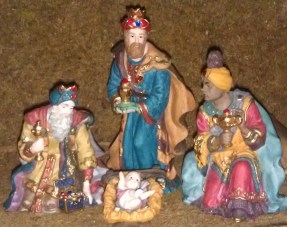
magi-and-jesusM is for Magi. I want to talk about the wise ones, but have other plans for W! I have always thought they were fascinating characters. Despite the beloved “We Three Kings”, they are magi. If you read Matthew’s Gospel , it says clearly they were wise men, not kings from the East who came to pay their respects. (Incidentally, the only reason we think of there being three is because that’s how many gifts they brought. In some streams of the Christian tradition, they talk about as many as twelve visitors.)

I like the magi because they seek after truth. There are many sayings about how it’s the truly wise who can admit they don’t know everything. These wise ones serve as models for anyone willing to endure hardship, take risks, literally step away from all that is familiar, and go where they have never been, to fulfill their quest.

In another letter I’ll look at the religion of the wisemen- for now I’ll point out they were not Jewish. Nonetheless they were interested in the birth of a child some hoped would be a Messiah for the Jews. There is no indication in the story that they became followers of Jesus. They were faithful people who were open-minded enough to look beyond their own religious traditions, to see God at work.

Part of my not-so-hidden agenda for these Advent letters is to offer nurture to people’s minds as well as their spirits. I believe it’s healthy for us to ask questions, and dig deep into the stories of our Christian tradition.

The Jesus movement has lost a lot of great people who felt they would have to turn off their brain, or at least compartmentalize their thinking, to stay in the church. I had a wonderful conversation recently with a man who holds a doctorate in atmospheric physics. He said he felt like a hypocrite going to church. He thought he had to accept the Bible without questions, and take the creeds as literally true.

A former colleague makes the distinction between faith and belief. He would say it’s possible to have faith in God, and to see the sacred and spiritual dimensions of life, without necessarily buying into, or “believing” every aspect of the portrayal of God found in popular religion, the teachings of the church, and all the layers of tradition. (Like the kings in the carol.)

How about you? Do you think we can have faith, and at the same time have questions, and doubts about what we have been taught about God, and Jesus?

Here is something I don’t doubt. Jesus taught that God wants us to bring our whole selves along for the ride, on our journey towards truth. When a religious teacher asked Jesus which was the most important commandment, he said,

“‘Hear, O Israel, the Lord our God, the Lord is one. Love the Lord your God with all your heart and with all your soul and with all your mind and with all your strength. ‘The second is this: ‘Love your neighbour as yourself.’ There is no commandment greater than these.” (Mark 12:30-31)

That’s a word to the wise!

The Advent Alphabet: L is for Love

love-lettersL is for love. Here are my favourite lines of scripture on the subject, from Eugene Peterson’s contemporary paraphrase, The Message:

“My beloved friends, let us continue to love each other since love comes from God. Everyone who loves is born of God and experiences a relationship with God. The person who refuses to love doesn’t know the first thing about God, because God is love—so you can’t know God if you don’t love….No one has seen God, ever. But if we love one another, God dwells deeply within us, and God’s love becomes complete in us—perfect love!” (1 John 4:7-12, excerpts)

I love the line that says “no one has seen God, ever”. It is reassuring to those of us who are still searching, and a corrective note for those who claim to have it all sorted.

When I was a teenager, I had a friend named Dan, who tried vigorously to “save me”. In his way of thinking, this meant I had to say that I believed certain things about Jesus, repeat a simple prayer, and then my eternal soul would be assured of a place in heaven. If I sound a bit cynical about this, it is because I am.

Members of my family had been raised on this kind of “Old Time Religion”, and I’d heard it all before. Maybe because I heard it as a young child, the frightening images of eternal hell-fire and sulfurous damnation actually got to me. Dan would preach this vile stuff, warning that if Jesus came back this afternoon my name would not be on the roll to be called up yonder. (The pictures he painted would make it hard to fall asleep at night.)

Sometimes I went to church with Dan. He would pull up to my house in his little yellow Volkswagen beetle- an original, not one of the neo-retro versions we see today. I knew as soon as I got in the car he would start in with his monologue. Dan liked to talk about two things: the valiant Russian soldiers who fought against the German army in world war two, and the horrors of what would happen if I didn’t get saved. (I realized later that Dan fought his own military campaign, for his idea of Jesus.)

One bright Sunday morning Dan and I went to worship at an evangelical church. I’d suggested this church because a young woman I knew attended there, and she had a friendly smile. She wasn’t there that Sunday- at least I didn’t see her. But God was there. There was a feeling in that place. I had been in churches before that seemed to be places of reverence- in the sense that people became quiet when they walked in- a kind of holy hush. This sanctuary seemed different. I felt an aliveness in the room, that did not seem to have much to do with the worshippers, or the music, or even the preacher (who in tone, and content, sounded very much like Dan.)

For a few minutes in that place I experienced a sense of God’s presence. It was reassuring, like a kind person’s smile, or a hug from a toddler. This presence seemed to communicate, “I know you. You’re going to be okay- don’t worry about what they’re saying. You are loved.”

It did not happen that day, but there came a time, a few months later, when I had a conversion experience, and made a conscious decision to follow the way of Jesus. I don’t know if I got saved, but I know that I am loved by God. And so are you.

The Advent Alphabet is a ministry offering of Rev. Darrow Woods, of Trinity United Church in Oakville, Ontario. Please feel free to share this, like this on Facebook, and pass it on to your friends.

The Advent Alphabet: K is for Kite?

star-kiteK is for kite. No really, it is. I need to do a little stretch here. H was already for Herod, so I’m not doing King.

Said the night wind to the little lamb, “Do you see what I see? Way up in the sky, little lamb, Do you see what I see? A star, a star, dancing in the night With a tail as big as a kite, With a tail as big as a kite.

http://www.christmas-carols.net/carols/do-you-hear.html (you can listen to the tune and read the lyrics here)

“Do you hear what I hear” is a lovely seasonal piece, a favourite since it was written in 1962. It became a hit the following year when Bing Crosby recorded his version, and many other artists have since sung it. It is a good example of what story-tellers often do. They take elements from a well-known tale, and use them like a painter uses the colours on their palette, to create something new.

The “new” story may remind us enough of the old one to ensure that we pay attention, and take the new piece seriously. Sometimes this is done quite deliberately, to gain an audience for a message the writer wants to get across. In this case, the composers, Noel Regney and Gloria Shayne Baker had a definite agenda, that is revealed in the line “pray for peace people everywhere”. They wrote their song at the height of the Cuban missile crisis, when they feared a nuclear war was very possible.

The casual listener to this song can easily grasp the message, and is likely not too concerned about the factual details. We know that in the “real” Nativity stories from Matthew and Luke there is no talking wind (or lamb!) no shepherd boy, and that Herod is not much like the King in the song. We also know they have gone beyond the biblical text in describing the star with a tail as big as a kite, dancing in the night.

“After Jesus was born in Bethlehem in Judea, during the time of King Herod, Magi from the east came to Jerusalem and asked, “Where is the one who has been born king of the Jews? We saw his star in the east and have come to worship him… Then Herod called the Magi secretly and found out from them the exact time the star had appeared. He sent them to Bethlehem… the star they had seen in the east went ahead of them until it stopped over the place where the child was. When they saw the star, they were overjoyed.” (excerpts from Matthew chapter 2)

At this time of year there are often articles putting forward plausible scientific explanations for the appearance and behaviour of the star. The “tail as big as kitecomet-ison-tail-142x200” is from the theory the Magi had spotted a comet. I have also heard versions that involved a distant star going nova, or some alignment of planets that together reflected an unusually bright light. I will say more about the star when we get to Z is for Zoroastrian.

I wonder if 2000 years from now there will be commentators taking time to analyze the words of “Do you hear what I hear?”, and putting forward plausible explanations of how a message could be passed from the wind, to a lamb, to a shepherd boy, and then to a mighty king? If they go to all that trouble, I hope they also get the message, and pray for peace.

The Advent Letter is a ministry offering from Rev. Darrow Woods, of Trinity United Church in Oakville, Ontario.

J is for Joy

J is for Joy. On the third Sunday of the Advent season, we light the candle for Joy. What do we mean by Joy?

“ joy is the intersection between the human and the divine, and that’s why at some points, when you experience joy you throw your hands in the air, you laugh, you dance, but at other times you experience joy you cry, and you like release in this other way, and it’s the same thing, and its coming from this place of letting go…”

That came from a hip-hop artist named Michael Franti, who leads a band called Spearhead. I heard him interviewed in a podcast of the CBC radio show Tapestry. Franti is a deeply spiritual person who was raised Christian, and is now a Yoga teacher. He uses music as a way to work for peace and unity.

He produces some incredibly joyfilled music. Here is a link to one of my favourites:

https://youtu.be/ehu3wy4WkHs

https://youtu.be/ehu3wy4WkHs

I am attracted to Franti’s idea of joy being found at the intersection of the human and the divine. During my training for ministry I worked and studied with Quakers for two years. Many Quakers say every moment, of every day, is potentially sacramental. (God is equally present with us at all times, everywhere, but there are times when we are more open, more able to accept what God is offering us, which is Presence.)

I don’t think God ever “goes away”. God is everywhere, in everything, including us. But we do not seem to sustain that awareness of God’s Presence all the time. There are times when we feel like God is very far away, or that God is just an idea, and not a reality.

The image that comes to mind is of feeling so weighed down with the pain and grief that we all experience, that we are not able to look up. Our head is downcast, and our eyes are pointed at our own feet. All we can see is the patch of ground where we stand. It becomes hard to imagine that we might ever feel different, or better.

In our culture there is such a tendency to avoid feeling bad. We have medication and distractions available. There are all manner of short-term highs we can use to numb our feelings, or mask them, or allow us to feel something other than what is real. But these do not lead us to joy.

Our spiritual path must take us through the sadness, through the famous “valley of the shadow of death”, before we can come out the other side.

Michael Franti talked about this in musical terms: “in the history of African-American music we have the blues, which is this expression of deep sadness, and sorrow, and struggle, and then once you have passed through the blues you come to funk, which is the same chords, just played faster, and now you have music that is celebration, and it is that transformative quality of music…”

 When we find ourselves open again to God’s presence, there is a transforming power. The song of sadness can become one of celebration. Our slow sad shuffle through life can become a dance of joy.

The Advent Alphabet is a ministry offering from Rev. Darrow Woods, minister at Trinity United Church in Oakville, Ontario. Each day during Advent, a different letter of the English Alphabet will be a jumping off place for a reflection.

I is for Incarnation

carnation-milk-boxI is for Incarnation. Another name for Christmas is the “Feast of the Incarnation”.
When I was a child, money was tight. My mother prepared milk by mixing water with flakes poured from the red and white box of Carnation powdered milk. On special occasions, like Christmas, she splurged and bought ”real” milk- the good stuff!

Years later, when I began to study theology, it was hard to keep a straight face when the seminary professors spoke of the “good news” of the Incarnation. Growing up, good news meant “no-carnation”- I hated the pale bluish, thin fluid. The manufacturing process began with milk, freeze-dried it, powdered it, and boxed it, to be reconstituted later by well-meaning moms. The result was a literally pale imitation of the real thing.

“Incarnation” comes from the latin for “flesh”- caro. It means that Jesus, is “God in the Flesh”.

There are times I find that idea as hard to swallow as I did the milk mixed from powder. Don’t get me wrong. I believe God sent Jesus to help us understand the incredible depth of love, and compassion that God has for us. I believe God wants each of us to know we are loved, and cherished, and vitally important to God’s hopes and dreams for the world.

But after Jesus’ earthly life, some people who passed on the Good News did not just deliver the message, they “processed” it. They broke it down, and put it back together, packaged as they saw fit. (A bit like the Carnation people do with milk!)

In the process they diluted the message from a call to follow Jesus’ way of actively sharing God’s love and acceptance, to our need to “accept Jesus”, and be saved. I find no evidence in the Gospels that Jesus sought that kind of prominence. Jesus wanted everyone to feel free to approach God with the confidence of a child who knows they are loved, and to pass that love along- to “flesh it out” with our own actions.

I believe we are invited to look at every person, including ourselves as members of God’s family, as our own flesh and blood. All humans are our flesh and blood family, no matter where they live, and what their culture or religion might be.

The powdered milk people have a vested interest in convincing us their product is the best. Well-intentioned followers of Jesus, living in a world of competing religions, made similar claims- that Jesus was the best, and perhaps only way to experience God’s goodness. This has too often de-generated, and been corrupted, and reduced to message that says “God will love you, if you become more like us.”

We understand when an advertiser claims one brand is better than others. It’s the game they play, to capture market share. But this behaviour is offensive when it comes to faith.

I believe the way to follow Jesus, is to offer people the same radical love and acceptance he offered. We begin by acknowledging all people are already God’s people, and our human ideas about who is “in” and who is “out” cannot limit divine love. We should not water down the incredible gift of God’s love. We should share the “good stuff” and proclaim Jesus, who as it says in our United Church Song of Faith,

“ announced the coming of God’s reign—a commonwealth not of domination but of peace, justice, and reconciliation.

He healed the sick and fed the hungry.

He forgave sins and freed those held captive by all manner of demonic powers.

He crossed barriers of race, class, culture, and gender.

He preached and practised unconditional love—love of God, love of neighbour,

love of friend, love of enemy—

and he commanded his followers to love one another

as he had loved them.

The Advent Alphabet is a daily offering of meditations during the Advent Season, from Rev. Darrow Woods of Trinity United Church, in Oakville, Ontario.

H is for Herod

H is for Herod. We remember him as the evil King of the Jews who tried to coerce the Magi into telling him the location of the Christ-child. Matthew’s Gospel says:

“When Herod realized that he had been outwitted by the Magi, he was furious, and he gave orders to kill all the boys in Bethlehem and its vicinity who were two years old and under, in accordance with the time he had learned from the Magi…. After Herod died, an angel of the Lord appeared in a dream to Joseph in Egypt and said, “Get up, take the child and his mother and go to the land of Israel…  So he got up, took the child and his mother and went to the land of Israel. But when he heard that Archelaus was reigning in Judea in place of his father Herod, he was afraid to go there. Having been warned in a dream, he withdrew to the district of Galilee and he went and lived in a town called Nazareth. So was fulfilled what was said through the prophets: “He will be called a Nazarene.” “ (Matthew 2:16-23, excerpted)

The name Herod is a short-hand way of pointing to a villain. I remember a James Taylor song in which he used the images of the Magi and Herod as poetic archetypes for heroes, and for the evil they face. He sang:

“But Herod’s always out there

He’s got our cards on file

Its a lead pipe cinch,

if we give an inch

Old Herod likes to take a mile” (James Taylor, Home by another way)

Stories need a villain to give the hero someone to oppose, and to further the plot. (Can you imagine how tedious it would be to watch a detective show in which there wasn’t actually a crime,  a “bad guy” to catch? The villain gives the story the necessary conflict, and drama.)

Matthew tells us Herod ordered the death of all boys in Bethlehem under the age of two, in the same way that Pharaoh ordered the death of all the Hebrew males who were born in the time of Moses. Moses escapes death when he is discovered in his hiding place, floating in a basket amongst the rushes. He is adopted by the Pharaoh’s daughter, and raised to be a Prince of Egypt. Moses grows up to be a leader of his people in their struggle against slavery.

Matthew’s Gospel often draws parallels between Jesus, and important figures in the religious history of the Jewish people. It is part of how he does his theological work, to identify Jesus as the culmination of thousands of years of “salvation history”. (Being like Moses is poetic short-hand for saying Jesus has been sent to save his people.) Jesus is another miracle child who narrowly escapes death.

There is ample evidence that Herod, who was appointed by Rome as “King of Judea” was a genuine villain. Sources outside the Bible document a history of abuse of power, of murder, and mental instability. However, there is no evidence the “slaughter of the innocents” ever happened. If it didn’t, it is possible Matthew crafted the story to suit his theological purposes, to say something about Jesus. It is also possible that Matthew needed this element in the nativity story to help him resolve another plot issue, which I can say more about when we get to N is for Nazareth. (Advent does involve waiting!)

The Advent Alphabet is a ministry offering from Rev. Darrow Woods, minister at Trinity United Church in Oakville, Ontario. Each day a different letter is a jumping off place for a reflection.


G is for Gold

magi-and-goldG is for gold. When the Magi  “saw the star, they rejoiced exceedingly with great joy. And going into the house they saw the child with Mary his mother, and they fell down and worshiped him. Then, opening their treasures, they offered him gifts, gold and frankincense and myrrh.” (Matthew 2:10-11)

Another time I want to discuss the Magi finding Jesus in a house. Today I want to talk about gifts.

Do you ever wonder why it is the Magi gave Jesus gifts to honour his birth, and now we celebrate his birth by gifting each other? An article I referenced the other day http://en.wikipedia.org/wiki/Christmas offers insight into the development of the gift giving tradition. It also discusses the importance of holiday spending to the first world economy. (G is for Gold!)

Many retail businesses in Canada depend upon December sales to make their profits for the year. I remember a few years ago, in the wake of an economic downturn, we heard political leaders encourage spending as a way to make things better. The suggestion was we had a patriotic duty to shop.

I can remember living in the United States and being warned by friends to stay away from stores on Thanksgiving weekend- the beginning of the annual shopping frenzy. Sadly, there are stories every year about people in stores being injured in disputes over “bargains”. This extreme behaviour should serve as a warning for the rest of us- like the canary in a coal mine.

There are good reasons to look carefully at our spending and giving patterns at Christmas time. The first may be the one I eluded to earlier- that we may have got off track from the start, by giving each other gifts, when it is Jesus we intended to honour. There are other reasons.

We may want to consider the ecological impact of all the goods that are transported here from around the world (mainly Asia, as far as I can tell!), the packaging, and the wrapping. How much “stuff” do we truly need? Do the things we buy actually convey the message, and communicate the feelings we have for our loved ones? We may want to consider the morality of exchanging expensive (and often un-needed) gifts while other people struggle for the basics needed for life.

One year, my family hosted a pre-Christmas open house, and served baked goodies and hot apple cider. We accepted donations for World Vision, and together with our contributions, we raised enough money to buy sheep, and farming implements, and classroom supplies, for people in the developing world. Our kids loved the project, and the memory provides a good balancing effect against some of the media-induced “needs and wants” that appear on our Christmas lists.

Have you finished your planning and shopping for this season, or is there still time to make some changes? Here is a good website to look at: http://www.buynothingchristmas.org/alternatives/index.html

The Advent Alphabet is a ministry offering from Rev. Darrow Woods, minister at Trinity United Church in Oakville, Ontario.