The Cloud of Unknowing

After a full day of visiting with people, and teaching, Jesus and his friends were to spend the night in the home of Simon’s mother-in-law. It turned out she was sick with a fever. Jesus healed her. The story suggests she was not able to feed them supper until she felt better.

I wonder if part of the healing was to help her in the kitchen, and listen to her blow off steam about being the only cook in a houseful of able-bodied people. That was probably not it, but I do think an important part of Jesus’ healing work was listening deeply, to communicate to people by the simple and profound act of attention, that they were loved.

On Friday evening, and all day Saturday we had a training session here at the church, for people interested in helping with the Week of Guided Prayer. We each practiced listening to another person, as they spoke of their experience of reading and praying with a scripture passage. Our teacher reminded us that the word listen is made up of the same letters as the word silent. There are times when the best gift we can give another person is to be silent, and listen to them.

Words have their place. There is nothing wrong with words, but there are times when words fail. What do you say to someone who is in pain, or feeling anxious, or grieving, or struggling with a serious illness?

Sometimes the best we can do is just be with a person, meet their eyes softly with our gaze, and listen. Sometimes silence is the best, and most healing way for us to be with them. That kind of patient presence shows a person they have your attention. You are not even worrying about thinking of something to say, you are just there, fully with them.

However the healing happened, Simon’s mother-in-law was healed. This was wonderful, and a mixed blessing, because word quickly spread. Soon there was a line of people at her door, all seeking comfort, hope, love and healing from Simon’s friend Jesus. What may have been planned as a restful evening in with a small circle of friends became an after-hours clinic. Jesus gave himself to the loving work of listening to each person, and helping them find healing.

This story, even though it is just a few lines in Mark’s Gospel, is like a pencil sketch by a true artist. I love sketches that are mostly open space on the page, shaped and defined by simple lines that suggest the contours of the subject. A few lines give you enough to let your imagination, and memory fill in details. There is magic and mystery in this kind of art. You are touched as much by what is unseen, as by the marks on the page.

The sketch of Jesus in this story suggests his humanness. He had compassion for those in need. Jesus also became tired, and I imagine, drained by his giving of self. It was hard work to be available so fully, for so many. How much hurt and loneliness, misery and despair could he witness, before he felt the immense weight of it all?

This sketch also points towards the possibility, without defining it, that there is more to Jesus. There is something around, with, within him that is more. Is it more than human? Theologians have tried to describe it, to point to the truth and beauty inside the mystery, using words like holy, divine, spirit, God in the flesh, God incarnate. They are good words, but they are just words.

At times I am amazed at how seriously we take our words. Honestly, we often have enough trouble finding words to answer a question like “how are you?” Or “what colour is that flower?” Or “how do you feel when you hear that song?” Words are limited. Words don’t mean the same thing to the person speaking as to the person hearing. We do the best we can, but it is a humbling task, trying to say what we mean, even about things we think we understand.

What is the best word to describe Jesus as he taught, and loved, and healed people? Were the people around him seeing God? Were they seeing more God, or seeing God more clearly than we do, when we look into the eyes of a loved one? Even these questions are like lines in a simple sketch that define the space, and still leave room for mystery, for visual silence.

It may be sufficient to say Jesus is human enough, to help people, and be wearied by the work. Jesus is God enough, that love and healing flowed through him to those in need. The story also shows Jesus as human enough to feel the need to go off by himself, in the early morning after the after-hours clinic night, to pray.

Depending on the translation, the story says he went off alone, into the desert, or it says he went to a deserted place to pray alone, or my favourite, he went to a lonely place to pray. The lonely part of me is helped to hear that Jesus could be in a lonely place- it hints he could be lonely, or see loneliness in a landscape.

Jesus prayed. This adds more lines to the pencil sketch that points to who he is, without explaining everything. If Jesus is totally God, then why would he go off to a place of solitude to pray to God? That would just be talking to himself! He could do that anywhere, and why would he?

There is more mystery here than clear answers. Jesus prayed. He was not just talking to himself. Later on in the Gospels, Jesus teaches his followers to pray. “Our father”, he says. Say “Our Father”, and talk to God, like I do.”

The story does not tell us what Jesus prayed, or how he prayed in the lonely place. I am drawn to the idea that Jesus prayed in silence.

There are many ways to pray. We pray and ask for help, for ourselves, or for others. We make prayers of gratitude. We have prayers about coming to terms with our mistakes, sometimes called confessions. We have prayers of praise, in which we acknowledge the amazing awesomeness of God. All these prayers fall into the category of spoken, or sung, or at least thought prayers. They involve words and images, and are directed to a particular idea of God. When we say “loving God”, or “Our Father”, or “God who made the earth and all its creatures”, we are aiming our words, thoughts and feelings towards a God we imagine a certain way.

Another kind of prayer recognizes the limits of our words and images for God. It can be called silent, or contemplative prayer. We do not always know what words to say when we talk with each other, and we don’t always have words to pray. We may not even know how to think about, or talk about, or imagine the God to whom we would pray.

Christian tradition has collectively agreed there are some things we can say with some confidence about God, and Jesus. Alongside this set of ideas, there has always been a stream of thought that whispers that our words and ideas about God, and Jesus were made up by people a lot like us. They are human words, human ideas, and likely to be incomplete, inadequate, and not always helpful. There is more to life, the universe, God, and us, than we know how to express. There is a lot we simply do not know. There is mystery.

A healthy, growing faith life, and prayer life, has room for humility, and openness to mystery. Openness to a larger reality only hinted at, pointed to vaguely by our words and images.

There is a book that dates from 14th century England called “The Cloud of Unknowing, in which a soul is oned with God”. It is a collection of short essays intended to help the reader develop in a way of contemplative prayer that does not depend on our human ideas and limited images of God. In fact, in one essay the author suggests we abandon what we think we know about God, and for the purposes of prayer, let go of trying to know, and simply set ourselves on being with, and loving God. The author suggests that our preconceived ideas about God actually get in the way. They are like a cloud of unknowing, that lies between us and God.

I imagine Jesus in that quiet, solitary place, opening his heart to love God in the same way he loved the people who came to him for help. I imagine God in return loving Jesus completely, and looking upon him with a soft-eyed gaze, if we can say God has eyes!

This open-hearted way of praying is available to each of us. It is what we encourage each Sunday, when I ring the prayer bowl to signal the beginning and end of a time of silent prayer. In the space between, in the mystery of silence, there is room, as we sang at the beginning of the service this morning to:

“Come and find the quiet centre

                        in the crowded life we lead,

            find the room for hope to enter,

                        find the frame where we are freed:

            clear the chaos and the clutter,

                        clear our eyes, that we can see

            all the things that really matter,

                        be at peace, and simply be.”  Amen

“God loves everyone? Seriously?”

We just heard a reading in which Paul, the missionary who founded the church in Corinth tackled the question of whether it was okay to eat food offered to idols. The whole thing may sound strange to our 21st Century ears, without some context.

Corinth was a seaport in ancient Greece. Trading goods and people from many cultures and natins flowed through the port. The city itself was under Roman rule in Paul’s time. There were public temples built to honour the Roman gods, as well as those of other religions. It was normal for people to keep their own religion, and also honour the gods of the official Roman religion.

A lot of the tension that arose between the first Christians and the Roman rulers had to do with the Christian idea that there is only one God. Christians, like Jewish people are monotheistic, but as far as Roman law was concerned, they were atheists, because they refused to honour the state gods. Some Jesus followers refused to go to the Roman temples, or take part in festivals for the Roman religious holidays. They saw the Roman gods as false idols.

There were other Christians who saw no harm in attending a banquet at a Roman temple- because as far as they were concerned, the Roman religion was all make-believe, and honoured gods that didn’t actually exist. Why not enjoy a good meal?

Paul, as the spiritual leader of this fledgling Christian community, was asked for an opinion. He agreed with those who felt free to eat whatever food was available, but also said, “take care that this liberty of yours does not somehow become a stumbling block to the weak. “

Paul recognized some people might be confused if they saw Christians eating food offered to idols. It might appear they were worshipping Roman gods. Paul said, “if food is a cause of their falling, I will never eat meat, so that I may not cause one of them to fall.”

Paul did not want anything to be a barrier to a new believer finding their way into the love and acceptance of Christian community. It was more important to him that people gain a knowledge of God’s love, than to enjoy the fine cuts of meat available at a Roman temple.

This is a story about our response to God’s radical hospitality. It puts out a healthy challenge to all of us who gather to follow Jesus. Are there things we do, consciously or unconsciously, that make it harder for people to find their way to God’s love?

I spent most of last weekend in a curling club in Peterborough. Thanks to the Little Rocks program at the Oakville Curling Club, our kids have had the opportunity to learn to curl, and also to curl competitively in bonspiels. I liked the Peterborough club. They had free wi-fi, which helps when I am working on my sermon, and they don’t have a dress code, like some of the fancier private clubs.

It was a culture shock the first time we went to a bonspiel at a club with a dress code. To be frank, I still don’t get it. The parents sit in what is basically a bar, and all around us people are quaffing beers and talking too loud, and sometimes rudely, while ostensibly watching their kids, who are down on the ice. But you are not allowed to wear jeans, or shirts that don’t have a collar.

Part of me resents being told what to do, or what I am not allowed to do, and rails against the dress code. But I have to get all the sarcasm out of my system before I get to the club. The host clubs are being generous in offering their venue for a youth bonspiel. I try to be a good guest. I resist the urge to mock the notion I am somehow more acceptable if I wear dress slacks.

When I lived in rural Manitoba, the curling rink was in the same building as the town hockey rink, and was a place for everybody. The foursome I curled with included two farmers, the local insurance agent, and me, the United Church minister. I curled all winter for around $100, and had a great time. Some people had fancy curling gear, but most of us were less formal. Heavy wool sweaters and jeans, and the old corn brooms.

It may not be that big a deal that a private club enforces rules designed to keep out people who look a certain way. After all, the club is not claiming to be for everyone.  It is a very different thing when a church acts like a private club, and has written, or unwritten rules, or attitudes that leave people out. For many years my mother did not go to church, even though she made sure us kids were up and dressed and ready to go. We walked ourselves to church, and mom stayed home. Ironically, my dad was often at the curling club on winter Sunday mornings.

My mom’s feelings were hurt when two church ladies visited our home one evening, and said she really should be wearing a hat and gloves to church. They had also come to talk to my parents about making an annual pledge. At that time, my family was scraping by, living in a small apartment on the top floor of someone’s house. My dad drove shifts for Lacey’s Taxi Company, when he wasn’t at the community college finishing his high school equivalency. My mom worked part time as a department store seamstress, and most of what she earned paid the babysitters.

A church should be a place where no one is looked down on, or rejected. There should be no rules to keep people out, or to limit God’s love to the people we find acceptable. That’s why we have an open communion table. That’s why I will marry or bury, or baptize anyone.

I am glad to be part of the United Church. Over the course of my lifetime, our denomination has struggled to remove barriers that were part of our tradition. In 1962 we declared it was possible for people who had been divorced to be re-married in the church. In 1969 we decided a minister could be divorced, and still serve the church.  In 1988 we said sexual orientation was not an issue when it came to membership in the church, or a barrier to serving as a minister. In 2003, the United Church took a leading role in advocating for legal recognition of same-gender marriage in Canada.

None of those changes happened easily, and many congregations, including this one, were scarred by conflict. Each time one of these issues have come up, there have been some who said of course we need to change. Each time there have also been those who came out with a different opinion. Usually a majority of people hesitate to take a side at all, often out of fear. They don’t want their church to suffer losses of people, or revenue, or status. They want everyone to get along.

The other story we heard this morning was from the first chapter of the Gospel of Mark. It describes Jesus’ debut as a preacher and teacher, in a synagogue in Capernaum. Things went well until “he was interrupted by a man who was deeply disturbed and yelling out.”

The story says he was afflicted, or possessed of an evil spirit. What I find most interesting is he was not a stranger to the congregation, he was one of them. When he yelled at Jesus, he said, “What business do you have here with us, Jesus? Nazarene! I know what you’re up to! You’re the Holy One of God, and you’ve come to destroy us!”

In other words, “Hey Jesus, don’t come in here with your radical ideas and try to change us!” I can imagine the same things being said to the first Christians who dared to oppose slavery, or advocated for the legal rights of women and children, or worked so women could vote, or pushed to make it possible for women to become ministers.

It brings us down to earth to realize this critic of Jesus was a member of the congregation. He was not some stranger. Jesus confronted the spirit within the man. Jesus said, “Quiet! Get out of him!” The afflicting spirit threw the man into spasms, protesting loudly—and got out.

The story says that Jesus confronted the evil spirit within the man, and told it to get out, but the man himself was not rejected. He remained a part of the community. I read a quote this week from The Gulag Archipelago, a book by the Nobel Prize winning Russian author Aleksandr Solzhenitsyn:

 “If only there were evil people somewhere insidiously committing evil deeds, and it were necessary only to separate them from the rest of us and destroy them. But the line dividing good and evil cuts through the heart of every human being. And who is willing to destroy a piece of his own heart?

During the life of any heart this line keeps changing place; sometimes it is squeezed one way by exuberant evil and sometimes it shifts to allow enough space for good to flourish. One and the same human being is, at various ages, under various circumstances, a totally different human being. At times he is close to being a devil, at times to sainthood. But his name doesn’t change, and to that name we ascribe the whole lot, good and evil.”

Every human being is capable of doing terrible things, and leading other people astray.  When we are bound by the power of our own fear of change, or fear of the unknown, or fear of people who are not quite like us, it is harder to be a force for good. It is hard to be really hospitable, in the way that God would have us be, if we are possessed by selfishness, or close-mindedness.

Jesus confronted the narrowness, and fearfulness that can live within us, and can limit us. Jesus came to help us know about ourselves, that we are each capable of doing courageous and loving things, extending the God’s radical hospitality to all people who hunger for acceptance and love. Amen

“What hooks us?” (Mark 1:14b-20)

The story of Jesus’ call of the fisherman is so familiar we may not think about how weird it would be, for 4 guys with jobs, families, homes, obligations, and connections to their community, to literally drop everything. To let the fishing nets fall at their feet, step over and around them, and start following Jesus. That happened when Jesus called to Simon and Andrew, and again a little further down the beach, Jesus called to James and John, and they followed.

Can you imagine a situation in which you would walk away from the life you have been living, to start over, with only the clothes on your back, and whatever is in your pockets? The only person I can think of who has done that is my friend Marvin, who left his home in Liberia as a refugee during a horrible bloody civil war.

It probably reflects my comfortable middle class Canadian bias that I kind of assume if these fishermen were willing to drop everything and follow Jesus, they did not have much to give up. They were probably just barely surviving and Jesus offered them something better. Maybe following a freelance, itinerant rabbi would pay better than being a fisherman. But James and John were working in a family business with their father. They had hired hands, which suggests they were at least doing well enough to pay other people.

What could Jesus have said to inspire these four to walk away from their old lives, and follow him? The New Testament offers these quick stories that are like scenes in a movie trailer- they give us clues to the big picture, but leave a lot out. I think Jesus already knew these four men.

Two Sundays ago we heard the story of Jesus being baptized. Tradition says John the Baptizer was Jesus’ cousin, and his role was to be like a herald, who went ahead to announce that someone important was coming, and people needed to pay attention. In The Message it says:

“John the Baptizer appeared in the wild, preaching a baptism of life-change that leads to forgiveness of sins. People thronged to him from Judea and Jerusalem and, as they confessed their sins, were baptized by him in the Jordan River into a changed life. John wore a camel-hair habit, tied at the waist with a leather belt. He ate locusts and wild field honey.

 As he preached John said, “The real action comes next: The star in this drama, to whom I’m a mere stagehand, will change your life. I’m baptizing you here in the river, turning your old life in for a kingdom life. His baptism—a holy baptism by the Holy Spirit—will change you from the inside out.”

If Simon and Andrew, and James and John were amongst those interested in what John the Baptist preached, they may have already been thinking about changing their lives. They may have met Jesus through John’s group. When the time came for Jesus to recruit his team, they would have had time to mull over what he represented.

For most people the experience of a calling, responding to a deep spiritual prompting from God is usually not an instant lightning bolt kind of thing. That happens too, but for most people it is gradual. A nagging thought, an idea that won’t go away, or keeps coming up in different ways and does not let you ignore it. It may take years of decades, even most of a lifetime before we finally get to the point when we act on the calling, sometimes because we can no longer do anything else but change our life.

There can be a sense of being called toward something new- like the early disciples who dropped their nets to follow Jesus. There can also be a sense of being called away from something- the realization that there is something, or perhaps more than one thing about our life that we need to change. We may not need to change our job, or our address, but we may need to change the focus of our lives.

I counselled a person this week who has moved from one bad relationship to another. She is not an alcoholic, but has spent her life taking care of, being abused by, and cleaning up after drunks and addicts. This has cost her a lot, and she is beginning to say she wants a different life, before it is too late.

Life is short. We only have so much time. To what do we want to give that time? As Jesus said in the Gospel, “Time’s up! God’s kingdom is here. Change your life and believe the Message.”

Because life is short, and we only have so much time, it is important to live it well. By living well, I don’t mean a self-oriented, consumer-oriented version of life, in which we keep score by having the best stuff, the most toys, the newest and shiniest of everything. By living well I mean more basic things like: having a clear conscience; making a positive difference in the world; being at peace with God, others, ourselves; being able to sleep at night; not living in constant fear or dread; knowing our life matters, to God, to other people, to the world; knowing we are loved, and able to share love with others; not taking ourselves too seriously; being open to new challenges, continuing to grow and learn; having fun.

If we don’t have this kind of spiritual nurture, no amount of material wealth, or power, or prestige will fill the emptiness inside. We may need to change our lives. We may need to stop feeding our egos, and start feeding our souls.

A lot of the problems in our world, and in our own lives are rooted in our addiction, or attachment, or devotion to the wrong things. We are too easily hooked on the “junk food” that seems to feed our hungry ego, when what we really need is soul food. According to the Franciscan priest and spiritual writer Richard Rohr, the three most common varieties of ego-feeding junk food are these core compulsions: to be successful; to be right; to be in control.

The call from God is to repent, to turn our lives around, to focus on what is really important, rather than such soul-starving distractions. This call is not just for those first fishermen turned disciples, or other saints, or spiritual heroes. God wants each of us to have whole, and holy lives. Following God means letting go of things that hold us back from the life meant for us.

A couple of weeks ago when we repeated the vows of baptism and confirmation, I talked about how the instructions on shampoo bottles used to say “wash, rinse repeat”. This is how it is with the call to follow God in full and holy living. We need to wash, rinse, and repeat, over and over again, because we keep complicating and confusing our lives, and getting distracted, and falling for the temptation to follow the wrong things.

The good news is that we can change our lives, and get back to soul food, and wean ourselves off the junk food. There is a spiritual basis for a new and better life.  Over the millennia, Christians have realized that it can be very helpful to have a daily plan, that includes the practices we do everyday, to keep ourselves on track. Just as an athlete or a musician needs to practice to keep in shape, to nurture their gifts, and maintain their skill, we need daily practice to stay spiritually healthy.

This past summer my daughter and I made a pilgrimage to the Martin Luther King Center in Atlanta.  The original Ebenezer Baptist Church still resounds with his sermons, played over the audio system in the sanctuary. In the museum just down the street I saw, amongst other ordinary things, a pair of his shoes, his razor, and one of his suits, the trousers of which he put on one leg at a time, like any other person. Even a modern saint like Dr. King, who rose to world fame, and influenced so many, lived a human life, in which he recognized the need for daily spiritual practices, to keep on track.

In a book called “Rules for Prayer”, the author William Paulsell gathered a list of seven things Dr. King strove to do every day, for his spiritual fitness and well-being, and helped him be the person, God was calling forth.

  1. Meditate daily on the life and teachings of Jesus
  2. Live in the manner of love
  3. Pray daily to be used by God
  4. Sacrifice personal wishes
  5. Perform regular service for others
  6. Stay in good bodily and spiritual health
  7. Pray for the oppressor

We could do a lot worse, and hardly do any better, than to follow a daily rule like this one. Amen

Growing at Every Stage of Life

Every stage of life


A few years ago at a meeting of Halton Presbytery I heard a man named Mark McDonald speak. Mark is an Anglican priest, who studied at Wycliffe College in Toronto, and served for a time in Mississauga. His career has taken him all over North America. He served for ten years as the bishop for the Episcopal Diocese of Alaska. In 2007 he became the first National Indigenous Bishop for the Anglican Church in Canada.

Bishop Mark talked at our meeting about his understanding of the role of the church within the wider society.

He described for us the little mission churches that still exist in small native communities in Alaska. There might be one priest serving 7 or 8 little churches, visiting each congregation on a rotating basis. But even on the Sundays when the priest was not there, a core of faithful people, often mostly women, will gather in each little church, for prayers, and to sing hymns. When the priest is able to come, the core is there, and then a few more. Mark said in most places, a big congregation gathered for communion might be 12 people, mostly elders.

Mark also told us that in each of these communities, if something major happened, like the a death, or a wedding, or a weekend of gospel music, then the little group of 12 worshippers would grow and grow, and all the people of the village would be there, joining in for the occasion.

The bishop had an interesting, and inspiring way of looking at this, drawing upon his aboriginal heritage. He said that in each of these small communities, the little core of people who meet every week for prayers and hymns are like the elder women from the ancient days, who did the important work of tending to the fire, literally keeping the home fires burning. In the centuries before matches, and barbeque lighters, this was no small job. In the midst of a winter storm, the fire kept people warm and alive. The fire gave them the capacity to cook and to clean, and to prepare medicine.

Hunters could go off in search of game, with the knowledge that when they returned home they would have a warm place to rest and recover, and that the meat they brought back could be cooked and preserved to sustain their families.

Rather than look down on the people who may only come out to something at the mission church once or twice a year, Bishop Mark celebrated the faithful ministries of those who are there every Sunday, and during the week.

During the first world war there was a popular song with the title “keep the home fires burning” which was meant to encourage the mothers and wives, sisters and girlfriends of those who answered the call to go to war. The phrase points to the importance of those who often have the most thankless jobs while others are in the limelight

Those affected by the ice storm last year, who lost lights and heat when the power wires came down, know what it means to be at home in the dark and in the cold. They know in a very tangible way what it means to keep the home fires going, and what it is like when we can’t.

We had a great crowd here on Christmas Eve. Some people we may not know very well, and some who we only see once or twice a year, along with folks who come back to visit when they are home to be with family. The presence of all those people in the sanctuary literally heats the place up.

It is possible to become cynical, and a bit resentful of those we don’t see here that often. We may wonder what our little mission church would be like if we needed extra seating every week. But it also important to remember that we don’t necessarily know what is happening in the lives of those people. We don’t have a way to calculate the importance in their lives, of having this place to come to, when they seek the warmth and light.

This morning in our Gospel reading we heard about about Anna, who seems to have spent most of her life faithfully tending the home fire. In her 84th year of widowhood, she saw the effect it had on Simeon when Mary and Joseph brought their infant son Jesus into the Temple for his dedication service. Anna broke out into song, and began to tell everyone she met about the special child. It is as if the little spark she had been helping to tend could now burst out bright and hot into a full fledged fire.

Last year I became reacquainted with a man I went to school with, a Quaker pastor and author named Philip Gulley. Phil has written a series of novels and short stories that reflect his life in small town Indiana, usually centered around the goings-on at a Quaker meetinghouse, which is what they call a church. In his book of short stories called “Hometown Tales” there is a story that he turned into fiction, but rings true for me. It is about a woman named Margaret, who believes that got has been tending to her, gradually getting her ready to serve.

Every Monday morning, my friend Jim and I eat breakfast at Bob Evans and swap war stories. Jim pastors an inner-city church, and his stories have more meat and gristle than mine. One morning he told me about Margaret. Margaret is an eighty-year-old widow in his church. She lives in a retirement center and ventures out once a week to buy groceries at Safeway. Margaret, Jim reports, is a sweet lady, though that hasn’t always been the case. She told Jim that when she was younger she was not a good person, but God has slowly changed her.

Occasionally, God builds the house overnight, but most times God nails up one board each day. Margaret was a board each day. Several years ago, Margaret felt God wanted her to do something for her inner-city church. So she prayed about it, and after a while the Lord told her to save all her pennies for the children of the church. Margaret was hoping for something a little grander, but she didn’t complain. A person has to start somewhere, she told Jim. So every year at Christmas, she wrapped up her pennies, about ten dollars’ worth, and gave them to her church. She told them it was for the kids and not to spend it on pew cushions.


One afternoon a lady down the hall from Margaret came to visit. She noticed Margaret’s mayonnaise jar full of pennies. She asked her why she was saving pennies. Margaret told her it was for the kids at church.


“I don’t have a church,” the lady said. “Can I save up my pennies and give them to the kids in your church?”


“Suit yourself,” Margaret said.


Before long, thirty folks in the retirement center were saving their pennies for the kids.


Every Wednesday, they climb on the retirement center’s bus and drive to the Safeway. They steer their carts up and down the aisles, then stand in line at the checkout counter. They put their groceries on the moving belt and watch as each price pops up on the display. When the checker calls the total, the old folks count out the money a bill at a time. Then they ask for the change in pennies. They count that out, too, one penny at a time. The other customers stand behind them and roll their eyes. They don’t know a work of God is underway.


The next year at Christmastime, the women loaded up their jars and took their pennies, twenty thousand of them, to the church Christmas party. The kids staggered from the Christmas party, their pockets bursting with pennies.


When the kids found out who was behind the pennies, they wanted to visit the retirement center and sing Christmas carols. Pastor Jim took them in Big Blue, the church bus. They assembled in the dining room. Jim watched from the back row. In front of him sat one of the retirement center ladies. Jim didn’t know her, had never seen her. She was explaining to a visitor what was going on.

 “These children, you see, they’re from our church, and they’ve come to visit us. We’re awfully close.”


The next week, one of the men in the retirement center passed away. Jim came and conducted the memorial service right there at the retirement center, which is fast becoming the new church annex.


All of this, mind you, began with Margaret in her apartment praying to the Lord to let her do a mighty work. She admits now that she was a little disappointed when God told her to save her pennies. She was hoping for a more flamboyant ministry. She didn’t want to start with pennies. Then she thought back on her own life and how sometimes God builds houses one board each day. Amen

What is Joy? (for the 3rd week of Advent)

“Waiting Actively”

Have you had the experience in which you keep looking at a word, and the more you look at it, the less familiar it seems? You look at it, or hear it said out loud, and part of your brain says, “Is that even a word?”

Psychologists call this “semantic satiation”. The theory is the neurons in your brain that have the job of responding to a certain word, after responding over and over again, become desensitized to it, and are temporarily unable to do the job of helping you connect the word to its meaning. So you can look at the word, or hear it, and draw a blank. You just can’t connect meaning to the word.

I have been looking at Christmas cards this week. Cards I have received, and ones I was getting ready to send. A lot of them use the same words over and over again.  I had the experience of semantic satiation, looking at these cards, and realizing the meaning of the words was slipping away.

Merry Christmas. Happy Holidays. Best of the Season. Wishing you Joy. Joy. Joy. Joy. Joy. How do we get back to the meaning of a word like Joy, which is our advent word for this week?

Last week I talked about how Advent is a time of waiting, preparing for the coming of Jesus. There is an important difference between passive waiting, and active waiting.

We are getting ready to celebrate the birth of Jesus. A key figure in the nativity story is Mary, waiting to give birth. The image of a pregnant woman is powerful. Anyone who has been where she was, waiting for her child to be born, and anyone who has made the journey with a pregnant woman, knows this is not passive waiting.

A pregnant woman may be encouraged to rest, to take it easy, but that does not mean she is not doing anything. She is actually very busy, doing a lot. Within her body huge work is happening. The woman’s body is preparing itself for giving birth. Her body also continues to nourish and nurture, and guide the development, the growing going on in her womb.

The expectant mother is a perfect image of someone who is actively waiting. Patiently, or impatiently, they are busy, waiting for the day. But this kind of waiting absolutely does not mean sitting around doing nothing, until something happens to you. In this kind of waiting she is an active participant, doing her part in what needs to be done.

When that semantic satiation thing happens inside our head, and we temporarily lose the connection to the meaning of a word, it may help to get out of our heads, and look at things from a different perspective. Not everything is about us.

Our gospel reading this morning from Luke is the beautiful passage often called Mary’s Song, or the Magnificat. The word Magnificat is the Latin version of the word “magnify”, which means “praise”. Luke tells the story of Mary responding to the news she is pregnant, and the child growing in her womb will have a special mission.

Mary sang that her spirit rejoiced in God, her Saviour. To rejoice means to see joy, or to feel joy, to be joyful. Mary knows what the word means. She finds Joy in having a role in God’s work, for doing her part in something so much bigger than her. Mary went on to sing about God is doing.

“God’s mercy is for those who fear God from generation to generation. God has shown strength with God’s arm;

God has scattered the proud in the thoughts of their hearts. God has brought down the powerful from their thrones,

and lifted up the lowly; God has filled the hungry with good things,

and sent the rich away empty.”
It does not get any easier to hear those words about God scattering the proud, bringing down the powerful, and sending the rich away empty. That sounds pretty bad for those of us who like our pride, who crave power, and have believed the world’s hypnotic message that it is good to be rich.

Even though it is hard to hear these words, we know they are true. The joy Mary sang about is not to be found in being proud, in wielding power, or being rich. The joy she sang about is not just about us, and our personal accomplishments.

The song-writer Michael Franti said, “ joy is the intersection between the human and the divine, and that’s why at some points, when you experience joy you throw your hands in the air, you laugh, you dance, but at other times you experience joy you cry, and you like release in this other way, and it’s the same thing, and its coming from this place of letting go…”

Mary let go of a lot, to embrace her role in the bigger story. And she knew great joy. A few weeks ago, while talking about the mission of churches, and the future of congregations like ours, I quoted a writer named Frederick Buechner. Perhaps the most famous thing he ever wrote comes from a book called “Wishful Thinking”. He said,

“The place God calls you to is the place where your deep gladness and the world’s deep hunger meet.”


Buechner was talking about the same thing Mary sang about. True joy, true gladness, true meaning in life is found not so much in our own ambitions, plans, desires, but in the larger story of God’s hopes and dreams. What is really needed? How can we be part of giving birth to a world that is more like God imagines for us? How can we more often see God at work in the world?

Another of my favourite writers, the Roman Catholic monk Thomas Merton said,

“Life is this simple. We are living in a world that is absolutely transparent, and God is shining through all the time. This is not just a fable or a nice story. It is true. If we abandon ourselves to God and forget ourselves, we see it sometimes, and we see it maybe frequently. God shows Himself everywhere, in everything- in people and in things and in nature and in events. It becomes very obvious that God is everywhere and in everything and we cannot be without him. It’s impossible.”

Today we gathered and blessed the White Gifts. This week Linda and Kathy, and their helpers will distribute them to families they know, that need help to make Christmas a little more special for their children. This is just a part of the year round work that Linda and Kathy do, on our behalf.

When we act generously, when we reach out beyond ourselves, we can get a glimpse of the world as God would have it be. I find great meaning, and yes, Joy, when I go out and shop for a child I have never met, and try to imagine what might make them smile.

True joy is found at the intersection of the human and the divine. We find Joy where we see God at work. God is everywhere, always, but we do not seem to be able to see that all the time. We are more able to see God when we go beyond passive waiting for something to happen to us, and we are more like Mary, quietly, actively waiting to help goodness and mercy shine through into our world. Amen

Wait a minute…. (for the second week of Advent)

Wait a second. Okay, just a little longer. Okay, it’ll be any time now…
How much waiting do you do in your average day? Week? Year?
Where do you do your waiting?
What do you wait for?
How are you with waiting?
What do you do while you wait?

We are in week 2 of Advent, the season of waiting.
liturgical year

Not all churches follow this liturgical calendar, but it is familiar to most United Church of Canada congregations, as well as to those in the Roman Catholic, Anglican, Lutheran, Presbyterian and Methodist traditions.

Advent is a four week season, that began on the fourth Sunday before Christmas Day. We tend to look at it as the time to wait for Christmas to arrive. We decorate the church, and put up the trees, and return to old and new traditions such as the collection of items for White Gift Sunday, the lighting of the candles on the Advent wreath, placing decorations on our Memory Tree.

These traditions help get us in the holiday spirit, and they are a healthy alternative to the commercially driven messages that come at us at this time of year.

There are other dimensions to Advent that we can hear in the bible readings. In the first centuries after the Jesus’ earthly life, many of his followers lived with expectant hope, or fear, depending on how you see it, that he would be returning to the earth, any day, or any moment now. They talked about something called the Second Coming, at which point Jesus would return, and this chapter of human history would be over. All the kingdoms and cultures, and marketing plans and investments, and building projects, and governments, and wars, and distractions of life in the world as we know it would instantly grind to a halt.

Maybe think of it this way: What if everything that humans do, and all of our interests and relationships, and travels, and work, and study, and all the things that occupy us, were actually happening not in this world, and within time as we understand it, but were actually happening inside a massive computer? It all seems real, and engaging, and of ultimate importance, until it just stops. Jesus returns, and it is as if he pulls the plug on the computer, and everything that was happening in our world is just suddenly over.

For followers of Jesus who lived in slavery, or under the domination of the Roman Empire, or who were suffering great pain, or grieving the loss of loved ones, the idea that in one moment all things could stop, that Jesus could interrupt all the programs in the universal computer, might be a source of great comfort, and of hope.

The underlying message is that Jesus is part of something much grander, much larger, than the world and history as we see it, and that Jesus would come back, into our history, and put an end to all the small human things, and introduce us to life outside the computer.

The Greek word for this ending of time event was Parousia. In Latin it was translated as adventus, which means coming, or preparation. It is about something about to happen. We have watered it down to something a lot less scary, which is waiting for Christmas. But listen again to these words Dorothy read earlier:

“With God, one day is as good as a thousand years, a thousand years as a day. God isn’t late with his promise as some measure lateness. He is restraining himself on account of you, holding back the End because he doesn’t want anyone lost. He’s giving everyone space and time to change.

But when the Day of God’s Judgment does come, it will be unannounced, like a thief. The sky will collapse with a thunderous bang, everything disintegrating in a huge conflagration, earth and all its works exposed to the scrutiny of Judgment.”

This world ending, history smashing event for which some Jesus followers have been waiting for over 2000 years does not seem to have happened. Some churches, and some preachers invested a lot of time calculating the exact time and day when it might occur, and so far they have all been wrong. Some of them placed so much emphasis on the end of all things, they lost track of how wonderful and beautiful and meaningful life is while we have it. It is like going on a car trip, and being so focussed on the destination that you never look out the window. You can miss so much that way.

Each of us only has so much earthly time. We will live a certain number of seconds, minutes, days, weeks, months, years. We don’t know how many, or how long, and that is probably just as well. But we all know that at some point, all the programs running on the universal computer that is our life will stop. We will no longer be in this earthly life. Will we face judgement? A lot of preachers have made a lot of that idea as well. They have busied themselves scaring people to get them to straighten out their lives, and live by a certain set of rules.

Simply knowing we have a finite number of days should be enough to make us pay attention to what we do with the time we have. Not only should we look out the window, we should enjoy the view, and share our excitement and joy with our fellow travellers. We should do useful things. We should be of help to others. We should pass on what we have learned, to those we love.

We will not always be here. While we are here, we have the opportunity to live, and love, make a difference. What are we waiting for? Amen


What is the mission of the church?

I grew up in the church, in a little United Church congregation in the east end of Fort William, now called Thunder Bay South. This church was an important part of my early life. Sunday School and cubs, and later on, I became a Sunday School teacher, and also had my first experiences of doing bible readings in church. I remember how scary that was.

Around this time last year I received an invitation from that congregation, to be part of their year-long celebration of 100 years of ministry. There was no way they could afford to pay my way to come to Thunder Bay. The idea was that if I happened to be coming up that way, they would love to have me come as a guest preacher.

I picked a date for this fall, and looked forward to going. I really wanted to share in their celebration, and to thank them for the influence of that church on my life.

While I was on sabbatical this spring in England I heard from their minister, who said that if I still wanted to come, I better pick a date before the end of the summer. I was able to fly up for the last Sunday in August. I was honoured to preach, and have my chance to say thank you to that congregation for their influence on my life.

The following Sunday, they had their very last service, and closed the church. The building is now up for sale.

This past Sunday, my wife preached, and presided over communion at the closing service of her home congregation, a little country church near Port Rowan and Simcoe, in the village of Walsingham. Our kids went with her, and they sang the beautiful hymn “In the bulb there is a flower”. There is grief, sadness, regret mixed in with these celebrations.

My home church had to close because the folks left are now too tired, and feeling too old, and can’t do all the work, or raise the money anymore to keep things going. They have been in survival mode for at least 20 years, maybe longer, and that is tiring, dis-spiriting. They just kept trying to do the same things over and over again, with diminishing results.

I knew most of the people who were there. That was good for me, but not a good sign for a church. I had not been active in that congregation for almost 30 years. As Jesus said in the second reading from Matthew, we are supposed to be getting out into the world, teaching people about God’s love, showing a way to live that is about following Jesus, and baptizing, and making new disciples. After 30 years, that congregation should have included a lot of people I had never met. What happened?

I love that church, and its people, and felt I could ask them questions. The same questions may work for us as well. How many of us have good people in their lives, in their family and circle of friends, who are kind, caring, spirited people, but who have little or no interest in the church, or organized religion? How many people do you know who might call themselves “spiritual but not religious”?

A lot of people in Canada fall into those categories. Statistics Canada numbers from the last census indicate that about 30%, a little less than 1 in 3 of your neighbours and friends go to church once a year. That might be for Christmas, or Easter, or for a wedding or a funeral. 9%, or a little less than 1 in 10 attend church once a month. 19%, or a little less than 1 in 5 attend on a weekly basis. The big number on this slide is the 42% of Canadians who never go to church. Many of them have never been, and have no actual idea of what we are about.

Is there something seriously wrong with all those folks? Probably, but not anything that isn’t also wrong with all of us.

Why do people not like church? Lots of reasons. It can be boring. Some church people act holier than thou. Some ministers and some lay people do incredibly stupid and cruel things in the name of religion. Congregations can be stuffy, and cliquish. Some people see congregations as too stuck in their ways. Others see churches as too willing to change, and not stuck enough! Some might wish we could go back in time to the era when the churches and Sunday Schools were full every week.

There can be mixed motives for this desire for full churches. Some wish for it because it would take the pressure off of those who work so hard now to keep things going. Like all those who gave their time and donations and efforts for the church auction last night. Some of us also wish for full churches because we have experienced the depth and breadth of God’s love, have been changed by it from the inside out, and sincerely wish that for other people.

Churches can be a means to point people towards God, and can be wonderfully caring, nurturing, challenging, and inspiring. The community that gathers in, and is nurtured in a church can be of great support and encouragement to us when we are sad, or hurting, or sick, or frightened.

But we live in a time in which many people are simply not interested in church the way we currently do it. How do we connect with them?

Jesus was pretty clear about what it meant to follow him. He talked about what matters. That we visit, befriend, show mercy and kindness to those in need. He did not discriminate on the basis of church attendance and he did not give extra credit for showing up. He was interested in how we actually love others in God’s name.

He went as far as saying that when we spent time with those who are sick, sad, hungry, unpopular, hard to get along with, in prison, or other kinds of trouble, that we were with him. He also talked about his followers getting out into the world to make new disciples, to teach, and show people a new way of life, that was about following him, in his ways of love and compassion. I don’t read that as being about getting people to come to church, but rather us who know, or who want to know Jesus, going to be with those who need a word of hope, of encouragement, of compassion.

We can actually see Jesus in each other, in each other’s vulnerability, and brokenness, and messiness. We can bring God’s love to each other, in the midst of the hardship and confusion of life.

It may mean that congregations like ours need to develop new strategies for connecting with the world around us. It does not seem to work all that well, for us, and for most other congregations to simply turn on the heat and lights, unlock the doors, and wait for people to show up. Some will, and that is wonderful. But there are a lot of other folks out there who are not reached that way.

A couple of weeks ago a group from our congregation went to an event called “Fresh Expressions”, which was sponsored by our Presbytery, which is an organization of the United Churches in Mississauga, Milton, Oakville, and Burlington. We came together to learn about a program that is encouraging congregations to dream, to take risks, and follow new visions of how to connect with God’s people.

One of the stories we heard was about a Methodist church in Yorkshire, England, that did something very daring. They recognized a new way to serve their community, made some significant changes.

That congregation is in a small village, a very different context from ours. They identified something that was absent from their community, and put their own unique stamp on it. During the week they operate a daycare that uses the soft play area, and on weekends, the Ark becomes an active Sunday School. It is also a great place for Vacation Bible School when there are school breaks. The indoor playground has become their way to connect with families with children, and begin to build relationships. Those caring relationships help the church people and their neighbours get to know each other. From that, comes new understanding.

That experiment could have been a total flop, but from the story, it seems like the congregation did not have much to lose. They were struggling to keep going, with less than 10 people attending worship. They were ready to take a chance.

One definition of mission is to find a place where the world’s need intersects with something we are able to give. That’s a bit like what Jesus was saying about visiting him, when we visit those who are poor, or sick, or in prison. Placing ourselves, and our resources, abilities, in the situations where they are needed.

In the new year, as part of our celebration of the 50th anniversary of this congregation, we will be doing some praying, thinking, wondering, hoping, visioning about how we can reach beyond ourselves, to discover new ways in which what we have to offer can meet actual needs in the world.

When we find those exciting, challenging places, that will stretch us, scare us, push us beyond what we are used, but allow us to connect with, and show God’s love to people who are new to us, God will be with us. Amen

Remembrance Sunday, November 9, 2014

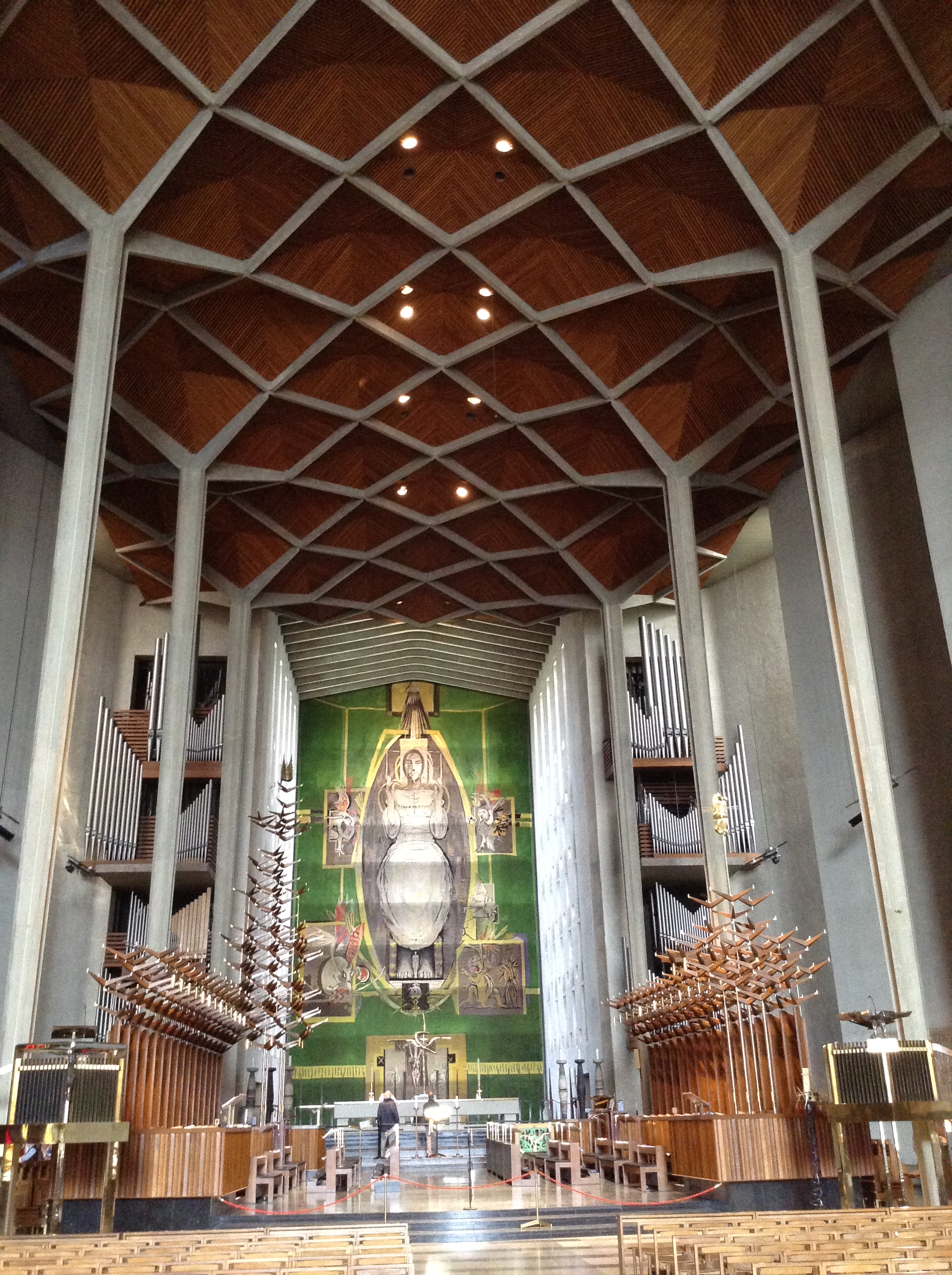
IMG_0291On a bright spring morning this May I made a pilgrimage to St. Michael’s Cathedral, Coventry in West Midlands, England. This church, built in the 14th century, had been all but destroyed on the night of November 14, 1940. Luftwaffe bombers dropped incendiary devices all over the city, several of which hit the cathedral.

The official website for St. Michael’s tells the story this way:

Rather than sweeping away the ruins or rebuilding a replica of the former church, inspired by the message of Christ for reconciliation, the then leaders of the Cathedral Community took the courageous step to build a new Cathedral and preserve the remains of the old Cathedral as a moving reminder of the folly and waste of war. From that point, Coventry Cathedral became the inspiration for a ministry of peace and reconciliation that has reached out across the entire world.

IMG_0227

Shortly after the destruction, the cathedral stonemason, Jock Forbes, noticed that two of the charred medieval roof timbers had fallen in the shape of a cross.  He set them up in the ruins where they were later placed on an altar of rubble with the moving words ‘Father Forgive’ inscribed on the Sanctuary wall. 

The decision to rebuild the cathedral was taken the morning after its destruction.  Rebuilding would not be an act of defiance, but rather a sign of faith, trust and hope for the future of the world.  It was the vision of the Provost at the time, Richard Howard, which led the people of Coventry away from feelings of bitterness and hatred. 

Following the destruction of the Cathedral in 1940, Provost Howard made a commitment not to revenge, but to forgiveness and reconciliation with those responsible.

Using a national radio broadcast from the cathedral ruins on Christmas Day 1940 he declared that when the war was over he would work with those who had been enemies ‘to build a kinder, more Christ-child-like world.’

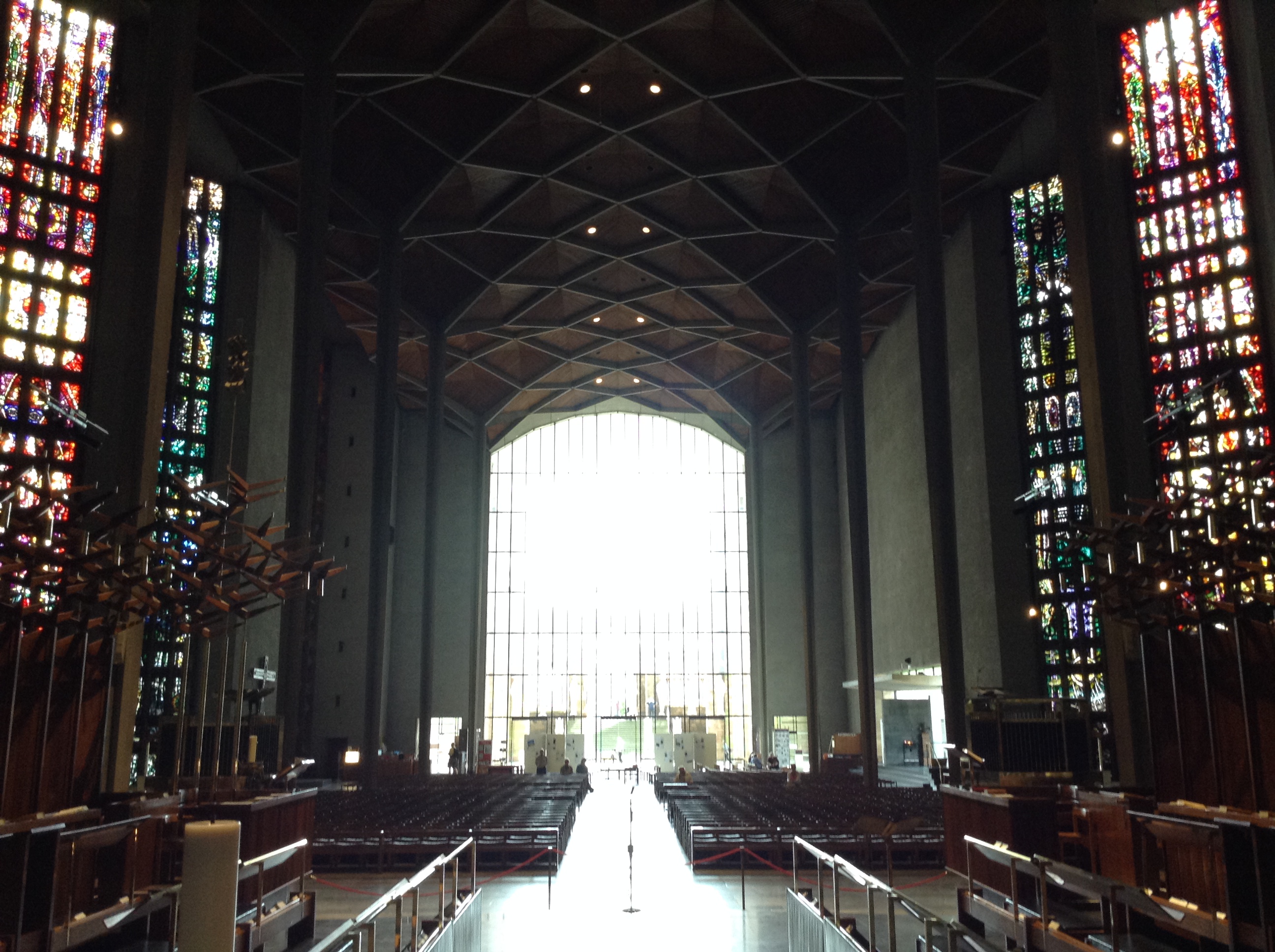
The new cathedral was built alongside the ruins of the old. The cornerstone was laid in 1956, and the new building was consecrated in 1962. The sculptures on the wall are of St. Michael defeating the devil.

The inside of the cathedral is quite beautiful, although in a modernist style that had people shaking their heads in the beginning. There is a huge tapestry of Jesus that overlooks the altar at the very front of the sanctuary.

The cross on this main altar was made of three medieval nails from the original cathedral. The Cross of Nails has become a symbol of the cathedral’s mission of peace and reconciliation. One of the crosses made of nails from the old cathedral was donated to the Kaiser Wilhelm Memorial Church in Berlin, which was destroyed by Allied bomb attacks and is also kept as a ruin alongside a newer building.IMG_0250

There are 160 Community of the Cross of Nails reconciliation centres all over the world, and each place has a cross made from nails from the ruins of the old cathedral. The reconciliation work happens locally in reconciling churches and community groups in England but also in the Middle East and central Africa working with terrorists and dictators as well as local churches, tribes and gangs.

IMG_0272

I like the view from the front of the church, looking out to the light of day. Here is what the roof of the new cathedral looks like, from the bell tower of the old cathedral. IMG_0304

There is a university across the square from the cathedral, and there were a lot of young people out and about while I was there. In the heart of the downtown core, there were a lot of poor people on the streets. I had lunch in a restaurant operated by another local church, that employs former street people, and offers affordable meals and a place to visit.

Several churches in the city are working together in an initiative called “Hope Coventry”. There is recognition that communities, and people, are always in need of rebuilding, and in need of hope.IMG_0241

On this Remembrance Sunday, after the recent deaths of two Canadian soldiers so close to home, we are especially aware of the need for hope, and for efforts like that of the provost of the Coventry cathedral, who committed himself, long before the end of the second world war, to “work with those who had been enemies ‘to build a kinder, more Christ-child-like world.”

This video of the song by JP Cormier, reminds us in a powerful way that it is not only those who are killed in battle that need to be remembered. In his introduction he made specific reference to PTSD, Post-Traumatic Stress Disorder. Cormier reminds us that our remembering has to go beyond just having a day of anthems and flag-waving and laying of wreaths. We have an obligation to stay with, and help these men and women live beyond the extreme conditions, the violence, the inhumanity of war. These things cannot help leave their marks on a person, even as the walls of the old church in Coventry are still scarred and scorched.

While I was in Coventry this spring I was reading the book “Falling Upward: A Spirituality for the Two Halves of Life”, by the Franciscan monk and spiritual teacher Richard Rohr.  In a part of the book in which he was talking about the importance of community in the transforming of lives, he told a story of how in the wake of their defeat in the Second World War, some Japanese villages understood that even as their country was being re-built, there was a need to rebuild the soldiers who were coming home.

They “had the savvy to understand that many of their returning soldiers were not fit or prepared to re-enter civil or humane society. Their only identity for their formative years had been to be a “loyal soldier” to their country; they needed a broader identity to once again rejoin their communities as useful citizens. So these Japanese communities created a communal ritual whereby a soldier was publicly thanked and praised effusively for his service to the people. After this was done at great length, an elder would stand and announce with authority something to this effect: “The war is now over! The community needs you to let go of what has served you and served us well up to now. The community needs you to return as a man, a citizen, and something beyond a soldier.”

(Rohr, Richard (2011-02-11). Falling Upward: A Spirituality for the Two Halves of Life (pp. 43-44). Wiley. Kindle Edition.)

Our work to build a better world, to make peace amongst those who have been on opposite sides, and our honouring of sacrifice and dedication must also extend to re-building, not just of physical structures like cathedrals, but of lives. Amen

Sermon for All Saints, in the wake of the attack on Parliament Hill

I watched a tv show this week called Scorpion, which is a cross between The Big Bang Theory, and The A Team. A group of social misfits who also happen to be scientific geniuses, with off the chart IQ’s to prove it, band together with an FBI agent to solve problems and do crisis management when something big and bad is about to happen.

In this episode, the genius team was called in to do a last minute fix on computers that control a decommissioned nuclear power plant. The place was about to overheat, and blow up, or melt down, or whatever an out of control nuclear power plant would do.

After watching the events of Wednesday morning unfold, in which Corporal Nathan Cirillo was killed, and Parliament and much of downtown Ottawa were under lockdown, it was actually a weird kind of relief to watch a fictional action show about geniuses who could quickly resolve a crisis. Real life problems are not fixed in 44 minutes plus commercials.

There was a moment in the show when it seemed the geniuses could fail. The dramatic arc of these kind of shows requires a serious crisis in which the heroes seem to fail about halfway through the show, then pull together, renew their bonds of friendship, and solve the problem just before the last commercial break. After the break, there is the obligatory winding down celebration, with some variation on, “That was a really close one!” Like I said, after watching real life horror and drama in Ottawa, there was a strange comfort in this escapism.

At the moment when it seemed all was lost, and the nuclear power plant would explode, and send out clouds of fallout that would kill everyone within a hundred miles, one of the non-genius characters said, “ I am going to say a little prayer.”

One of the geniuses, with the unlikely name of Happy, said, “I don’t really believe in death. First rule of physics: Energy cannot be created or destroyed, it just changes shape.”  Then she paused, as if pondering the need for prayer, then nodded her head, and said, “But, still..”

I am obviously not a scientific genius, and can’t say if Happy got it right about matter and energy. But I like what she said, that no energy can be destroyed. Most people I know hope that whatever happens to our physical bodies, that something of us, a soul, a spirit, whatever, will persist.

We seek assurance, when someone we love dies, or when we are pondering our own mortality, that we will be reunited with our loved ones, that we will be with them again, beyond this earthly life.

This is perhaps the season for this topic. It will be Hallowe’en in a few days. In the liturgical calendar, it is called All Hallow’s Eve, the night before All Saints Day, which is followed by All Souls Day. All Saints Day was established to honour the saints of the faith. All Soul’s Day was the time to remember all those who had departed in the past year. Some traditions said the souls of those who died continued to roam the earth until All Saints Day.

Many elements of Hallowe’en have ancient roots. Candles lit up rooms to help guide the souls on their way. People wore costumes to disguise themselves from enemies who had died, or evil spirits who might come to haunt them one last time. People went door to door, and collected baked treats called “soul cakes”, in exchange for offering prayers for the recently departed. In some countries, families gather at the graves of loved ones, and have a big party, to celebrate their memories. In some places they leave special pastries on the grave.

My favourite poet, the Irish mystic John O’Donohue wrote “On passing a graveyard”:

May perpetual light shine upon

The faces of all who rest here.

May the lives they lived

Unfold further in spirit.

May the remembering earth

Mind every memory they brought.

May the rains from the heavens

Fall gently upon them.

May the wildflowers and grasses

Whisper their wishes into the light.

May we reverence the village of presence

In the stillness of this silent field.

For those of us in the Northern Hemisphere, there is something about this season that is well suited to thoughts of endings and beginnings. Summer has ended, the farmers have reaped their harvests. Fields and trees are barren of fruit. The leaves are falling, and the cool of the air tells us that autumn is soon turning to winter, the cold, dark, dormant time of year- the season most like death.

The ancient Celts looked upon the times when the seasons change as having special significance. They saw them as liminal times, when the boundaries between the seen and the unseen were thinner, more porous, and it might be possible for souls and spirits to slip between worlds.

We heard a poetic description of heaven this morning from the Book of Revelations. In this time, with our memories of missions to the moon, and our scientific view of the world, how do we think about heaven?

In the ancient world people, including those who wrote our scriptures, shared a view of the physical universe that included an actual physical place for heaven. It is called the three tiered view of the cosmos. There was the ground, where people live. Above the flat earth, there was the vault or arch of the sky. Below the ground was the world of the dead, and above the sky was heaven. But we know that beyond the atmosphere of our big round planet, there is the vastness of outer space, filled with galaxies of stars, and other planets.

So how and where do we imagine heaven? The early Celtic Christians had some ideas about the soul, and about heaven that I think can be of help. There is a beautiful phrase used in the New Testament Letter to the Hebrews, which talks about how we are surrounded by a “cloud of witnesses”. It comes after a discussion of people mentioned in the Old Testament stories of God’s people, who lived out their faith, and sometimes endured hardship, and who now have died. The idea that we are surrounded by these unseen witnesses is part of how Celtic Christians talked about heaven.

In their view, when a person died, and their soul left behind their physical body, they moved, not so much to a different place, but to a different way of being. As the poet I mentioned earlier, John O’Donohue would say it, “When the soul leaves the body, it is no longer under the burden and control of space and time. The soul is free; distance and separation hinder it no more. The dead are our nearest neighbors; they are all around us.”

O’Donohue quotes another mystic, the 13th century priest and philosopher Meister Eckhart, who was once asked, “Where does the soul of a person go when the person dies?” He said, no place. Where else would the soul be going? Where else is the eternal world? It can be nowhere other than here.”

We have been brought up, most of us, to think of heaven as way up there some place, far away from us. But there are other ways to think about it.

The Celtic Christians also believed that our soul is the part of us that can each across the thresholds between this time, and eternal time, and can get glimpses of the eternal.  Maybe that is what Jesus was getting at when he said, “Blessed are the poor in spirit, for theirs is the kingdom of heaven. Blessed are those who mourn, for they will be comforted. Blessed are the pure in heart, for they will see God.”

God has made each of us with an appetite for a life beyond the life we live every day. Some people feel when they are drawn into a beautiful piece of music, or some great passion, or into the depths of a memory that seems as real now as when the events happened, that part of them is connected to the eternal.

When our hearts are filled with love for another person, even if they have died, and our hearts are also filled with grief and the pain of not seeing them anymore, we know how powerful love is, and how it is so much more than our physical selves. I have come to believe that the presence of love in my heart is a glimpse of heaven, and of God, because that love has its source in God’s love.

God loves us before we were born, and loves us each of our earthly days, and God’s love is not interrupted when we die. We continue to be held in God’s love, which is eternal, and has no beginning, and no end, it just goes on and on, and around and around, like the seasons. The cold of winter gives way to the newness of spring, and a cycle begins again. Or to borrow an idea from Happy the genius in that television show, perhaps Love is the energy that cannot be destroyed. Amen