
Take a few minutes to listen to these three songs, all performed by great Canadian recording artists:
I heard an interview on Thursday with some members of Bare Naked Ladies. The interviewer Tom Power, offered his own take on the million dollars song. He said despite its upbeat tune, and goofy lyrics about kraft dinner, chesterfields and tree-houses, he hears it as a very sad song.
The song’s narrator talks about extravagant things he could do with a million dollars, but the sad thing is all he really wants is love. The guys from the band congratulated him, and told him he heard it right. It’s a song about unrequited romantic love.
We then hear Michael Buble’s take on the Beatles song, which says it clearly. We already know this, if we think about it. You can’t buy real love.
The video is Canadian jazz singer Sophie Milman doing the old Cole Porter song, ”Love for Sale”, which even though it sounds sultry and compelling, is actually quite cringey, when you think about it- the character in that story song is singing about selling herself.
We will have a special guest speaker joining us at Trinity on Sunday, February 11. The Rev. Jennifer Potter will talk to us about human trafficking, and the sex trade in Oakville, Burlington, Mississauga and beyond. It is a billion dollar industry that uses and abuses people.
There is nothing romantic about prostitution. It preys on the weak and vulnerable, and it appeals to the lowest, worst parts of human nature. It takes the normal, healthy desire for human intimacy, for love, and reduces it to a poor and unwholesome substitute, and a commodity to be bought and sold. The Beatles had it right. You can’t buy love.
You can buy substitutes, but like John Merrick’s elephant bones or Dijon ketchup, they are not what we really need. And they won’t fill the emptiness of a hungry heart.
We are born with the appetite for real love. We don’t all get it in the purest form or quantity we really need. We discover other things that seem almost as good. The culture we live in, and the economy we are surrounded by thrives on selling us the substitutes.
There was a disease sailors used to get on long voyages. It didn’t matter how much they ate while at sea. If they did not get fruits and vegetables, they’d end up suffering with swollen gums, teeth falling out, bulging eyes, dry and scaly skin, and slow-healing wounds and bruises.
Material goods. Money. Fame. Security. Power. Attention. Flattery. Influence. The assurance we are right. Control. These all feed us something. They are not all bad in themselves. But if what we need is Vitamin C, and what we get is cotton candy, eventually we will have scurvy.
I was out with a friend this weekend. His wife was out with their oldest daughter, who I will call Cynthia, shopping for prom dresses. I took him with me to IKEA, to help me buy a sink and vanity, and plumbing fixtures. We had a lot of fun, and I got what I needed for my bathroom.
When we got back to his house Cynthia was practically glowing, she was so excited. She’d found “the dress”. But Cynthia was actually far more excited about the experience at the dress shop. She described donning each prospective prom dress, then stepping into heels, and then up onto a podium, that was lit from above with spotlights, and surrounded on three sides by mirrors.
Cynthia’s mother watched as she modelled the dress, taking direction from the sales assistant about turning, and putting her hands on her hips, and “working it”. I asked if was like being on the cable television show “Say Yes to the Dress”. She was not surprised I know the show, because Cynthia is friends with my daughter Naomi, who loves it.
Cynthia told me that they had not yet bought the dress, because they needed to look at some more options- but if they go back, she will get to put the dress on again, and stand on the lit podium. If she says “yes” to that dress, the sales assistant will press a button to lower a special background behind her, and the salon photographer will come in, and take her glamour shots, modelling the dress. These are the pictures Cynthia would then post on social media, to let her girl-friends know what she will be wearing on prom night. This is so that no one in her circle of friends will say yes to the same dress.
Cynthia is so excited. My guess is that this really is “the dress”, and the buying experience she will end up with. I know her Dad pretty well, and he is a softy. It is actually quite wonderful to see his daughter that happy.
As a relatively objective observer I wonder how much the salon experience adds to the figure charged against my friend’s credit card. How much is steak, and how much is sizzle?
I also want step back from this a bit, and compare it to what Jesus saw going on in the Temple. Pilgrims from all over Israel would come to Jerusalem at the High Holidays, to make their visit to the Temple. Part of a visit to the Temple was to make a ritual sacrifice, to have a pure, unblemished animal killed, and parts of it burned on the altar, to send the aroma, the smoke heavenward, as an offering to God. This was considered part of what it meant to be faithful, and to be in right relationship with God. It was part of religious duty.
Out of town visitors to Jerusalem would find it difficult to bring a live animal on their journey, so they would buy one at one of the many convenient shops within the temple walls. If they brought their own, the animal inspector might find a fault or blemish that would disqualify their goat or lamb, or doves, and they would have brought them all that way for nothing. So much easier to shop on the spot.
But wait, if they wanted to buy the animal at the Temple, they couldn’t use any Roman coins. Roman coins bore the engraved image of Caesar, and were considered unclean. Fortunately, right beside the animal sellers there were money-changers, who would, for a fee, trade your dirty Roman money for nice clean Jewish shekels.
Then you could wait in line to buy your sacrificial animal, have it inspected, then wait in line again to have it presented for slaughter, and ritual burning at the altar. Only certain parts of the animal would be burned. The rest would be available for purchase, at the shops in the temple courtyard. After all, if you were in town for Passover, you might need to put on a meal, to feed your family and friends.
This all operated with the smoothness and regularity of a well-oiled machine. It could create the impression that management really did know what they were doing, and all the fancy hocus-pocus, flames and smoke and special coins were necessary parts of praying, or connecting to God.
According to one of my favourite authors, Anne Lamott, the basic prayers of humans who are seeking God’s attention, reassurance, peace, and love, boil down to three simple words. Help! Thanks! Wow!
Do we really need all the sizzle? Can’t we just talk to God, and listen for God? For his second sign in John’s Gospel, Jesus challenges the smoke and flame and shiny money show at the Jerusalem temple, the centre of Jewish ritual and religion. He messes up the spiritual shopping mall, and reminds the Temple officials they do not have an exclusive franchise on the mystery of God.
God is at work in the world. God is in your heart, and my heart, and in the hearts of all of our friends, and our enemies. God is in, and around, and beneath, and above and beside all of us. The notion that we have to pay for God’s love, or purchase access to God so that we can pray, is as ridiculous as Dijon ketchup. Amen
 Woody, the Cowboy, is toy-napped by a collector, who plans to sell him to a museum. The collector locked Woody into a room which contained other valuable toys. As soon as the collector left, Woody sprang into action, looking for a way to escape. Woody met some new friends: Bullseye the horse, Jesse the cowgirl, and the old prospector, Stinky Pete.
 This morning we will use parts of a re-covenanting service that originates with John Wesley. Wesley was a priest in the Church of England who saw that people needed help to be able to bring faith out of the sanctuary, and into the everyday. He did not limit his preaching to the pulpit, but took it to the streets, and spoke to thousands of people who would never set foot in a church. He organized new believers into societies, small groups that met regularly so that the members could encourage each other, and challenge each other, and help each other live out their faith. They helped each other stay on track, and make changes in direction as needed.
 Our saint for today is Nicholas of Myra. He was born in the 3rd century in a village in what is now the southern coast of Turkey. He was born into wealth and privilege, but sadness struck when his parents died in an epidemic while he was still young. They had raised him as a devout Christian, and their influence lived on in him, in a powerful way.
 Our next hymn, “I am the light of the world”, has its origins in a poem by Howard Thurman, an American philosopher, theologian, teacher, and civil rights activist. Thurman taught a theology of radical nonviolence that influenced and shaped a generation of civil rights activists, and he was a key mentor to leaders within the movement, including
 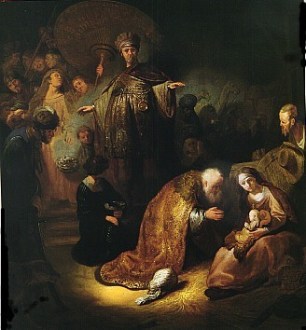 Z is for Zoroastrian. Do know this word? Some scholars suggest the Magi who appear in Matthew’s Gospel as visitors to Jesus were Zoroastrian priests. The word Magi derives from an Old Persian word “magus”, an occupational title for members of the priestly caste of the Zoroastrian religion. The Zoroastrians were interested in the stars, and had a highly developed “science” of astrology. Their reputation as astrologers led to the term Magi being used in connection with the occult, and this led to the development of the English word “magic”.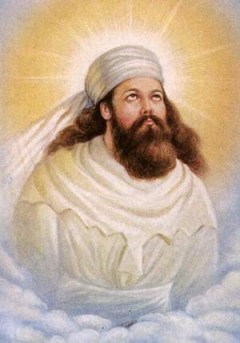
 Y is for Yeshua. Yeshua ben Joseph is the “reason for the season”! (The “ben” means “son of”) When I was growing up, I thought that his first name was Jesus, and his last name was Christ. It was actually not until I was studying the philosophy of religion in my under-grad years that I learned that “Jesus” is our translation of a Hebrew name which can also be expressed as “Joshua”. I say “expressed as Joshua” because in the original Hebrew writing there were only consonants, and the reader would have to fill in the vowel sounds. There is a whole group of variant ways to pronounce words that have the “J or Y” sound followed by the “S or Sh” sound, depending upon which vowel sounds we plug in. So we say his name is Jesus, but that is not a name that anyone who lived in his time would recognize.
 X
X W is for waiting. Advent is a season of waiting.
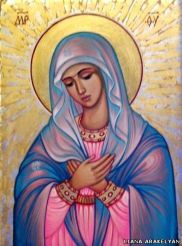 V is for Virgin. A word with volatile overtones of sexuality, judgement, and purity codes. In the western world at least, there is no time of year we hear that word more often than the season leading up to Christmas.
 U is for the United Church of Canada
 Darrow Woods: Writer of Things