
Advent Alphabet: T is for Theology

t-_jpgT is for theology. The first half of the word, “Theo” refers to God. The second half, “logia” (study) is connected to the word-family that includes “logos”, which means “word”, and “logic”, which suggests a system or method. We are doing theological reflection when we think about God, and the activity, the identity, the purposes of God. “What is God doing?” “Who (or what) is God?” “Can we understand God’s will, or plan?” “What does God have to do with me, or I with God?”

Saint Francis of Asissi famously spent whole nights praying two questions, “Who are you, God, and who am I?”

We do theology when we read the Bible stories about Jesus’ birth. We seek to understand something about God, and our relationship with God. This is good for us, and even better if we do with it with humble awareness it is not a simple task. We bring a lot more “baggage” with us than we may realize.

I remember a lecture from my time as a philosophy under-grad, about the distinction between “Event” and “Event Meaning”. The professor said:

” Two groups of people, wearing clothing that identified them as members of opposing sides, faced each other across a wide expanse. There was a loud noise, and then a fairly large projectile was seen flying through the air, from an area dominated by one group, towards an area dominated by the other group. Then there was a lot of confused movement, and more loud noise, and it appeared that members of both groups were quite agitated.”

The professor asked, “Can anyone tell me what I was describing?”

One student made a convincing argument the scene was a battlefield. Another said it was a football game. A cynical soul at the back of the room wondered if there was a difference.

We needed more information to interpret the story. If that information was not available, we might “fill in the blanks” using our own memories, creativity, or biases. The result might say more about ourselves, than the author’s intended meaning.

An author brings their culture, and beliefs, and language, and biases into their work. We as readers are on alert to sift through and get a sense of the meaning. We may be hampered, or helped, by our own education, experience, and attitudes. In an earlier letter I mentioned how important it is to read what is in the text, and not what we expect to be there. (Can you find an inn-keeper or cattle in the nativity story?)

This issue of interpretation can crop up with relatively simple documents, like a shopping list or a sales receipt. (I have never learned to read a baseball box score in the newspaper.) When the subject matter is much more complex, there is even greater need for humility.

I believe we are meant to use our minds, and ask questions, and think carefully about matters of faith. I don’t mean to suggest it is a purely intellectual exercise- we definitely need to listen to our hearts, and pay attention to our experience in life.

John Wesley, one of the founders of the Methodist movement, drew upon scripture, tradition, reason, and experience when he sought theological understanding. He encouraged all followers of Jesus to do the same.

The Advent Alphabet is a ministry offering from Rev. Darrow Woods, minister at Trinity United Church in Oakville, Ontario.

Advent Alphabet: S is for “So what?”

so-what-babyS is for So what? (It’s also the title of my favourite track on the classic Miles Davis jazz album, Kind of Blue.)

Over the last twenty or so years, when I have taught the material in yesterday’s letter about the “real story” of Jesus birth, I have encountered three basic responses.

People have asked, “Why have I been involved with church most of my life, and never heard that Matthew and Luke tell different stories?”

They find it hard to believe there are significant factual differences between the two gospels. The best way to check it out is to read Matthew chapters one and two, and then read Luke chapter one, and chapter two up to verse 20.

The second response, fortunately less common, has been anger. “Why are you telling me this? I like the story the way I remember it.”

The story as many of us remember it from Sunday School pageants, and story-book retellings is a “conflation”- which is what scholars call it when two or more stories are fused into one.

The third response, the one I secretly hoped for in these teaching situations, is part of the title of today’s letter. “So what?” Why does it matter?

The differences in the stories of Jesus’ birth serve to remind us Matthew and Luke were written as gospels, rather than history. The authors were doing theological, rather than journalistic work.

Matthew was written at least 50 years after Jesus’ death. Luke may have been written a little later. The authors were at best 2nd generation members of the Jesus movement- not amongst the original disciples. (It was common in the ancient world to attach the name of an honoured figure to a religious document- in tribute, and to claim some of the authority of the person.)

Matthew’s author was probably a Jewish scribe (perhaps trained in the Jewish religious system), who lived in Syria, and was a Jewish convert to Christianity. Scholars see hints that he wrote after the destruction of Jerusalem and the temple by the armies of Rome in the year 70 C.E.

Luke’s author was probably a Gentile who became a follower of Jesus. He wrote his gospel in “koine’ ”, the ancient greek that was the common language of government and trade in the Roman empire.

Each Gospel writer used stories from the Jesus movement’s oral tradition, as well as hymns and sermons, and other documents shared amongst the early congregations. They wove them together with their own style, and agenda. They wrote for specific audiences, and aimed to be accessible, and sensible to the people who would hear their words read aloud in worship.

The authors of Matthew and Luke were not eyewitnesses to any of the events they described.

What they were witnesses to, was the effect Jesus and his ministry had on people whose lives were touched. They saw the movement that grew around the first disciples, and quickly began to spread. They were aware of God at work in human history- of God being with them through Jesus of Nazareth. They experienced the spiritual presence of “the risen Christ”, which they saw as fulfillment of ancient promises about a Saviour. They were passionate about spreading the “Good News”- the Gospel.

Spreading the Good News is not the same thing as reporting on “the news”. When we try to talk about the reality of God, and the work of God in our midst, and our response to God, we rely on allegory, and metaphor, and images and concepts that are already part of our vocabulary. Many scholars are convinced that in the ancient world, those listening to a “religious story” would not expect it to be factually true- they would be listening for the underlying truth more than for facts.

I think gospel writers have more in common with jazz musicians, painters and poets than reporters. They used human language to communicate the meaning and power they saw in the Jesus movement to change lives. Jesus is still at work in the world, bringing hope, and healing, and meaning, purpose and joy.

The Advent Alphabet is a ministry offering from Rev. Darrow Woods, minister at Trinity United Church in Oakville, Ontario.

Advent Alphabet: R is for the “Real Story”

luke-illuminatedAt our house on Christmas morning we have a tradition of reading about the birth of Jesus, usually from the Gospel of Luke, before we do anything else. At times it is enough to hear the story again, listen with the heart, and open our spirit to receive God’s gifts. (Then we move on to exploring our stockings, and tearing away at wrapping paper!)

While there are moments to just soak in the wonder of the biblical stories- there are also times to use our intellectual gifts. It is worth the time to read from Matthew and Luke, and note any differences you see, in their treatments of Jesus’ birth.

Both Gospels offer a “genealogy” for Jesus. (Matthew’s is in chapter one, Luke’s is in chapter three) These family trees are very different. One example is that Matthew says Jacob was Jesus’ grandfather, and Luke says it was Heli.

Matthew does not describe the birth of John the Baptist or the visit of the angel Gabriel to Mary, announcing that she will bear a child. Matthew does not describe Mary’s visit to Elizabeth, or Mary’s recitation of the Magnificat (which is almost certainly lifted straight from Hannah’s song in the Samuel story). Matthew makes no mention of the journey to Bethlehem. There is no Roman census. Jesus is not wrapped in bands of cloth or laid in a manger. There is no inn, no stable, and there are no shepherds or angels (except the angel that appears to Joseph in his dreams). In Matthew, the Magi visit Jesus in a house.

Luke’s story does not include the Magi, or the star. There is no mention of Herod ordering the death of all Hebrew boys under the age of two, and Mary and Joseph do not flee to Egypt with Jesus.

Despite the efforts of pageant directors to “harmonize” these two stories, a close look reveals they are not complimentary tales that fill in blanks left by the other.

There are some things about which these writers agree. They both say that Jesus was born near the end of the reign of King Herod. Bethlehem was his birthplace, but he grew up in Nazareth. They both present Joseph as the father of Jesus (in fact, the genealogies, though different in detail, demonstrate that as Joseph’s son, Jesus was of the line of King David.) They agree that Mary was the child’s mother, and that his name was Jesus. In both stories an angel announces that this child is destined to be a saviour. (In Luke the angel tells Mary, in Matthew, Joseph is told by an angel in his dream.)

Both gospels say that Mary and Joseph were betrothed but not married at the time of Mary’s pregnancy, and that Jesus was born after they began to live together. Both suggest that Mary was a virgin, and that Joseph was not involved in Jesus’ conception- that it was by the Holy Spirit.

Outside of the two Nativity stories, and the story of the boy Jesus in Jerusalem (Luke 2:41-52) in deep discussion with the Temple priests, the Gospel stories are all about Jesus as an adult. (There are fanciful tales about the boy Jesus as a trouble-maker and wonder-worker, but they are not found in the Bible. These are in documents written much later, considered of doubtful authenticity.)

Until the moment Jesus began his public ministry, and gathered followers, why would anyone (outside of his family and neighbours) have known of his early life? He was the child of simple, probably illiterate people, from an obscure village in an unimportant province of a small territory of the Roman Empire. Who would have been there to write down the “real story”?

What do we do with all of this? Personally, my faith in God, and my passion for following the way of Jesus do not depend on the reliability of stories about his birth. If we read the rest of the stories about Jesus, as we have them in Matthew, Mark, Luke, and John, there are many more disagreements. As I have mentioned in other letters, I don’t think they were writing history- they were telling stories to teach theology. I am drawn to the meaning of the stories, and the “rightness” of the way that Jesus taught.

Advent Alphabet: Q is for Questions

question-markQ is for questions. I asked in an earlier letter if it was possible to have faith, and also have questions, even doubts about what we have been taught about God, and Jesus. I quoted a friend who makes the distinction between having faith in God, and believing everything put forward in our religious tradition. (His name is Rev. Del Stewart, and I had his book “Thinking About Christmas” with me as I wrote some of these letters.)

I continue to have questions and opinions about Christian tradition. I hope to encourage your thinking, and your questions. My friend and editor Tom Ehrich addressed some questions about the stories of Jesus’s birth, in his latest edition of the online magazine Fresh Day:

Question about the infancy narratives

The Jesus movement, as it evolved first in the early church, and then over time, to the current multiplicity of churches and sects and denominations, has collected a big “box” of ideas about God, and Jesus, and our relationship with God. Different groups keep their own special containers of ideas that make them distinct. There have been terrible feuds over the centuries about what should or shouldn’t be in the box.

Many denominations, including the United Church of Canada, have creeds, or statements of belief. (The word creed comes from the latin word “credo” which means “I believe”.) Often we use creeds not so much to teach people about what we believe, but to say, “If you agree with these statements, you can be one of us”. I remember when I attended confirmation classes as a young adult, the minister used each session to “explain” a section of the Apostles Creed. (Not be confused with Apollo Creed, who faced off in the ring against Rocky.)apollo-creed

Creeds have been a kind of “entrance examination” we require before welcoming someone into the church. Before we baptize an infant, we ask the parents a set of questions- that contain fairly abstract and complex ideas. They are expected to say “Yes, I believe that”, if they want to have their child baptized.

There are good reasons for asking the questions- we want to make sure people know what we stand for, before they agree to join us. But there are problems with the “faith in a box” approach. It does not always encourage independent thought. We often ask our newest members to agree to things the average person in the pew could not explain. This also perpetuates what I see as the “faith as a noun” problem.

To require people to give assent to a package of ideas about God and Jesus can lead to thinking about faith as something we “have”. To “have faith” is often thought of as accepting what is in the box. (The other side of this would be that if you question or doubt anything in the idea box, you obviously don’t “have” faith.)

I think that faith should be a verb rather than a noun, action rather than static object. Faith is praying, loving, risking, trusting, hoping, thinking, doubting, doing, building, helping, singing, living. It is what we do, not what we have. We can do these things in the company of people who have different ideas. We can be active faithful people, even when we are not sure we agree with, or understand everything in the box.

The Advent Alphabet is a ministry offering from Rev. Darrow Woods, minister at Trinity United Church in Oakville, Ontario

Advent Alphabet: P is for Palestine

judea-mapP is for Palestine. That’s the name the Romans used to refer to the area between the Mediterranean Sea, and the Jordan River, that included Judea (land of the Jews), and Samaria (home of the famous Good Samaritan), and Galilee, the area that includes Nazareth, the town where Jesus grew up. The name Palestine may have origin with the Philistine people (Remember David and Goliath? Goliath was a Philistine.)

The biblical account of the settling of this land (also called Canaan) by descendants of slaves who escaped Egypt in search of a Promised Land takes up considerable space in the Old Testament. It also provides the cultural and mythic matrix for Jewish identity, and by extension, the Christian understanding of what it means to be God’s people. One of the most powerful elements has been the quest for freedom- political, economic, religious freedom.

For much of recorded history, Palestine has been subject to one form of domination or another. The Persian Empire, the Hellenistic Empire of Alexander the Great, the Hasmonean Dynasty (a short-lived period of home-grown Jewish rule), the Roman Empire, the Byzantine Empire under Constantine, several Islamic dynasties, the Crusaders, Egyptian rule, the Ottoman Empire, the “British Mandate”, United Nations administration, and finally the partitioning of the land to create the modern state of Israel. Is there another area  whose very name summons up such strong feelings and controversy?

The religions of three great “peoples of the Book” grew out of this fertile area. Judaism, Christianity and Islam all view this area as “Holy Land”. This Holy Land has been the location, and the object of so much human conflict and war over the centuries.

This is where Jesus was born. A place where ordinary people have always longed for a lasting peace, that has so far eluded them. A place that has inspired deep faithx and prayer, and which continues to frustrate and confuse people all over the world. A place of incredible beauty, rich history, and also terrible hardship and pain. (It makes sense to me that religious ideas born in this place, that spoke to the human condition there, would resonate with people in other places that have known strife, and in places where people have sought freedom.)

Before we take our two minutes of silent prayer today, let’s say a prayer for the Holy Land and all its cultures, and peoples.

The Advent Alphabet is a ministry offering from Rev. Darrow Woods, minister at Trinity United Church in Oakville, Ontario.

Advent Alphabet: O is for Oakville

oakville-place-parking-lotO is for Oakville, a town in Ontario. If you don’t live in Oakville, think about the place where you live. At Christmas time, whatever our theology, whatever our reading of the biblical stories, we celebrate God’s intimate engagement and involvement with the human race, in the places where we live. We are both comforted and challenged by the message of universal love, extended to all people.
When I wrote G is for Gold, I tackled questions related to our materialism, and raised the possibility of celebrating Jesus’ birth in ways that are closer to the values he represents. Sojourners Magazine, (https://sojo.net/about-us) long a voice in the wilderness, calling for justice for all of God’s people, sent an email a few years ago with this seasonal reminder to their readers:

“A popular Christmas song says “let your heart be light,” and that “our troubles will be out of sight.” Even though Christmas is a time of wonder and excitement at the birth of our Savior, a troubled economy, violent conflicts, and extreme poverty weigh on our spirits and require our attention.

So instead of just the feasting and presents, what if we all take action this Christmas? Let’s not just sing about God’s love when we can commit to actions that will bring love, peace, and justice for our neighbours far and near.

In the spirit of a joyful, Christ-centered Christmas, we’ve even written a carol for a subversive sing-along. Who said doing justice had to be boring or serious?! So, clear your throat and join us in a rousing chorus of: “Have Yourself a Peace and Justice Christmas” (to the tune of “Have Yourself a Merry Little Christmas”).

Have Yourself a Peace and Justice Christmas

Have yourself a peace and justice Christmas,

Set your heart a-right.

Flee the malls and focus on Christ’s guiding light.

Have yourself a peace and justice Christmas,

Give your time away.

Share God’s love,

And serve “the least of these” today.

Here we are, as we pray for peace,

We’ll live simply and give more.

We care for those far and near to us,

Which brings cheer to us, once more.

God brings down

The haughty from high places,

And lifts up the low.

God cares for the hungry and the humble, so –

Forget the stress and let the peace and justice flow! “

The Advent Alphabet is a ministry offering from Rev. Darrow Woods, minister at Trinity United Church in Oakville, Ontario.

Advent Alphabet: N is for Nazareth

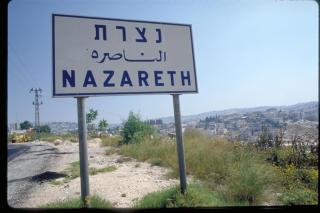
nazarethN is for Nazareth, Jesus’ home town in Galilee. But wait, what about that other little town? Why did the gospel writers make a point of telling us he was born in Bethlehem?
The earliest versions of the Gospels from Matthew and Luke were written at least thirty to forty years after Jesus’s death. This was about 70 A.D., around the time Roman forces destroyed the Temple in Jerusalem. In the midst of great upheaval and persecution, the Jewish leaders clamped down on the Jesus followers. There was bitterness and name-calling, reflective of the tension between the traditional followers of Judaism, and Jews who were following the way of Jesus.

A major challenge to the claims Jesus was the Messiah was that he came from Galilee, which was in Gentile territory. Some argued that according to the Hebrew scriptures, the Messiah had to be of David’s line, and come from Bethlehem in Judea.

Nazareth was a backwater village, and the butt of many jokes. John 1:46 quotes the insult frequently thrown at Christians: “Can anything good come out of Nazareth?”

The Gospels according to Matthew and Luke each dealt with the “Nazareth problem” in their own ways, which also served their theological aims.

Matthew provided a geneaology that traced Jesus’ descent from the family of King David. Matthew also described Joseph and Mary and the baby living in a house in Bethlehem when the Magi came to visit. Perhaps as a plot device, Matthew told the horrific story of King Herod’s slaughter of the innocents, which caused the Holy Family’s flight to Egypt. This story connects Jesus to the story of the first Joseph, who was taken by force to Egypt.

Joseph (the heroic figure in the Book of Genesis, not the earthly father of Jesus) had been sold into slavery by his jealous brothers. He rose to a place of power second only to the Pharaoh, and later acted to save his brothers and their families from a terrible famine. The Egypt connection also tied Jesus to Moses, another baby who narrowly avoided genocide at the hands of a corrupt leader.

The author of Matthew’s Gospel wanted to bring hope to fellow Jewish followers of Jesus, a persecuted minority. An important underlying theme in this Gospel is that God protects and saves, even as Joseph protected his people in the Genesis story, and as Moses saved the people from slavery in the Exodus story.

Matthew’s Gospel says Joseph kept the family in Egypt until he heard Herod had died- but because Herod’s brother succeeded him, out of fear, Joseph hid his family in Nazareth.

In the Gospel of Luke Joseph and Mary start out in Nazareth, but the census registration requires them to travel to Bethlehem. (Historical records indicate Rome did order a census in Palestine several years after Jesus’ birth, but there is no evidence Jews would be required to return to their ancestor’s hometowns to be counted.)

Luke provided his own version of a geneaology linking Jesus to David, through Joseph. (It is very different from the family tree in Matthew.)

The escape to Egypt is not part of the story in Luke’s Gospel. In Luke, after Jesus’ birth, the family visited Jerusalem for purification rites in the temple, and returned to Nazareth, where he was raised.

Luke’s gospel has underlying themes of the universality of God’s love, and a call for social equality. Mary is presented as a faithful woman, obedient to God, who will help renew the covenant between God and the people, and open it to Gentiles as well as Jews.

In Luke’s Gospel, the baby Jesus is visited, not by wealthy wise ones from the East, but by ragged, unclean shepherds. They are good representatives of the humble poor who will be lifted up, as the proud rich are brought low, as Mary described in the song of praise we call the Magnificat.

Matthew and Luke used material available to tell their stories about Jesus, with the goal of inspiring faith, and bringing hope to their audience. I don’t know if they intended their stories to be taken literally.

Decades after they were first committed to the page, the Gospels of Matthew, Luke, Mark, and John, as well as other writings of the early church were collected together. It would have been evident then, as it is now, that their stories are not factually consistent.

Some religious scholars say that in this era, 100-300 years after the time of Jesus, people of the Ancient World would not have been caught the same way we can be on the issue of literal accuracy. They would listen to the stories for the truth they contain.

The Advent Alphabet is a ministry offering from Rev. Darrow Woods, minister at Trinity United Church in Oakville, Ontario.

Advent Alphabet: M is for Magi

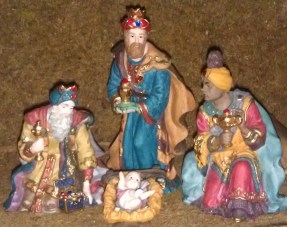
magi-and-jesusM is for Magi. I want to talk about the wise ones, but have other plans for W! I have always thought they were fascinating characters. Despite the beloved “We Three Kings”, they are magi. If you read Matthew’s Gospel , it says clearly they were wise men, not kings from the East who came to pay their respects. (Incidentally, the only reason we think of there being three is because that’s how many gifts they brought. In some streams of the Christian tradition, they talk about as many as twelve visitors.)

I like the magi because they seek after truth. There are many sayings about how it’s the truly wise who can admit they don’t know everything. These wise ones serve as models for anyone willing to endure hardship, take risks, literally step away from all that is familiar, and go where they have never been, to fulfill their quest.

In another letter I’ll look at the religion of the wisemen- for now I’ll point out they were not Jewish. Nonetheless they were interested in the birth of a child some hoped would be a Messiah for the Jews. There is no indication in the story that they became followers of Jesus. They were faithful people who were open-minded enough to look beyond their own religious traditions, to see God at work.

Part of my not-so-hidden agenda for these Advent letters is to offer nurture to people’s minds as well as their spirits. I believe it’s healthy for us to ask questions, and dig deep into the stories of our Christian tradition.

The Jesus movement has lost a lot of great people who felt they would have to turn off their brain, or at least compartmentalize their thinking, to stay in the church. I had a wonderful conversation recently with a man who holds a doctorate in atmospheric physics. He said he felt like a hypocrite going to church. He thought he had to accept the Bible without questions, and take the creeds as literally true.

A former colleague makes the distinction between faith and belief. He would say it’s possible to have faith in God, and to see the sacred and spiritual dimensions of life, without necessarily buying into, or “believing” every aspect of the portrayal of God found in popular religion, the teachings of the church, and all the layers of tradition. (Like the kings in the carol.)

How about you? Do you think we can have faith, and at the same time have questions, and doubts about what we have been taught about God, and Jesus?

Here is something I don’t doubt. Jesus taught that God wants us to bring our whole selves along for the ride, on our journey towards truth. When a religious teacher asked Jesus which was the most important commandment, he said,

“‘Hear, O Israel, the Lord our God, the Lord is one. Love the Lord your God with all your heart and with all your soul and with all your mind and with all your strength. ‘The second is this: ‘Love your neighbour as yourself.’ There is no commandment greater than these.” (Mark 12:30-31)

That’s a word to the wise!

The Advent Alphabet: L is for Love

love-lettersL is for love. Here are my favourite lines of scripture on the subject, from Eugene Peterson’s contemporary paraphrase, The Message:

“My beloved friends, let us continue to love each other since love comes from God. Everyone who loves is born of God and experiences a relationship with God. The person who refuses to love doesn’t know the first thing about God, because God is love—so you can’t know God if you don’t love….No one has seen God, ever. But if we love one another, God dwells deeply within us, and God’s love becomes complete in us—perfect love!” (1 John 4:7-12, excerpts)

I love the line that says “no one has seen God, ever”. It is reassuring to those of us who are still searching, and a corrective note for those who claim to have it all sorted.

When I was a teenager, I had a friend named Dan, who tried vigorously to “save me”. In his way of thinking, this meant I had to say that I believed certain things about Jesus, repeat a simple prayer, and then my eternal soul would be assured of a place in heaven. If I sound a bit cynical about this, it is because I am.

Members of my family had been raised on this kind of “Old Time Religion”, and I’d heard it all before. Maybe because I heard it as a young child, the frightening images of eternal hell-fire and sulfurous damnation actually got to me. Dan would preach this vile stuff, warning that if Jesus came back this afternoon my name would not be on the roll to be called up yonder. (The pictures he painted would make it hard to fall asleep at night.)

Sometimes I went to church with Dan. He would pull up to my house in his little yellow Volkswagen beetle- an original, not one of the neo-retro versions we see today. I knew as soon as I got in the car he would start in with his monologue. Dan liked to talk about two things: the valiant Russian soldiers who fought against the German army in world war two, and the horrors of what would happen if I didn’t get saved. (I realized later that Dan fought his own military campaign, for his idea of Jesus.)

One bright Sunday morning Dan and I went to worship at an evangelical church. I’d suggested this church because a young woman I knew attended there, and she had a friendly smile. She wasn’t there that Sunday- at least I didn’t see her. But God was there. There was a feeling in that place. I had been in churches before that seemed to be places of reverence- in the sense that people became quiet when they walked in- a kind of holy hush. This sanctuary seemed different. I felt an aliveness in the room, that did not seem to have much to do with the worshippers, or the music, or even the preacher (who in tone, and content, sounded very much like Dan.)

For a few minutes in that place I experienced a sense of God’s presence. It was reassuring, like a kind person’s smile, or a hug from a toddler. This presence seemed to communicate, “I know you. You’re going to be okay- don’t worry about what they’re saying. You are loved.”

It did not happen that day, but there came a time, a few months later, when I had a conversion experience, and made a conscious decision to follow the way of Jesus. I don’t know if I got saved, but I know that I am loved by God. And so are you.

The Advent Alphabet is a ministry offering of Rev. Darrow Woods, of Trinity United Church in Oakville, Ontario. Please feel free to share this, like this on Facebook, and pass it on to your friends.