Wait a minute…. (for the second week of Advent)

Wait a second. Okay, just a little longer. Okay, it’ll be any time now…
How much waiting do you do in your average day? Week? Year?
Where do you do your waiting?
What do you wait for?
How are you with waiting?
What do you do while you wait?

We are in week 2 of Advent, the season of waiting.
liturgical year

Not all churches follow this liturgical calendar, but it is familiar to most United Church of Canada congregations, as well as to those in the Roman Catholic, Anglican, Lutheran, Presbyterian and Methodist traditions.

Advent is a four week season, that began on the fourth Sunday before Christmas Day. We tend to look at it as the time to wait for Christmas to arrive. We decorate the church, and put up the trees, and return to old and new traditions such as the collection of items for White Gift Sunday, the lighting of the candles on the Advent wreath, placing decorations on our Memory Tree.

These traditions help get us in the holiday spirit, and they are a healthy alternative to the commercially driven messages that come at us at this time of year.

There are other dimensions to Advent that we can hear in the bible readings. In the first centuries after the Jesus’ earthly life, many of his followers lived with expectant hope, or fear, depending on how you see it, that he would be returning to the earth, any day, or any moment now. They talked about something called the Second Coming, at which point Jesus would return, and this chapter of human history would be over. All the kingdoms and cultures, and marketing plans and investments, and building projects, and governments, and wars, and distractions of life in the world as we know it would instantly grind to a halt.

Maybe think of it this way: What if everything that humans do, and all of our interests and relationships, and travels, and work, and study, and all the things that occupy us, were actually happening not in this world, and within time as we understand it, but were actually happening inside a massive computer? It all seems real, and engaging, and of ultimate importance, until it just stops. Jesus returns, and it is as if he pulls the plug on the computer, and everything that was happening in our world is just suddenly over.

For followers of Jesus who lived in slavery, or under the domination of the Roman Empire, or who were suffering great pain, or grieving the loss of loved ones, the idea that in one moment all things could stop, that Jesus could interrupt all the programs in the universal computer, might be a source of great comfort, and of hope.

The underlying message is that Jesus is part of something much grander, much larger, than the world and history as we see it, and that Jesus would come back, into our history, and put an end to all the small human things, and introduce us to life outside the computer.

The Greek word for this ending of time event was Parousia. In Latin it was translated as adventus, which means coming, or preparation. It is about something about to happen. We have watered it down to something a lot less scary, which is waiting for Christmas. But listen again to these words Dorothy read earlier:

“With God, one day is as good as a thousand years, a thousand years as a day. God isn’t late with his promise as some measure lateness. He is restraining himself on account of you, holding back the End because he doesn’t want anyone lost. He’s giving everyone space and time to change.

But when the Day of God’s Judgment does come, it will be unannounced, like a thief. The sky will collapse with a thunderous bang, everything disintegrating in a huge conflagration, earth and all its works exposed to the scrutiny of Judgment.”

This world ending, history smashing event for which some Jesus followers have been waiting for over 2000 years does not seem to have happened. Some churches, and some preachers invested a lot of time calculating the exact time and day when it might occur, and so far they have all been wrong. Some of them placed so much emphasis on the end of all things, they lost track of how wonderful and beautiful and meaningful life is while we have it. It is like going on a car trip, and being so focussed on the destination that you never look out the window. You can miss so much that way.

Each of us only has so much earthly time. We will live a certain number of seconds, minutes, days, weeks, months, years. We don’t know how many, or how long, and that is probably just as well. But we all know that at some point, all the programs running on the universal computer that is our life will stop. We will no longer be in this earthly life. Will we face judgement? A lot of preachers have made a lot of that idea as well. They have busied themselves scaring people to get them to straighten out their lives, and live by a certain set of rules.

Simply knowing we have a finite number of days should be enough to make us pay attention to what we do with the time we have. Not only should we look out the window, we should enjoy the view, and share our excitement and joy with our fellow travellers. We should do useful things. We should be of help to others. We should pass on what we have learned, to those we love.

We will not always be here. While we are here, we have the opportunity to live, and love, make a difference. What are we waiting for? Amen

 

What is the mission of the church?

I grew up in the church, in a little United Church congregation in the east end of Fort William, now called Thunder Bay South. This church was an important part of my early life. Sunday School and cubs, and later on, I became a Sunday School teacher, and also had my first experiences of doing bible readings in church. I remember how scary that was.

Around this time last year I received an invitation from that congregation, to be part of their year-long celebration of 100 years of ministry. There was no way they could afford to pay my way to come to Thunder Bay. The idea was that if I happened to be coming up that way, they would love to have me come as a guest preacher.

I picked a date for this fall, and looked forward to going. I really wanted to share in their celebration, and to thank them for the influence of that church on my life.

While I was on sabbatical this spring in England I heard from their minister, who said that if I still wanted to come, I better pick a date before the end of the summer. I was able to fly up for the last Sunday in August. I was honoured to preach, and have my chance to say thank you to that congregation for their influence on my life.

The following Sunday, they had their very last service, and closed the church. The building is now up for sale.

This past Sunday, my wife preached, and presided over communion at the closing service of her home congregation, a little country church near Port Rowan and Simcoe, in the village of Walsingham. Our kids went with her, and they sang the beautiful hymn “In the bulb there is a flower”. There is grief, sadness, regret mixed in with these celebrations.

My home church had to close because the folks left are now too tired, and feeling too old, and can’t do all the work, or raise the money anymore to keep things going. They have been in survival mode for at least 20 years, maybe longer, and that is tiring, dis-spiriting. They just kept trying to do the same things over and over again, with diminishing results.

I knew most of the people who were there. That was good for me, but not a good sign for a church. I had not been active in that congregation for almost 30 years. As Jesus said in the second reading from Matthew, we are supposed to be getting out into the world, teaching people about God’s love, showing a way to live that is about following Jesus, and baptizing, and making new disciples. After 30 years, that congregation should have included a lot of people I had never met. What happened?

I love that church, and its people, and felt I could ask them questions. The same questions may work for us as well. How many of us have good people in their lives, in their family and circle of friends, who are kind, caring, spirited people, but who have little or no interest in the church, or organized religion? How many people do you know who might call themselves “spiritual but not religious”?

A lot of people in Canada fall into those categories. Statistics Canada numbers from the last census indicate that about 30%, a little less than 1 in 3 of your neighbours and friends go to church once a year. That might be for Christmas, or Easter, or for a wedding or a funeral. 9%, or a little less than 1 in 10 attend church once a month. 19%, or a little less than 1 in 5 attend on a weekly basis. The big number on this slide is the 42% of Canadians who never go to church. Many of them have never been, and have no actual idea of what we are about.

Is there something seriously wrong with all those folks? Probably, but not anything that isn’t also wrong with all of us.

Why do people not like church? Lots of reasons. It can be boring. Some church people act holier than thou. Some ministers and some lay people do incredibly stupid and cruel things in the name of religion. Congregations can be stuffy, and cliquish. Some people see congregations as too stuck in their ways. Others see churches as too willing to change, and not stuck enough! Some might wish we could go back in time to the era when the churches and Sunday Schools were full every week.

There can be mixed motives for this desire for full churches. Some wish for it because it would take the pressure off of those who work so hard now to keep things going. Like all those who gave their time and donations and efforts for the church auction last night. Some of us also wish for full churches because we have experienced the depth and breadth of God’s love, have been changed by it from the inside out, and sincerely wish that for other people.

Churches can be a means to point people towards God, and can be wonderfully caring, nurturing, challenging, and inspiring. The community that gathers in, and is nurtured in a church can be of great support and encouragement to us when we are sad, or hurting, or sick, or frightened.

But we live in a time in which many people are simply not interested in church the way we currently do it. How do we connect with them?

Jesus was pretty clear about what it meant to follow him. He talked about what matters. That we visit, befriend, show mercy and kindness to those in need. He did not discriminate on the basis of church attendance and he did not give extra credit for showing up. He was interested in how we actually love others in God’s name.

He went as far as saying that when we spent time with those who are sick, sad, hungry, unpopular, hard to get along with, in prison, or other kinds of trouble, that we were with him. He also talked about his followers getting out into the world to make new disciples, to teach, and show people a new way of life, that was about following him, in his ways of love and compassion. I don’t read that as being about getting people to come to church, but rather us who know, or who want to know Jesus, going to be with those who need a word of hope, of encouragement, of compassion.

We can actually see Jesus in each other, in each other’s vulnerability, and brokenness, and messiness. We can bring God’s love to each other, in the midst of the hardship and confusion of life.

It may mean that congregations like ours need to develop new strategies for connecting with the world around us. It does not seem to work all that well, for us, and for most other congregations to simply turn on the heat and lights, unlock the doors, and wait for people to show up. Some will, and that is wonderful. But there are a lot of other folks out there who are not reached that way.

A couple of weeks ago a group from our congregation went to an event called “Fresh Expressions”, which was sponsored by our Presbytery, which is an organization of the United Churches in Mississauga, Milton, Oakville, and Burlington. We came together to learn about a program that is encouraging congregations to dream, to take risks, and follow new visions of how to connect with God’s people.

One of the stories we heard was about a Methodist church in Yorkshire, England, that did something very daring. They recognized a new way to serve their community, made some significant changes.

That congregation is in a small village, a very different context from ours. They identified something that was absent from their community, and put their own unique stamp on it. During the week they operate a daycare that uses the soft play area, and on weekends, the Ark becomes an active Sunday School. It is also a great place for Vacation Bible School when there are school breaks. The indoor playground has become their way to connect with families with children, and begin to build relationships. Those caring relationships help the church people and their neighbours get to know each other. From that, comes new understanding.

That experiment could have been a total flop, but from the story, it seems like the congregation did not have much to lose. They were struggling to keep going, with less than 10 people attending worship. They were ready to take a chance.

One definition of mission is to find a place where the world’s need intersects with something we are able to give. That’s a bit like what Jesus was saying about visiting him, when we visit those who are poor, or sick, or in prison. Placing ourselves, and our resources, abilities, in the situations where they are needed.

In the new year, as part of our celebration of the 50th anniversary of this congregation, we will be doing some praying, thinking, wondering, hoping, visioning about how we can reach beyond ourselves, to discover new ways in which what we have to offer can meet actual needs in the world.

When we find those exciting, challenging places, that will stretch us, scare us, push us beyond what we are used, but allow us to connect with, and show God’s love to people who are new to us, God will be with us. Amen

Remembrance Sunday, November 9, 2014

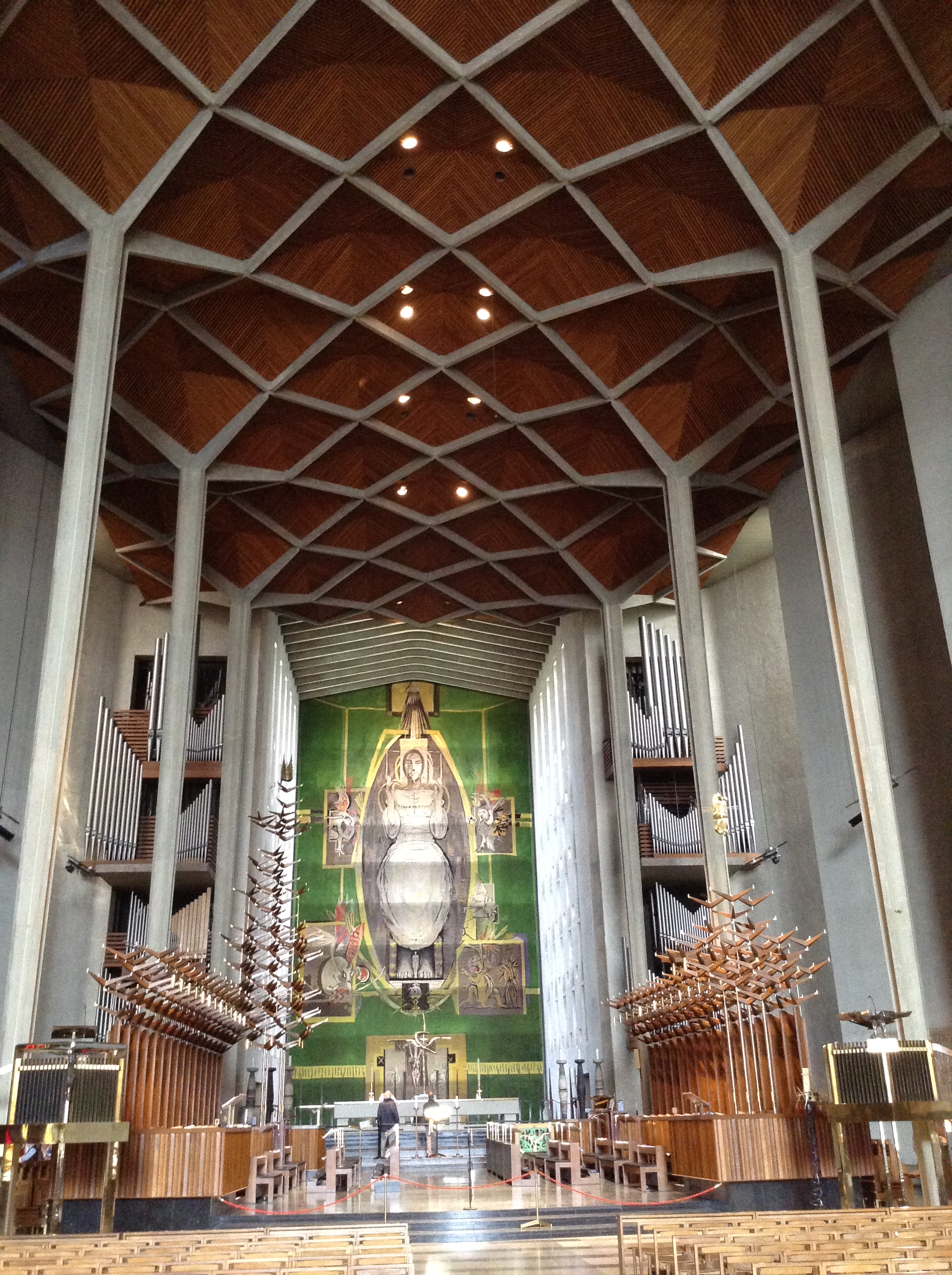
IMG_0291On a bright spring morning this May I made a pilgrimage to St. Michael’s Cathedral, Coventry in West Midlands, England. This church, built in the 14th century, had been all but destroyed on the night of November 14, 1940. Luftwaffe bombers dropped incendiary devices all over the city, several of which hit the cathedral.

The official website for St. Michael’s tells the story this way:

Rather than sweeping away the ruins or rebuilding a replica of the former church, inspired by the message of Christ for reconciliation, the then leaders of the Cathedral Community took the courageous step to build a new Cathedral and preserve the remains of the old Cathedral as a moving reminder of the folly and waste of war. From that point, Coventry Cathedral became the inspiration for a ministry of peace and reconciliation that has reached out across the entire world.

IMG_0227

Shortly after the destruction, the cathedral stonemason, Jock Forbes, noticed that two of the charred medieval roof timbers had fallen in the shape of a cross.  He set them up in the ruins where they were later placed on an altar of rubble with the moving words ‘Father Forgive’ inscribed on the Sanctuary wall. 

The decision to rebuild the cathedral was taken the morning after its destruction.  Rebuilding would not be an act of defiance, but rather a sign of faith, trust and hope for the future of the world.  It was the vision of the Provost at the time, Richard Howard, which led the people of Coventry away from feelings of bitterness and hatred. 

Following the destruction of the Cathedral in 1940, Provost Howard made a commitment not to revenge, but to forgiveness and reconciliation with those responsible.

Using a national radio broadcast from the cathedral ruins on Christmas Day 1940 he declared that when the war was over he would work with those who had been enemies ‘to build a kinder, more Christ-child-like world.’

The new cathedral was built alongside the ruins of the old. The cornerstone was laid in 1956, and the new building was consecrated in 1962. The sculptures on the wall are of St. Michael defeating the devil.

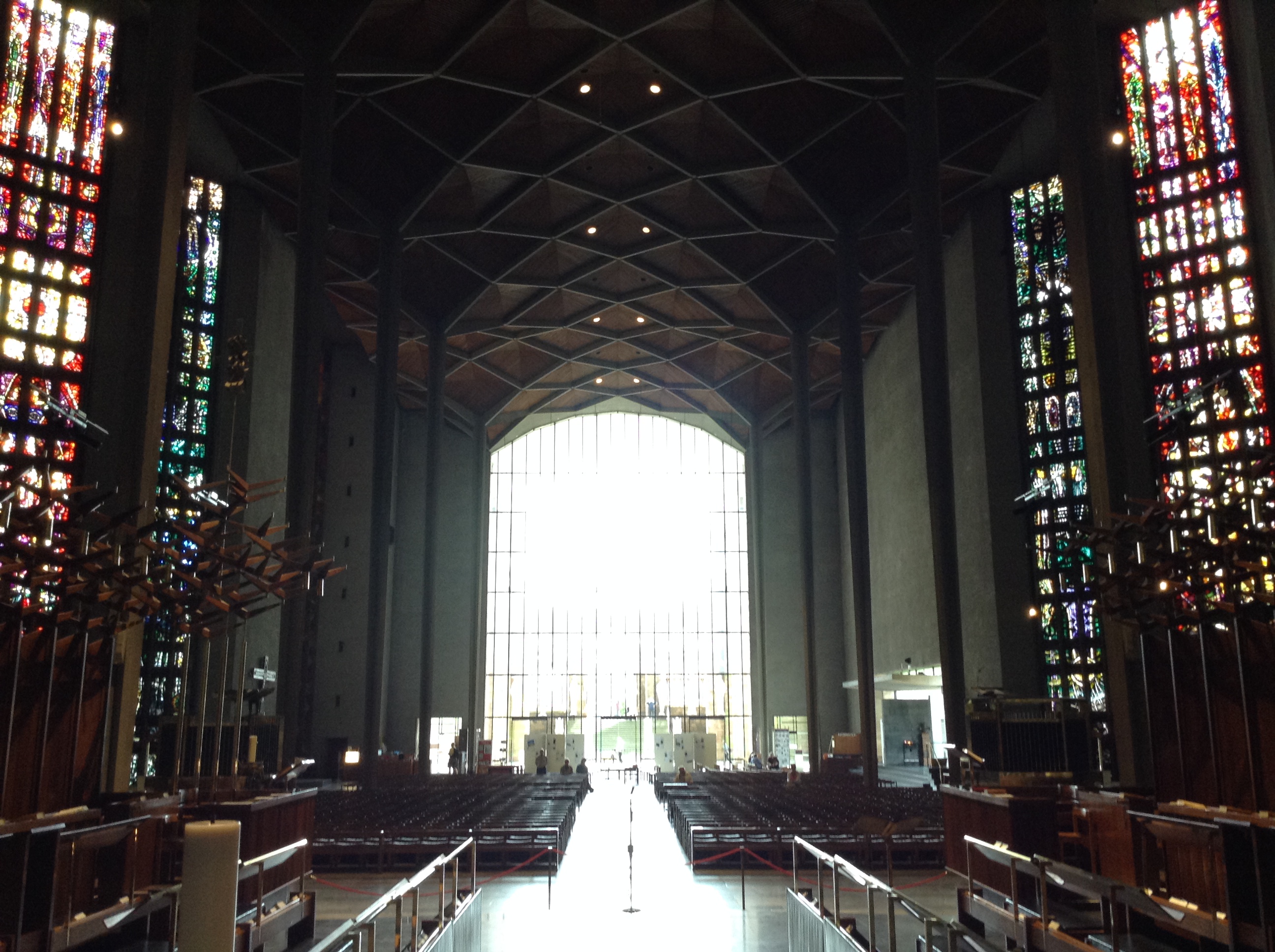
The inside of the cathedral is quite beautiful, although in a modernist style that had people shaking their heads in the beginning. There is a huge tapestry of Jesus that overlooks the altar at the very front of the sanctuary.

The cross on this main altar was made of three medieval nails from the original cathedral. The Cross of Nails has become a symbol of the cathedral’s mission of peace and reconciliation. One of the crosses made of nails from the old cathedral was donated to the Kaiser Wilhelm Memorial Church in Berlin, which was destroyed by Allied bomb attacks and is also kept as a ruin alongside a newer building.IMG_0250

There are 160 Community of the Cross of Nails reconciliation centres all over the world, and each place has a cross made from nails from the ruins of the old cathedral. The reconciliation work happens locally in reconciling churches and community groups in England but also in the Middle East and central Africa working with terrorists and dictators as well as local churches, tribes and gangs.

IMG_0272

I like the view from the front of the church, looking out to the light of day. Here is what the roof of the new cathedral looks like, from the bell tower of the old cathedral. IMG_0304

There is a university across the square from the cathedral, and there were a lot of young people out and about while I was there. In the heart of the downtown core, there were a lot of poor people on the streets. I had lunch in a restaurant operated by another local church, that employs former street people, and offers affordable meals and a place to visit.

Several churches in the city are working together in an initiative called “Hope Coventry”. There is recognition that communities, and people, are always in need of rebuilding, and in need of hope.IMG_0241

On this Remembrance Sunday, after the recent deaths of two Canadian soldiers so close to home, we are especially aware of the need for hope, and for efforts like that of the provost of the Coventry cathedral, who committed himself, long before the end of the second world war, to “work with those who had been enemies ‘to build a kinder, more Christ-child-like world.”

This video of the song by JP Cormier, reminds us in a powerful way that it is not only those who are killed in battle that need to be remembered. In his introduction he made specific reference to PTSD, Post-Traumatic Stress Disorder. Cormier reminds us that our remembering has to go beyond just having a day of anthems and flag-waving and laying of wreaths. We have an obligation to stay with, and help these men and women live beyond the extreme conditions, the violence, the inhumanity of war. These things cannot help leave their marks on a person, even as the walls of the old church in Coventry are still scarred and scorched.

While I was in Coventry this spring I was reading the book “Falling Upward: A Spirituality for the Two Halves of Life”, by the Franciscan monk and spiritual teacher Richard Rohr.  In a part of the book in which he was talking about the importance of community in the transforming of lives, he told a story of how in the wake of their defeat in the Second World War, some Japanese villages understood that even as their country was being re-built, there was a need to rebuild the soldiers who were coming home.

They “had the savvy to understand that many of their returning soldiers were not fit or prepared to re-enter civil or humane society. Their only identity for their formative years had been to be a “loyal soldier” to their country; they needed a broader identity to once again rejoin their communities as useful citizens. So these Japanese communities created a communal ritual whereby a soldier was publicly thanked and praised effusively for his service to the people. After this was done at great length, an elder would stand and announce with authority something to this effect: “The war is now over! The community needs you to let go of what has served you and served us well up to now. The community needs you to return as a man, a citizen, and something beyond a soldier.”

(Rohr, Richard (2011-02-11). Falling Upward: A Spirituality for the Two Halves of Life (pp. 43-44). Wiley. Kindle Edition.)

Our work to build a better world, to make peace amongst those who have been on opposite sides, and our honouring of sacrifice and dedication must also extend to re-building, not just of physical structures like cathedrals, but of lives. Amen

Sermon for All Saints, in the wake of the attack on Parliament Hill

I watched a tv show this week called Scorpion, which is a cross between The Big Bang Theory, and The A Team. A group of social misfits who also happen to be scientific geniuses, with off the chart IQ’s to prove it, band together with an FBI agent to solve problems and do crisis management when something big and bad is about to happen.

In this episode, the genius team was called in to do a last minute fix on computers that control a decommissioned nuclear power plant. The place was about to overheat, and blow up, or melt down, or whatever an out of control nuclear power plant would do.

After watching the events of Wednesday morning unfold, in which Corporal Nathan Cirillo was killed, and Parliament and much of downtown Ottawa were under lockdown, it was actually a weird kind of relief to watch a fictional action show about geniuses who could quickly resolve a crisis. Real life problems are not fixed in 44 minutes plus commercials.

There was a moment in the show when it seemed the geniuses could fail. The dramatic arc of these kind of shows requires a serious crisis in which the heroes seem to fail about halfway through the show, then pull together, renew their bonds of friendship, and solve the problem just before the last commercial break. After the break, there is the obligatory winding down celebration, with some variation on, “That was a really close one!” Like I said, after watching real life horror and drama in Ottawa, there was a strange comfort in this escapism.

At the moment when it seemed all was lost, and the nuclear power plant would explode, and send out clouds of fallout that would kill everyone within a hundred miles, one of the non-genius characters said, “ I am going to say a little prayer.”

One of the geniuses, with the unlikely name of Happy, said, “I don’t really believe in death. First rule of physics: Energy cannot be created or destroyed, it just changes shape.”  Then she paused, as if pondering the need for prayer, then nodded her head, and said, “But, still..”

I am obviously not a scientific genius, and can’t say if Happy got it right about matter and energy. But I like what she said, that no energy can be destroyed. Most people I know hope that whatever happens to our physical bodies, that something of us, a soul, a spirit, whatever, will persist.

We seek assurance, when someone we love dies, or when we are pondering our own mortality, that we will be reunited with our loved ones, that we will be with them again, beyond this earthly life.

This is perhaps the season for this topic. It will be Hallowe’en in a few days. In the liturgical calendar, it is called All Hallow’s Eve, the night before All Saints Day, which is followed by All Souls Day. All Saints Day was established to honour the saints of the faith. All Soul’s Day was the time to remember all those who had departed in the past year. Some traditions said the souls of those who died continued to roam the earth until All Saints Day.

Many elements of Hallowe’en have ancient roots. Candles lit up rooms to help guide the souls on their way. People wore costumes to disguise themselves from enemies who had died, or evil spirits who might come to haunt them one last time. People went door to door, and collected baked treats called “soul cakes”, in exchange for offering prayers for the recently departed. In some countries, families gather at the graves of loved ones, and have a big party, to celebrate their memories. In some places they leave special pastries on the grave.

My favourite poet, the Irish mystic John O’Donohue wrote “On passing a graveyard”:

May perpetual light shine upon

The faces of all who rest here.

May the lives they lived

Unfold further in spirit.

May the remembering earth

Mind every memory they brought.

May the rains from the heavens

Fall gently upon them.

May the wildflowers and grasses

Whisper their wishes into the light.

May we reverence the village of presence

In the stillness of this silent field.

For those of us in the Northern Hemisphere, there is something about this season that is well suited to thoughts of endings and beginnings. Summer has ended, the farmers have reaped their harvests. Fields and trees are barren of fruit. The leaves are falling, and the cool of the air tells us that autumn is soon turning to winter, the cold, dark, dormant time of year- the season most like death.

The ancient Celts looked upon the times when the seasons change as having special significance. They saw them as liminal times, when the boundaries between the seen and the unseen were thinner, more porous, and it might be possible for souls and spirits to slip between worlds.

We heard a poetic description of heaven this morning from the Book of Revelations. In this time, with our memories of missions to the moon, and our scientific view of the world, how do we think about heaven?

In the ancient world people, including those who wrote our scriptures, shared a view of the physical universe that included an actual physical place for heaven. It is called the three tiered view of the cosmos. There was the ground, where people live. Above the flat earth, there was the vault or arch of the sky. Below the ground was the world of the dead, and above the sky was heaven. But we know that beyond the atmosphere of our big round planet, there is the vastness of outer space, filled with galaxies of stars, and other planets.

So how and where do we imagine heaven? The early Celtic Christians had some ideas about the soul, and about heaven that I think can be of help. There is a beautiful phrase used in the New Testament Letter to the Hebrews, which talks about how we are surrounded by a “cloud of witnesses”. It comes after a discussion of people mentioned in the Old Testament stories of God’s people, who lived out their faith, and sometimes endured hardship, and who now have died. The idea that we are surrounded by these unseen witnesses is part of how Celtic Christians talked about heaven.

In their view, when a person died, and their soul left behind their physical body, they moved, not so much to a different place, but to a different way of being. As the poet I mentioned earlier, John O’Donohue would say it, “When the soul leaves the body, it is no longer under the burden and control of space and time. The soul is free; distance and separation hinder it no more. The dead are our nearest neighbors; they are all around us.”

O’Donohue quotes another mystic, the 13th century priest and philosopher Meister Eckhart, who was once asked, “Where does the soul of a person go when the person dies?” He said, no place. Where else would the soul be going? Where else is the eternal world? It can be nowhere other than here.”

We have been brought up, most of us, to think of heaven as way up there some place, far away from us. But there are other ways to think about it.

The Celtic Christians also believed that our soul is the part of us that can each across the thresholds between this time, and eternal time, and can get glimpses of the eternal.  Maybe that is what Jesus was getting at when he said, “Blessed are the poor in spirit, for theirs is the kingdom of heaven. Blessed are those who mourn, for they will be comforted. Blessed are the pure in heart, for they will see God.”

God has made each of us with an appetite for a life beyond the life we live every day. Some people feel when they are drawn into a beautiful piece of music, or some great passion, or into the depths of a memory that seems as real now as when the events happened, that part of them is connected to the eternal.

When our hearts are filled with love for another person, even if they have died, and our hearts are also filled with grief and the pain of not seeing them anymore, we know how powerful love is, and how it is so much more than our physical selves. I have come to believe that the presence of love in my heart is a glimpse of heaven, and of God, because that love has its source in God’s love.

God loves us before we were born, and loves us each of our earthly days, and God’s love is not interrupted when we die. We continue to be held in God’s love, which is eternal, and has no beginning, and no end, it just goes on and on, and around and around, like the seasons. The cold of winter gives way to the newness of spring, and a cycle begins again. Or to borrow an idea from Happy the genius in that television show, perhaps Love is the energy that cannot be destroyed. Amen

Letting Love Work- the story of the prodigal

The Prodigal Son is one of the most well-known of Jesus’ parables. The word prodigal has taken on a negative meaning because of this story. Think of the word prodigy- which we use to describe someone like a child prodigy, who has a special talent or gift. The gift was his share of the family fortune, but we might also say he had the gift of nerve. Can you imagine asking for your share of the estate, whatever would be left to you, before the parent died?

The younger son set off for the world beyond the farm, and squandered his inheritance on everything they write country songs about. Parties, intoxication, wild and dangerous living. I like the way this version of the Bible, the Message puts it, undisciplined and dissipated, he wasted everything he had. After he had gone through all his money, there was a bad famine all through that country and he began to hurt. He signed on with a citizen there who assigned him to his fields to slop the pigs. He was so hungry he would have eaten the corncobs in the pig slop, but no one would give him any.”

This is when he saw how good he had it on the farm. He started the journey home, and on the way rehearsed how he would plead for forgiveness.  “Father, I’ve sinned against God, I’ve sinned before you; I don’t deserve to be called your son. Take me on as a hired hand.”

His father welcomed him back with joy and celebration. He did not listen to the rehearsed speech. He asked his servants to bring fresh clothes and sandals for his son, and to place the family ring on his finger. He called for a heifer to be slaughtered and roasted for a feast. A big party, and a good time, was planned for all. Those who were ready to have a good time, would have a good time. The older brother was not inclined to celebrate. He said to his dad:

 ‘Look how many years I’ve stayed here serving you, never giving you one moment of grief, but have you ever thrown a party for me and my friends? Then this son of yours who has thrown away your money on whores shows up and you go all out with a feast!’

31-32 “His father said, ‘Son, you don’t understand. You’re with me all the time, and everything that is mine is yours—but this is a wonderful time, and we had to celebrate. This brother of yours was dead, and he’s alive! He was lost, and he’s found!’”

The older brother had a serious case of sibling rivalry. He resented his brother’s hold on their father’s heart. This theme of 2 brothers vying for their father’s affection appears in many stories Jesus and his audience would have heard around the synagogue.

Cain and Abel had a serious case of sibling rivalry- so much so that Cain actually killed his brother Abel. Cain was a farmer, and Abel was a shepherd. Cain was tied to one place, tending his crops, while Abel would wander with the flocks, going where they went to graze. One son stayed close to home, and the other who followed wild wandering paths. They were rivals in the way they lived, and in competition for their father’s favour.

Cain and Abel each prepared a meal for their father. Adam liked the mutton Abel served, but was less excited about the vegetables and grain Cain offered. Cain was disappointed by his failure, and in his anger, killed his brother. As punishment he was banished from his father’s lands, and could never be a farmer again. He became the wanderer. The story says that God placed a mark, the mark of Cain on him, so no one who found him would harm him, but he could still never go home.

The prodigal’s older brother may have wanted to be rid of his brother, but did not kill him. In this story the wanderer came home, and the father, and older brother had to find a way to live with him. The father seems open-hearted, and so relieved to see his son again that rose above any feelings he might have about being poorly used. The older brother seems less charitable, but we might hope things would improve with time.

Part of why there are many Bible stories about families, is we can relate to them. For good or not, we all come from families, and like Cain, bear the mark of our families. How we grow up shapes us. The strengths and the wounds of family life form our character. Our own experience of family might lead us to ask some questions of the story.

Why did the younger son, the prodigal, leave home in the first place? Was he raised in a way that led to him feeling privileged, but also babied? Did he feel he had to leave to actually stand on his own? Did he grow up feeling the resentment of his older brother, and get to the point where he just needed out?

How about the older brother? He seemed so hurt by his dad’s willingness to be generous and forgiving to the younger son. Did he grow up always wondering if he was really loved? Did he have this idea the younger one was always the favourite?

How about the father? We like what we see at the end of the story, when he welcomed the prodigal back with open arms and a party. But do we really agree with his decision at the beginning of the story- to give the boy his inheritance and set him free? Was that really the loving thing to do? He could probably have guessed that the prodigal would crash and burn.

I talked about this story at the Queens Avenue residence this week. The residents often help me figure out my sermons. One woman asked why we never hear anything from the mother in the story. What an excellent question! The Bible is a product of a male-dominated, patriarchal culture, and most often the main characters, and usually the ones with speaking parts, are men. Even in the Genesis story, the main characters are Adam, Cain and Abel. Eve bears the children, but has no voice in how they are raised. In the Parable of the Prodigal Son, we can’t even tell if the mother is still alive. We might imagine a different story, and a different kind of family, if the wife had a voice.

One way this story has been interpreted is to say the father represents God, who is always forgiving, and always ready to welcome us home. I like the forgiveness part of this picture of God. I am less sure about God as a parent who gives in to the child’s wishes, even when they know it won’t be good for them.

I think God is at work in the story, inside, and all around each of the characters. God is at work, constantly, actively, passionately loving each character in the story, even if they have trouble loving themselves. The spark of love provides the hope in the youngest son’s heart that he might dare come home, and receive mercy, even though he is having trouble feeling kind or forgiving towards himself. He still believes love, and life, might be possible beyond his time in the depths.

Love is at work in the heart of the father, who is grateful his child found his way back, but who is also pained at the rivalry and rift between his sons. Love points him towards the hope of family harmony, despite past problems.

Love is at work in the older brother, who is resentful of his brother, and quick to anger, but who is also protective of his father, and hated seeing him so poorly treated. He does not feel ready to join the big party, but he does not leave the farm. He has not given up either.

Love is always in the background, as a possibility in every human story. Love is there when we are hard on ourselves, and on others, gently pointing us to a better way. Love is there beyond the harshness of momentary anger, and beyond the judging words that come out. Love holds out the hope that we can get over ourselves.

Jesus ended his parable before getting to the happy ending we might imagine and hope for, with all the family members in a tearful embrace. Maybe he did that to remind us of our own broken lives, and challenging relationships, inside and outside of family. We all have need of love, and forgiveness and reconciliation. Our desire to see the prodigal’s family reunited in love is a powerful reminder to us of how important it is to let love work in our own lives. Amen

Thanksgiving

Action prayer, repeated 3 times in silence

Fists clenched tight. (we hold on so tightly to what we think we need)

Hands open palms up. (it is so freeing to let go, and allow God in.)

Arms crossed over heart. (we begin to sense again, that God is with us, within us.)

In Hinduism, a sannyasi is a kind of religious ascetic, who renounces ties with all worldly things, and gives their life to prayer and devotion, in pursuit of spiritual liberation.

One evening a sannyasi was just getting ready to sleep under a tree.  A man from a nearby village came running up to him, and asked that he give him a precious stone.

“What stone” the sannyasi asked?

“Lord Shiva appeared to me in a dream last night and told me that if I came to this place at dusk tonight a sannyasi would give me a precious stone that would make me unbelievably rich. “

The sannyasi rummaged in his bag for a moment and, smiling, said, Lord Shiva probably meant this one. I found it in the forest today and you can certainly have it.

The villager gazed at the precious stone in wonder. It was as large as his fist and, even in the fading light, it dazzled with luminosity. He took it and walked away.

That night the villager couldn’t sleep. He was deeply troubled. The next morning at dawn he rushed back to the sannyasi, and thrust the diamond back into his hands. “I don’t want it,” he said.

“What I want is whatever you have that makes it possible for you to give it away so easily.”

What makes for such an open heart, and willingness to let go? When a baby is in the womb, it has no worries. Their every need is met, even before they know they need something. They are warm, and fed, and safely held. They are open-hearted, and open-handed. No need to hold on tight to anything.

When we emerge from the womb, the first sign we are alive and healthy is that we cry out. Perhaps we cry out for the warmth, the feeding, the sense of safety we have known, which was  interrupted by the journey through the birth canal. We come through an uncomfortable passage, and are now in a strange place. Where will we get what we need? Maybe we cry because we are confused. Maybe we cry because we are frightened.

Most often the freshly-born baby is picked up, and held close to the warm body of a care giver. When possible, the baby is placed in their mother’s arms. There is a familiar smell, an embracing warmth, a heartbeat that has been heard before. The child reconnects with its source, and calm reassurance overcomes anxiety. Love overcomes fear.

Mystics like the sannyasi make it a daily, hourly, minute by minute practice to let go of reliance upon things, upon status, upon people, and give themselves over as completely as possible to God’s loving provision. It is as if they begin to experience the whole of reality as something like the womb of God.. They are embraced and filled by love, and you can see it in them. They often glow with a more powerful luminosity than the most precious gem.

Most of us are not called to such a life of total renunciation. We see that as an extreme. We live in Canada, and for much of the year, would find the womb of the world to be fairly chilly, if we tried to live without a home, or possessions. Even so, mystics like the sannyasi offer us an important corrective to what can happen when we settle for less than real life, and real love.

We heard a story this morning about the Israelites. For generations they were slaves in Egypt. A prophet and leader named Moses roused them up, and led them out of captivity. He believed God was calling them to a new place, a promised land where they and their children could thrive in freedom.

A new nation was being born. Being born is challenging. I wonder if the baby ever feels it would be better to not come out. They might not choose to go from a safe and warm place where its needs are met, out into an unknown reality. But they need to be born, to grow to maturity.

Moses had a disquieting habit of leaving every once in a while, to climb a mountain to talk to God. The Israelites got nervous when their leader was away. They wanted something to hold on to, to soothe their fears, to provide them with a sense of safety and security. They were in those ways, not that different from newborns, or from us. The story says:

When the people realized that Moses was taking forever in coming down off the mountain, they rallied around Aaron and said, “Do something. Make gods for us who will lead us. That Moses, the man who got us out of Egypt—who knows what’s happened to him?”


2-4 So Aaron told them, “Take off the gold rings from the ears of your wives and sons and daughters and bring them to me.” They all did it; they removed the gold rings from their ears and brought them to Aaron. He took the gold from their hands and cast it in the form of a calf, shaping it with an engraving tool.

The people responded with enthusiasm: “These are your gods, O Israel, who brought you up from Egypt!”


5 Aaron, taking in the situation, built an altar before the calf. Aaron then announced, “Tomorrow is a feast day to God!”


6 Early the next morning, the people got up and offered Whole-Burnt-Offerings and brought Peace-Offerings. The people sat down to eat and drink and then began to party. It turned into a wild party!

The Israelites did what people often do when worried and afraid. They turned to things of the world to distract them from their pain and anxiety. They placed their trust in gold, a symbol of material wealth. They gorged themselves on food and drank themselves into confusion, and then reached out to each other for physical comfort, and sexual release. It really was a wild party.

This story depicts an extreme response, but we can see this dynamic at work in our own lives, and in the lives of people around us. The lure of the new and shiny thing. The desire for the bigger house, the more powerful car, the trip to an exotic vacation place.  Advertising that plays on loneliness, insecurity, fear of death to get us to buy things that we know, if we are honest, will not actually make our lives better. The way that sex is used to manipulate and dehumanize people. The solace people seek in alcohol, in gambling, in over-consumption.

God spoke to Moses, “Go! Get down there! Your people whom you brought up from the land of Egypt have fallen to pieces. In no time at all they’ve turned away from the way I commanded them: They made a molten calf and worshiped it.”

Moses may have over-estimated the spiritual maturity of his people. Maybe he thought they were more ready to place their hope and trust in God. Maybe they needed him to remind them of how to live, to stay connected to the real source of love and security in their lives, so they would not grasp so tightly the distractions available to them.

Moses may have wished that they could have seen the glory of a desert sunrise, felt the fresh air fill their lungs with every breath, heard the music of the voices of their children, and been grateful for the gifts of life in God’s world.

If the Israelites had practiced gratitude, and rejoiced in the blessings God offered them, they might have felt the warmth of God’s  loving embrace. They might have been able to relax their grip, and open their hearts. They might have been more aware of living in the womb of God’s love. They might have been more like the sannyasi in the story, who could so easily give away a diamond the size of his fist.

Our reading from the letter to the Phillippians offers us advice about how to grow spiritually, and to keep the connection to God open:

“Rejoice in the Lord always. I will say it again: Rejoice! 5 Let your gentleness be evident to all. The Lord is near. 6 Do not be anxious about anything, but in every situation, by prayer and petition, with thanksgiving, present your requests to God. 7 And the peace of God, which transcends all understanding, will guard your hearts and your minds in Christ Jesus.”

Take a moment now to think of 2 or 3 of the blessings in your life. What beauty, wonder, joy, love have you witnessed? You may notice that even as you think of these, gratitude arises within you. Thank God for these blessings.

Do the same each night before you go to sleep.  You may want to begin a gratitude journal, to track how your awareness of God’s provision grows, and how your sense of gratitude deepens.

Practicing gratitude is an essential part of our spiritual lives. Everything we have comes to us as a gift of God – every breath, every ability, every opportunity, every moment of life. The practice of gratitude can help us relax our greedy, selfish hold on the stuff of the world, and make more room in our hearts for God.

Action prayer

Fists clenched tight.

Hands open palms up.

Arms crossed over heart.

Amen. Thanks be to God

Stardust and Us, all blessed

World Communion Sunday, also celebrating Saint Francis with a Blessing of Animals

I mentioned a couple of weeks ago that I took my kids to an observatory this summer. A young astronomer was our guide that night. He spoke with great knowledge and enthusiasm about our solar system, the Milky Way galaxy, other galaxies, the whole universe. He described the life stages of stars. He talked about places where stars are born, the breath-takingly beautiful nebulae.  In these vast star-nurseries, cosmic forces draw together the basic elements that make up everything. The atoms that form matter are compressed together to release the energy that makes the stars shine, and lights and heats everything around them.

Our sun is made of those elements. So is our planet. Everything in and on and around our planet, including all that lives and moves, and shares in this state of being, everything is made of the same stuff as the stars. We are all made of stardust.

Puppies and guppies, ants and leaves of grass, big blue whales and Honda civics, the silicon and carbon of computers and smart phones. The fine polished wood of this podium, the bread and juice on our communion table. Everything is made of the same stuff. You and me, and the people I met yesterday from Liberia and Sierra Leone.  Your neighbours- even the ones you don’t know, and even the ones you don’t like. The universe is a womb from which we are all born. We all come from the same cosmic mother. We are all related.

The first Sunday in October has traditionally been Worldwide Communion Sunday, now called World Communion Sunday.  For decades this has been an occasion for Christian communities around the globe to gather, to break the bread and pour the cup, and remember the life and death and resurrection of Jesus. It has been a celebration of unity. We might recognize very little else in a Russian Orthodox liturgy beyond the raising of the bread and the pouring of the wine, but we can at least understand that! That holy sharing crosses boundaries of culture, language, custom, and reminds us that we are connected.

Today we are also remembering Saint Francis of Assisi. In the calendar of the Roman Catholic Church, yesterday, October 4 was his feast day. Francis was the son of a wealthy Italian family who left behind all the trappings of worldly, material success, and lived a life of radical poverty, of dependence on God for all things, and of deep identification with nature, and all living things. His first official biographer, Saint Bonaventure, said “Francis called all creatures, no matter how small by the name of brother and sister; because he knew they had the same source as himself. “

One way Francis is honoured around the world is with services that feature the blessing of animals. This fits with his sense of family connection to all living things. Anyone who has known and cherished a family pet can tell you the way love creates a bond, and joins at least a part of our hearts to a being that is radically different from us. Love helps us see past the differences, and instinctively see the worth, the value, in another created being.

What a good idea that is! Love can help us overcome the things that separate us. Love can help us see that despite our differences, we are actually all made of the same stuff. We are stardust, given breath and life by God. There is great hope in this awareness. Amen

Seriously, Jesus?

When I was a volunteer at Koinonia Farm in Georgia, they had a small vineyard. The farm supervisor hired local workers to pick grapes. The work was hard, and would begin early in the day, to get as much picking done before the heat and humidity really set in.

There was another reason to begin early. As the day warmed up, there was a greater possibility that twined in among the vines there might be a snake. They liked to wrap themselves around the cross-beams of the vine-stands, and sun themselves. The local folks were very afraid of snakes, and with good reason. In that part of Sumter County there were several varieties of venomous rattlesnakes. Their bite might not kill you, but from what I heard, they hurt like crazy. If like, most people there, you had no health insurance, a trip to the doctor or the hospital emergency ward could be an expensive inconvenience. Many families who lived near the farm had no grass in their yards. They preferred to keep the rich red soil around their houses bare of any vegetation, for fear of the proverbial snake in the grass.

The farm supervisor during my time was a retired Baptist preacher from Erie, Pennsylvania named Ray Rockwell. Ray was an ornery, crotchety old guy.  He was in his mid 70’s when I knew him, and could still out-work people half or even a third his age. On grape picking days he patrolled the rows of vines with a sharpened hoe, which he was not afraid to use, to quickly dispatch a rattlesnake if needed. He didn’t like guns, so the hoe was a preferred option.

The day labourers in Jesus’ audience did not contend with rattlesnakes, but they faced other daily challenges and threats. Many would have identified with the workers in the story, who each day looked for a place to earn a day’s wage, hopefully be enough to feed themselves and their family. Under the Roman rule of Palestine, most agricultural land was owned and controlled by a small wealthy class. There was a huge population of landless peasants. Some came from families that used to have their own farms, but had long ago had lost them. because they could not keep up with the heavy Roman taxes.

The Roman appointed tax collectors, with the help of the local government, and Roman soldiers, would seize the land to cover the tax bills, and then the land would be turned over to a wealthy family to manage, as long as they guaranteed the Emperor would get his share.

The day-labourers were at the bottom of the economic and social ladder. They might live on plots of rented farm land, and still have to look for work to supplement their income. The return on what they grew did not always cover the costs of working the land. So they would get up with the sun, and look for a day’s work, at the end of which they would be paid a denarius.

The story would sound very familiar to Jesus’ audience. They knew about hard work, and the precarious nature of life in Roman-ruled Palestine. Now that Jesus has drawn in his listeners with a story to which they can relate, he brings in the twists, the surprises that make this a parable.

The audience is already listening. They have already let the story get in past their defenses. Now the story is going to get under their skin. Jesus says that the landowner went out several times during the day and recruited more workers. These would be workers who had not been successful in finding work earlier in the day, and who likely expected to go home hungry that evening. The landowner goes out at nine, and noon, and at three in the afternoon, and at again at five. That may sound like quitting time to us, but in those days it might be more like 6 in the evening, depending on the time of year.

When the end of the day does finally come, which would be a tremendous relief to those who’d laboured since sunrise, the landowner instructed his foreman to pay each worker a denarius. This did not sit well with those who had been there all day.

I was out with the Sunday school when you heard this story, but I put questions in the bulletin for you to consider:

How do you feel about this story?

How would it feel to be the first one hired?

How would it feel to be the last one hired?

Jesus challenges us with contrasting versions of reality. There is the world we are used to, in which you only get what you deserve, or what someone else decides you deserve. This is also the world in which even if I have all that I need for today, I am still likely to want more, and also likely to be envious and indignant, if I feel like someone else got a better deal than me.

Then there is the world as God might have it be, in which a generous landowner might exercise the freedom to make sure all his workers went home with enough to feed their families. He did not make them rich, but they would have enough.

It would be like the manna that appeared for the Israelites on their trek across the desert. Enough appeared to meet everyone’s actual hunger, but no more. No ziploc bags, no freezers, no retirement plans. No extra for those who put in longer hours. Just enough for the day.

Can we even imagine living that way? Actually, that is how we live. We may go to bed at night with the knowledge that there is food in the pantry for tomorrow, but what we don’t know for sure is what tomorrow will bring, or whether we will live to see the next day. None of us knows what might happen. Our lives are literally out of our control. If we don’t control even our own life, how is it that we become convinced that we are in charge of, or own or control anything? Everything we need to live, including life itself, is on loan to us. We only have it for a while.

That, I think is one of the deep symbolic and spiritual meanings of the manna story, and of Jesus’ parable. We are not in charge. We do not really own anything. We are utterly dependent on the generous provision of God.

We resist this truth, in the same way that some of the Israelites tried to horde more manna than they needed for the day. In the same way that some of the vineyard workers wanted more than they really needed to feed their families. They wanted more. We want more. Human greed, which is rooted in fear, is the snake in the grass in this story. The owner of this vineyard does not use a sharpened hoe to strike this snake down. He uses something even more powerful. He uses open-hearted generosity. He rejects the worldly way of seeing things, that would have us wrap ourselves in the false security that comes from having more than we need.

We want that illusion of security. But in our hearts, we know that having more, hoarding more, gathering it all up so that we have more than our neighbours still does nothing to give us power over life and death. We are still captives.

The person who is the most free in the story is the landowner. We might look at this cynically and say that he could afford to be generous, because he was rich. But it is not the amount that he has, but what he is doing with it. It is his generosity that makes him free.

As Christian people, we do our best to follow Jesus. With his tricky stories, and with the example of how he lived, Jesus is leading us into God’s vision of how the world could be, and away from the way the world is. Jesus is leading us away from greed, and desperation, and fear, and the illusion of security. Jesus is leading us towards freedom, and generosity, and joy. Amen

Sunday, September 14, 2014 Pass it on (God’s love)

Last week I mentioned I returned this summer to Koinonia, a farm near Plains, Georgia. I lived and worked there as a volunteer almost 30 years ago. One of the founders of this Christian intentional community was Clarence Jordan. He was a Southern Baptist preacher, but was eventually removed from membership in that denomination because he could not accept their teachings about the separation of the races. He had an undergraduate degree in agriculture, as well as a Ph.D. in New Testament Greek. Koinonia Farm is a “test plot”: an ongoing experiment in life lived in the light of God’s love.

Jordan created an interpretation of the New Testament, called the Cotton Patch Gospel. He used the colloquial language of the American South he grew up in, and the geography and settings familiar to his neighbours in rural Georgia. He had a fondness for the parables, which he saw Jesus using to challenge the status quo. Parables often begin with familiar characters and situations, but then unexpected changes or twists throw the listener off guard. Jesus did not always take on difficult topics directly. He used story as a way to bait people into listening.

Jordan compared Jesus’ parables to the Trojan Horse from Ancient Greece. The gift of the horse, or the story, gets in past the defenses, and then releases its message on the unsuspecting. Before they realize it, the listener is caught up in the story, and is forced to look at contrasting realities- the world they live in, that has values and ideas that must be challenged, and the world as God would have it be.

Here is the Cotton Patch version of Matthew 18:21-35. It is often called the Parable of the Unforgiving Servant. In this version, Jesus’ name for Peter is “Rock”:

Then Rock sidled up and asked, “Sir, how often should I forgive my brother when he keeps doing me wrong? Seven times?” “I wouldn’t say seven times,” Jesus replied, “but seventy times seven!

 That’s why the God Movement is like a big businessman who wanted to settle the accounts of his customers. As he started to do so, one customer came in who owed a bill of more than ten thousand dollars. He had nothing to pay on the account, so the businessman told the sheriff to put up for sale everything the guy had and apply it to the debt. But the fellow did a song and dance. ‘Please give me some more time and I’ll pay every cent!’ he begged.

 The businessman was touched by the guy’s pitiful pleas, so he let him go and marked off the debt. Then that same guy went out and found a man who owed him a hundred dollars. Grabbing him around the neck, he choked him and said, ‘Pay me that money you owe.’

 ‘Please give me a little more time,’ the man begged, ‘and I’ll pay every cent.’ But he refused and, instead, he swore out a warrant for him. When the little man’s friends found out about it, they were really upset, so they went and told the big businessman all that had happened.

 Then the big businessman sent for the guy who had owed him the huge debt and said to him, ‘You low-down bum! I marked off all that debt for you because you begged me to. Shouldn’t you, then, have been kind to that little man just as I was kind to you?’

 Still hot under the collar, he turned the fellow over to the law to be thrown into the clink until every last dime of the debt had been paid. And my spiritual Father will treat you along the same lines unless every single one of you forgives your brother from your heart.”

(Cotton Patch Gospel: Matthew and John (Clarence Jordan’s Cotton Patch Gospel) Smyth & Helwys Publishing. Kindle Edition)

Many hearing Jesus’ story would relate to owing money to someone rich and powerful. Many would have been tenant farmers, in debt to the land-owner, trying to pay their rent on the land, cover the cost of seed, and feed their families.

This summer my son Joel and I visited a coal mine museum in Scranton, Pennsylvania. We went 300 feet underground, to learn how it was for the miners. There were about 20 of us crammed into a covered rail car. As the car rolled down its tracks into the shaft, we could feel it getting colder and colder, while it got very dark, and then pitch black, until we rolled towards the spotlit tunnel where they let us out. The tunnel was damp. We looked down side tunnels in which miners would have to slide on their backs, pushing with their feet, to get to the coal seam. In other tunnels they could stand, but would always be a bit bent over because of the low ceilings. It must have been brutal, awful work.

They lived in rented company houses, bought all their basic needs from their employer, and usually ended their weeks of hard labour even further in debt, caught in a downward cycle more grim than the tunnels of the mine itself. The tour guide even quoted the song about how they owed their souls to the company store. After Joel and I had been down in the dark, cold depths of the mine, the bright shining sun of a summer afternoon was a bit overwhelming, almost unbelievable.

The person in the parable owed ten thousand dollars. In the original version, it was ten thousand talents. A talent was the equivalent of 15-20 years of daily wages. This is an insane amount of money for a person to owe, exaggerated to show the person was relieved of a huge burden, when his debt was forgiven. It highlights the harshness of the way he treated the one who owed him a comparatively small amount. How could he be so petty, when he had been given such a gift of mercy?

This person was shown a glimpse of a possible new way to live. It was like they had left the darkness behind. In that moment the power of the sun radiated into his life. He felt the warmth, was blinded by a glorious light, and then it all changed. He was overcome by shadows. When he met the person who owed him money, it was as if the vision of a new way, with the light and warmth of love had faded. He was back in the murky world of business is business, and you have to get ahead, even if it hurts others. He forgot the mercy he had been shown, and he bought even more darkness down on the one who owed him a pittance, compared to what he himself had owed. He failed to pass on the forgiveness he had been shown.

People in Jesus’ audience undersood the world being a hard and harsh place. Like us, part of them might want the man in the story to be taught a lesson. The one who forgave the huge debt heard about the way this man treated his own debtor, and changed his mind. The man would be put in jail until he paid what he owed. Never mind that if you are in jail you probably can’t earn anything to pay anyone.

At this point those who heard Jesus’ story might realize nobody came out a winner. They are all back to playing by the rules of the cold, cruel world. No one gets forgiven, no one actually gets paid back, and no one finds any real peace. Jesus has drawn us into a story that shows us how the world works, and would keep on working, without love, and without the power of forgiveness. We can see how things work, and how they could work, with a little more light and warmth.

Forgiveness is a complicated thing. Sometimes people get hurt by the cruelty of another person, and then hurt again, when the idea of forgiveness gets mis-used. I have heard too many stories about people, usually women, who were being abused, emotionally, or physically, or both, and told they should go home and forgive the abuser. People need to do what they need to do, to get to a safe place, out of the reach of the abuser.

Forgiving a person does not mean accepting their bad behaviour. Forgiveness should be part of correcting what is wrong, not overlooking the offence. I am not an expert on forgiveness. It is as hard for me as for anybody here, to get over being hurt. It is something we work at day by day, step by step, just like anyone else. It is soul work.

There is soul work, and “sole work”. (Open running shoe box.) It might surprise you to learn the idea of forgiveness shows up consistently in reviews of new running shoes. I own many pairs of runners, and I read reviews before I buy them.

An important aspect of running shoes is their cushioning. The sole is designed as a platform for the foot. If you are a runner who lands hard on the heel with each step, you may need shoes that have heavier heel cushioning, to soften your landing, and minimize the jarring damage done to your joints.

If, with each step, each stride you take, you tend to land more on the outer edge of your foot, and then kind of roll to flatness, that is called over-pronation. There are shoes that correct for that. Same thing if you tend to land on the inside edge of your foot, and roll outwards, which is called supination. The cushioning of the sole compensates for our natural tendencies, and frees us to keep on going, doing the best we can.

The built-in capacity of a shoe to compensate for, to correct our faulty, imperfect running style is called forgiveness. Running coaches work with athletes to alter their stride, to correct it to what they call neutral, which would mean landing on the forefoot, and not the heel, and not rolling the foot either too much inward or outward. But in running, like in life, no one is perfect. We make mis-steps. We all need help. We all need forgiveness. Sometimes with every step we take.

Poor running form only harms you. Excessive rolling can stretch or tear ligaments, and cause a lot of pain. Landing hard on your heel sends a shock up through your leg, your knee, and ultimately your spine, and can lead to joint problems all the way up. But again, it only hurts you, and your ability to run, or walk.

But in the rest of life our mis-steps, conscious or not, cause pain and harm to others. The mis-steps, the mistakes of other people can cause us great harm. It can be hard to get past the pain, the harm done to us. As I said earlier, I am no expert on this, but it seems to me that one thing we can see in the parable is that if we forget that we ourselves need forgiveness, we are less likely to be forgiving of others. If we remember that we do things that hurt ourselves and others all the time, we may also remember how much we are like the person who needs our forgiveness.

This reminds me of what has sometimes been called a Cherokee prayer: O Great Spirit, grant that I may never find fault with my neighbor until I have walked the trail of life in his moccasins.

When we remember how we are all equally in need of forgiveness, it can be like coming out from a dark place, and back into the light of God’s love. Amen