
Beginner’s Wisdom

After our worship service last week, I heard someone comment that we’ve had baptisms two weeks in a row, and that next week, meaning this morning, we would be back to “normal”. I can understand what they might have been feeling- after the joy, the delight, the wonder of new life that we witness when we baptize a little one, things do seem a little quieter today.

A baptism works on our hearts, our souls, our minds in deep ways. We listen as the parents promise to raise their child in faith, and to give prominence to God in their lives, and in the life of the child. We make our own prayers asking for blessings upon the child. There is something about asking God to bless a person- remembering that our lives are in God’s hands that inevitably arouses thoughts of mortality. Hopes and dreams, gratitude and fear, joy and anxiety are all in the room with us. In the beautiful moments of a baptism, we can also have an encounter with mystery- with things bigger than the words we have to talk about them.

Deep things can get stirred up. Deep things like our own, deeply personal questions about life, and death, and the meaning and purpose of our existence, and the reality of God. It’s good for us to come together in this safe, welcoming space and allow those big questions and wonderings float up from our inner depths. It is good to be part of a community where those questions can float around, even if we don’t always talk about them, and don’t claim to have all the answers worked out. We need places in our lives where we are encouraged to encounter mystery.

A few years ago I was out for a walk with our son Joel, and I noticed on the path ahead of us the amazing sky blue of a robin’s egg. I was about to point it out to him, but stopped myself as we got closer, and I saw that within the broken halves of the egg there was the tiny dark form of a partially formed baby bird, shiny and wet, and being devoured by insects. When I realized what I was seeing, I experienced a powerful lesson about the beauty and brutality of creation- the shortness and uncertainty, the potential, and the utter vulnerability of all life, including ours.

In the face of that deep mystery, there is a real temptation to try to pin God down- to define God and how we relate to God, so that we can feel safe and secure.

When we baptise, and often when we offer a blessing, the words used will include reference to God the Creator, Jesus the Saviour, and the Spirit as Guide or Comforter. In my training for ministry I was taught that in order for a baptism to be “official”, and so that it would be recognized as such by other Christian churches, we have to make sure to use what is called the “Trinitarian Formula”. God described as “Father, Son and Holy Spirit”.

This uniquely Christian teaching, that there is only one God, but that God is known to us in these three ways, is the called the doctrine of the Trinity. This congregation is called Trinity United Church in deference to this historic idea about God.

Today is Trinity Sunday- the only special Sunday in the church calendar that is devoted to a theological teaching about God. It’s a teaching that gained official status in the Christian Church back in 325 A.D. at a meeting called by Constantine, the ruler of the Holy Roman Empire. He was in the process of making Christianity the official religion of the empire. With his military background, it seemed to make sense to him that all Christians be taught to believe the same things- similar to the Standard Operating Procedures military units follow. He called all the bishops and prominent leaders and teachers of the faith together for the Council of Nicea, and tasked them with writing the manual for Christian faith.

While I understand, and appreciate the importance of being on the same page with people, it also seems to me that it is problematic to define God, and then become totally invested in a particular set of words, or names, or ideas about God. It does not leave a lot of room for mystery, and for humility- the awareness that we are human and mortal, and limited, and that God, and God’s ways, are actually quite beyond our understanding. Once the words and names for God were set down in the Nicene Creed, other ways of imagining God, of talking about God were frowned upon.

Some important things were lost, or at least set aside, for a long time. The Old Testament reading we heard from the Book of Proverbs describes God the Creator as enjoying the company of a feminine figure, that is sometimes called “Lady Wisdom”, or “Sophia”, which is the Greek word for wisdom. She is the voice in Proverbs who says:

” The LORD created me at the beginning of his work, the first of his acts of long ago. Ages ago I was set up, at the first, before the beginning of the earth. When there were no depths I was brought forth, when there were no springs abounding with water. Before the mountains had been shaped, before the hills, I was brought forth– when he had not yet made earth and fields, or the world’s first bits of soil.

When he established the heavens, I was there, when he drew a circle on the face of the deep, when he made firm the skies above, when he established the fountains of the deep, when he assigned to the sea its limit, so that the waters might not transgress his command, when he marked out the foundations of the earth, then I was beside him, like a master worker; and I was daily his delight, rejoicing before him always, rejoicing in his inhabited world and delighting in the human race. “

So who, or what is this Wisdom figure? She seems to be something not quite God-like, because she was created by God. But she is not human either. This ancient poem preserved in the Book of Proverbs speaks of wisdom as a playful, creative, feminine figure, made by God before anything else was made, and leaving her mark on everything God made, like an apprentice in a Renaissance master’s studio, trusted to fill in details on a painting after the artist laid out the plan.

I am glad we had a chance to look at the Creation of Adam, a detail from Michelangelo’s work on the ceiling of the Sistine Chapel. Art scholars say that the Pope who commissioned Michelangelo was so keen to have him do this massive work, he pretty much allowed the artist to paint whatever he wanted. Scholars also believe that the artist read and re-read the Old Testament as he planned the project, and drew his own conclusions, rather than relying on the official theology of the church to guide his designs.
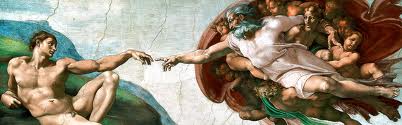
creation of adam

As we heard in the introduction to the reading from Proverbs, when Michelangelo designed the scene of the Creation Adam, he included the amongst the little babyish cherub angels floating around the figure of God, a very mature female figure. God’s right arm is outstretched towards Adam, and God’s left arm literally embraces Lady Wisdom.

I wonder how the history of the Christian church would have been different if the human leaders of the faith had embraced Lady Wisdom, and held her as close as God does in the painting. If the church had taught it’s people, and its priests, bishops, cardinals and popes to hold her in high regard, maybe the role of women in the church could have been different over the centuries. It remains a harsh reality that in many churches, women are stilled looked upon, and treated as second-class, not qualified, simply because of their gender, to serve as leaders.

Michelangelo’s painting seems to take its inspiration from the passage we heard from the Book of Proverbs. He offers us a picture of God that may surprise us. God has a friend, and delights in her company. This gives us a different way to think about God.

I don’t take Michelangelo’s picture of God literally. When I pray, I don’t imagine God looking like a half-naked bearded man floating in the sky, with a beautiful woman under his arm. But I am drawn to the image of Wisdom leaving her mark on all things that God creates. I think we can learn about God, and our relationship with God, as we pray about, and ponder deeply what we see, and experience here in the created world. There is wisdom present, even and especially in moments of mystery, which cannot be easily talked about or explained. Amen

More of the past, present and future

This Sunday I ended the sermon halfway through my prepared script. I suspect that only the people who follow along with their printed copies of the sermon would have known the difference. This edition of the fifth page follows this weeks sermon blog entry, which can be found at: http://wp.me/2WJ8e

Our choices are important. In Lord of the Rings, not even Galadriel’s magical mirror can show exactly what will happen in the future, because events are shaped by choices people make.

We heard another tale this morning from the Book of Acts. These adventure stories were preserved feature some of the heroic figures of the early Christian movement. These early followers of Jesus were on a quest to spread the word about Jesus to all who would listen. The stories were passed on to remind people that God’s work did not stop when Jesus was no longer seen walking the earth.

Paul, one of the first Christian missionaries, travelled the Roman trade routes all the way to Europe. In a town in ancient Greece called Phillipi he taught about God’s love, and offered baptism, and many people chose a new path for their lives.

One day Paul was walking with companions to a place of prayer. They were met by a female slave who earned money for her owners as a fortune teller. She began following Paul and the others, shouting, “These men are servants of the Most High God, who are telling you the way to be saved.” She kept this up for many days. Finally Paul became so annoyed that he turned around and said to the spirit, “In the name of Jesus Christ I command you to come out of her!” At that moment the spirit left her.

The fact that Paul commands the spirit of prophecy to leave the young woman reflects the belief that such a gift was evidence of demonic possession. Paul did an exorcism. He commanded the spirit in the name of Jesus to come out of her.

We don’t know what happened to the young woman, except that she no longer seemed to have fortune-telling ability. Her owners were not very happy about that! Paul’s act of exorcism sets off a whole chain of events that perhaps not even the fortune-telling slave girl could have predicted. The story says,

19 When her owners realized that their hope of making money was gone, they seized Paul and Silas and dragged them into the marketplace to face the authorities. 20 They brought them before the magistrates and said, “These men are Jews, and are throwing our city into an uproar 21 by advocating customs unlawful for us Romans to accept or practice.”

22 The crowd joined in the attack against Paul and Silas, and the magistrates ordered them to be stripped and beaten with rods. 23 After they had been severely flogged, they were thrown into prison, and the jailer was commanded to guard them carefully. 24 When he received these orders, he put them in the inner cell and fastened their feet in the stocks.

25 About midnight Paul and Silas were praying and singing hymns to God, and the other prisoners were listening to them. 26 Suddenly there was such a violent earthquake that the foundations of the prison were shaken. At once all the prison doors flew open, and everyone’s chains came loose. 27 The jailer woke up, and when he saw the prison doors open, he drew his sword and was about to kill himself because he thought the prisoners had escaped. 28 But Paul shouted, “Don’t harm yourself! We are all here!”

29 The jailer called for lights, rushed in and fell trembling before Paul and Silas. 30 He then brought them out and asked, “Sirs, what must I do to be saved?”

31 They replied, “Believe in the Lord Jesus, and you will be saved—you and your household.” 32 Then they spoke the word of the Lord to him and to all the others in his house. 33 At that hour of the night the jailer took them and washed their wounds; then immediately he and all his household were baptized. 34 The jailer brought them into his house and set a meal before them; he was filled with joy because he had come to believe in God—he and his whole household.

I wonder if those who were baptized that day, more than two thousand years ago, could have imagined that in our time, we would still be doing what they were doing. Looking for God’s presence, and God’s light, to help us as we move from our present towards the future. Amen

Past, Present and Future

Are there any Lord of the Rings fans here this morning? I want to show a brief scene from the first movie in the series, “The Fellowship of the Ring”.

The regal looking woman in white is Galadriel, the elf queen. It is interesting how her mirror ritual resembles baptism. She fills her silver pitcher from a living stream of water, and pours into a basin that looks very much like a baptismal font.

This is not totally surprising. J.R.R. Tolkien, the creator of the Lord of the Rings was a committed Christian. He was also a close friend of C.S. Lewis, whose Chronicles of Narnia use themes and elements drawn from Christian faith. In Lord of the Rings, and in Narnia, we are presented with fantasy worlds, and stories that deeply touch the human heart, because they are about loyalty and love, about life and death, about hope and despair, and about the conflict between good and evil. They are about falsehood and truth, and the importance of being able to discern the difference. They are about the importance of knowing who you are, and who you are meant to be.

Galadriel invites Frodo to look into the mirror, which will show him, “Things that were, things that are, and some things that have not yet come to pass.”

Our baptismal font is not Galadriel’s mirror- but it does give a glimpse into the past. For over two thousand years Christians have been baptizing and blessing, and welcoming people into our own travelling fellowship- our community of those who seek to follow the ways of Jesus. Gathering, and praying, and hoping and blessing are ancient practices of faithful people.

Our actions at the font also offer us a glimpse into each other’s hearts in the present time, as we join with the child and her family in a moment of blessing. We pray for this young life, and for those who are responsible for her. We offer support, and encouragement, and we make promises. We promise to continue to be here as a church- to keep being a community that takes seriously the message of Jesus, the love of God, and the ongoing guidance and direction of the Holy Spirit.

Gathered at the baptismal font, we may also get a glimpse of ourselves as God sees us- beloved members of God’s family. God sees our worth, our purpose, our identity, differently than we do ourselves, and differently than the world does.

In the midst of a world that seems ruled by darker forces- by economics and politics, by selfishness, and lust for power, and by insecurity and mistrust- we promise to represent another path- a way of life rooted in light, and love and hope, in compassion and fairness, in openness and gentleness.

As we gathered at the font, our attention was also on the future. Maeve is at the beginning of her earthly life. She has so much ahead of her.

As a parent, I can remember standing at the font with our babies. Filled with hope and pride, and desire to do the right things, to help direct and shape a young life. A bit fearful that I did not really know what I was doing. Grateful to have a community of faith around me, and loving and wise friends and family standing with me.

Our font does not work exactly like the mirror in Galadriel’s cave. We don’t get to see how Maeve will grow up, or exactly what her life will be like, or who she will love, or what she will see and do. We can’t see what journeys she will go on, and what battles she will fight. We may crave those details, but they are not forthcoming. What we are offered instead is a glimpse of the promise that wherever her life’s journey, her quest takes her, God will be with her.

God’s promise to always be with us can offer us hope and comfort, even, and probably especially in times of uncertainty. When we don’t know exactly how things are going to turn out, it is important to know who we are, and who is with us. God’s presence with us can help us make the right choices.
Amen

In the bulb there is a flower…

On Easter morning I enlisted the help of the children at church in planting sunflowers in a number of small and large pots. They each had the opportunity to push little black hard-shelled seeds into the loose brown potting mix soil. We planted small pots so that each child could bring one home, and three large pots, with numerous plantings have stayed at the church. My job in the weeks that have followed has been to watch over the pots. I transfer them outside, to a sunny spot near the main doors during the days that I am at the office. Each Sunday I have help moving the pots from the main entrance into the sanctuary.


IMAG0616

I have been enjoying watching the new life emerge. The plan is to transplant the sunflower plants outside the church building. We have a number of flower beds that were lovingly developed by devoted members of this congregation, and they are a legacy that deserves to be honoured, cared for, and renewed.

IMAG0617

I am excited at the prospect of these sunflowers thriving in the churchyard, a symbol of new life, of resurrection, of the absolute wonder of God’s creation.

I had coffee this morning with Richard and Nancy, senior members of the congregation, who now live in a retirement home. They each invested a great deal of passion and effort, and were leaders in the initial development of the church gardens. I told them about the sunflowers. Richard’s eyes shone as he talked about what he sees in a flower. He spoke of the arrangements that are on the dining room table each day in their retirement home, and about the delight he takes in their colour and form. ” To think that all this beauty emerges from a minor seed, puts one in mind of the wonder of God’s creation. It is life, and there is life in so many forms.. the animals, the plants, and in all the people… ”

Richard’s words touched my heart, and reminded me to open my eyes. When I returned to the church this afternoon I checked in on the sunflowers, and walked the church grounds. There is work to do, to nurture and care for all the flower beds, to clear away the detritus of last fall and winter, and help life thrive.

IMAG0618

Hallelujah! Thank God for KD Lang!

The highlight of watching the Juno awards last week was when KD Lang was inducted into the Canadian Music Hall of Fame, as a recognition for her lifetime achievement. She has a terrific presence, and voice, and used her acceptance speech to say important things. Rather than focus on herself, she showed gratitude for her family, and friends, and collaborators and supporters. She also showed gratitude for Canada, as a place where, in her words, a “freak” like her could have the career and success that she has had. She went on to encourage every person to be themselves.

I was so happy to be watching this with my 11 and 14 year old children!

Who is in and who is out?

I watched the Juno awards last week with my family. A way to measure my age is to watch with my 11 year old and 14 year old, and see which artists and bands they recognize, and which ones I do.

Many genres were represented in this annual celebration of Canadian music: Country and Pop, and World, Hip Hop and Rap, and R and B, and Jazz, and Classical, and Roots music, but most performers I saw on the show seemed to share a basic feature.  In their eager efforts to look unique, to be themselves, they all kind of looked the same. Whether they were wearing fancy dress formal wear, or tight leather pants, or a torn t-shirt and baggy jeans, for the most part, they looked “designed”, put together to make a statement. The statement seemed to be ” I am here, look at me! “

The only exception I saw to that sameness was a band from Saskatchewan called The Sheepdogs, who looked like they had just woke up, rolled out of their tour bus bunks, and rushed in to the theatre without taking time to wash up. Does this sound like I am getting old? I am not even talking yet about the music. My kids were interested, so I refrained from saying “Is this really what people listen to these days?”

A singer-song writer from “back in my day”, Paul Simon, sang in his song “Boy in the Bubble” “every generation throws a hero up the pop charts”. I hear that as a reminder that I don’t have to like my kids music. Actually, I am probably not supposed to like it. (I do like some, but not all!)

Popular music, and clothing styles, and hair-cuts, and the way people talk to each other are all symbols, markings and tools that generations and groups within a society use to identify themselves, and show themselves as distinct, different, from someone else. Part of this is natural, I think. We want to stand out a bit, and we also want to be able to look in a crowd and see who is like us. Kind of a modern tribal thing. We express personal preference, and group ourselves accordingly.

So what tribe or tribes do you identify with? Liberal or Conservative, or Green or NDP? Timmy’s or Starbucks? Jays or Yankees? Leafs or Canadiens? Globe and Mail or The Star? Whole Foods or Food Basics? Chevy or Ford? Or Chrysler? Domestic or Foreign? Catholic or Protestant? Christian or Muslim, or Sikh, or Hindu, or Buddhist, or Rastafarian? Believer or non-believer? Atheist, Agnostic, on the fence, or just confused? Glass half full or half empty?

Other distinctions can be more defining, and more inclusive, or exclusive, depending upon where you stand: Male or female. Married or single. Old or young. Gay or straight, or Bisexual, or transgendered. Canadian or foreigner. Rich or poor. Working or unemployed.

The Bible story we heard this morning hinges upon the question of tribal differences. Peter, one of the first disciples, was a leader, and missionary in the early church. Some of his powerful sermons are recorded in the Book of Acts, which also notes that many people responded to his preaching, and wanted to learn more about Jesus, and the message of God’s love. Soon many were becoming converts, leaving behind their former religion to join the group becoming known as the people of the Way, or the Christians.

The first members of this new movement were raised in the Jewish faith. That makes sense, since Jesus was born and raised a Jew, and lived his earthly life within a hundred miles of Jerusalem. The questions Jesus asked about organized religion were pointed at Judaism. Jesus’ efforts to help people understand God’s love, often in spite of religion, happened in a mostly Jewish context.

The Jews were descended from people who were held captive as slaves in Egypt. The Old Testament tells the story of the liberation of these former slaves, and their movement into a land they called their own, where they built a new nation. Their society was defined by adherence to religious rules that marked the Jews as different from their neighbours. One rule said all males must be circumcised 8 days after their birth. An adult male wishing to become a Jew had to be circumcised.

There were also dietary rules, still adhered to by many Jews today. Most of us are familiar with the phrase Kosher, or as Muslim people say, Halal. Certain foods are considered unclean. Animals that do not have cloven hooves, and do not chew their cud are forbidden, which means that cattle, sheep, goats, bison and deer are allowed, but pigs, camels, badgers and rabbits are not. Of creatures from the sea, Jews may eat anything that has fins and scales, but lobsters, oysters, shrimp, clams and crab are all forbidden. Chicken, geese, ducks and turkey are okay. Birds of prey such as hawks and eagles and scavengers such as vultures are not.

In Jesus time, and in Peter’s time, this sense of un-cleanness went beyond food, and extended to those who did not follow the Jewish rules. Faithful Jews were forbidden to eat at the same table as Gentiles- essentially all non-Jewish people. In a desert culture where a high value was placed on hospitality, and kindness to strangers in need, it was a powerful statement to say certain people were not welcome at your table.

Reports had begun to reach the Jesus followers in Jerusalem that Peter was having great success in spreading the message of God’s love to people outside of traditional Jewish territory. Rather than being overjoyed at the growth of the movement, many Jerusalem Christians were furious.

What was Peter doing? Did he somehow forget that those people were unclean? How could he sit down and share food with them? How dare he invite the non-circumcised to join the followers of Jesus? To us, this debate might sound a bit like the arguments about whether women should be allowed to vote, or whether a black athlete could be allowed to play in the major leagues.

My son Joel and I watched “42” last week, the latest movie version of the Jackie Robinson story. Joel is a ball player, and a baseball fan, and I loved watching this story with him. In his life, the idea of a colour barrier in baseball, or in any aspect of life seems ridiculous. We were both moved at the portrayal of Jackie Robinson’s courage, and dignity, as he faced incredible abuse at the hands, and from the mouths of people who saw the presence of a black man in major league baseball as the beginning of the end of their way of life.

When a person, or a group of people have been taught by their culture, by their church, by their families, that some people are better or worse than others, and that “they” must be kept separate from “us”, it can be awfully hard to hear another point of view. The person who calls for change, or represents another way to think can be seen as the enemy.

The story from the Book of Acts, that describes Peter’s vision, shows us that God is at work to break down the human-made barriers between people. Peter described seeing a large sheet being let down by its four corners from heaven. In it he saw all manner of animals including beasts that he had been taught were unclean. He heard a voice telling him, “Get up Peter. Kill and eat.”

Peter replied, “Surely not, Lord! Nothing impure or unclean has ever entered my mouth.” The voice from heaven then said, “Do not call anything impure that God has made clean.“ In Peter’s vision, this happened three times, and then the sheet full of animals was pulled back up into heaven. In the very next scene in the story Peter is brought to a household of people who wished to hear his message about the love of God, and in that house, as he spoke, everyone felt touched by God’s Spirit. Peter said that it happened for these people in the same way as it did for the first followers of Jesus.

God’s love is for everyone. The human-made barriers that separate us from each other, are not barriers to God. Thanks be to God. Amen


God’s Love is “Always”

I officiated this week at a funeral for Marie, who died in her early 70’s. I never met her, but loved hearing all the stories about her. She was a person who loved unconditionally, who was open-minded, and who had a young mind. Her son said she managed to think modern thoughts in every decade. Her welcoming spirit made it possible for their family rec room to be the hang out for her children and their friends as they were growing up. One of those family friends spoke briefly in tribute to this woman, and also offered a beautiful acapella version of the 1926 Irving Berlin song “Always”.

I heard this song in a whole new way. Berlin wrote it as a wedding gift for his wife, and it certainly works on that level, as a song of romantic love. “Always”, like many other ballads, can also be heard as God’s love song to us. (Especially the refrain!)

I’ll be loving you, always
With a love that’s true, always

When the things you’ve planned
Need a helping hand
I will understand
Always, always

Days may not be fair, always
That’s when I’ll be there, always

Not for just an hour
Not for just a day
Not for just a year
But always

Each of us needs to find a way to come to peace with the reality that for each of us, there is a time to live, and a time to die.

My beginning place is to remember that love is real, and that love comes from somewhere. My faith tells me that the love we need to live, and the love that brings depth of meaning, and joy to life, flows through us, but did not begin with us. Love comes from God, the source of all good things. Actually, I think that God is that love. The more we pay attention to the love in our lives, and the humbling reality that this love is bigger than us, the more possible it is to trust that love does not end when we die.

Here is what I believe. When we die, we go to be with God. God takes care of us. We go to the source of all the love that has made life possible in the first place. God’s love is “Always”.

The man who sang at the funeral is a Toronto-based musician named Denzal Sinclaire. I looked online for a Youtube of him singing the song.
denzal

Denzal has some gorgeous stuff out there, but not that one! I am including a link to a version sung by Katica Illenyi, a talented Hungarian performer.

Living as Resurrected People


The newly elected Pope of the Roman Catholic Church chose the name Francis. I love that, because Francis is one of my favourite saints. Saint Francis of Assisi symbolically rejected the wealth, the power, and the control of his family by stripping off all his expensive clothes, to stand naked in the town square. This was a way of saying he was placing all his hope and trust in God, and would not rely on worldly status, or his family’s influence, to make his way easier in this world.


Francis took the life, and teachings, and death, and resurrection of Jesus seriously, and chose to leave behind his old life, and live a new, resurrected life.


Francis is the saint we remember when we have a service to bless the animals. Francis saw God in the world around him, in all people, and in all living creatures.  Pope Francis seems to be starting out on a path of reminding us all to look for God at work in the world- and not only in the traditional holy places like churches and shrines.


Francis took the papal tradition of re-enacting Jesus washing the feet of the disciples, and turned it inside out and upside down. Rather than hold this ceremony in Rome’s St. John Lateran Basilica, where his papal predecessors have usually washed the feet of 12 carefully chosen priests, Pope Francis went to a juvenile detention centre called the Casal del Marmo. While there he washed, and kissed the feet of 12 convicted criminals. Two were Muslims, and two were women. No pope has ever done this, and Francis defied canon law when he washed and kissed the feet of a non-Catholic woman.


Why would the new Pope do these radical things? As Francis explained to the young inmates, “This is a symbol, it is a sign; washing your feet means I am at your service. Help one another. This is what Jesus teaches us. This is what I do. And I do it with my heart. I do this with my heart because it is my duty, as a priest and bishop I must be at your service.”


Before he left them, the pope also said, “I am happy to be with you. Do not let yourselves be robbed of hope.”


This was not new behaviour for this man. While archbishop of Bueno Aires, Argentina, he would celebrate the ritual foot-washing in jails, hospitals or hospices – symbolic of his ministry to the poorest and most marginalized of society.


I heard about something else he did after he was elected as the head of the world’s largest Christian denomination. (There are 1.2 billion Roman Catholics in the world.)  He went to the small hotel in Rome where he had been staying while attending the cardinal’s conclave, and checked himself out. He could have sent someone to do that- or had them send an invoice, but he returned to the hotel and thanked them for their hospitality, and personally paid the bill.


He also phoned the newspaper vendor near his home in Buenos Aires, to tell him that he would not be walking by to pick up his daily newspaper. He liked to stop by and pick up the paper, and chat with the vendor. Once a week he would bring back the elastic bands he saved, that the vendor uses to secure the rolled up papers.  I love the attention to simple details, and to the people he meets each day, that are revealed in these stories.


He has not gone as far as Francis of Assisi did, stripping naked in the town square, but this new Francis, the former Cardinal Jorge Mario Bergoglio, is shaking things up at the Vatican. He has rejected the tradition of living in the lavish Papal apartments. When Vatican officials showed him the accommodations, he said: “But there is room for 300 people in here.”


How wonderful! Wouldn’t it be amazing if other world leaders looked at the places they live with the same compassionate, humble eyes? I know I risk raising a ruckus when I say this- but I remember that the Queen of England is also the official head of the Anglican Church. How many people could live in Buckingham Palace, her official residence, or even one of her spare castles or estates? What is all that extra space for, in world where people go hungry and homeless?


I better be careful. Saying things like that can make a minister, or a pope unpopular. In more polarized places, asking questions about how the wealthy and powerful live can get a person killed. We are still close enough to Good Friday to remember that.


In our reading this morning from the Book of the Acts of the Apostles, we heard about the Jewish religious leaders in Jerusalem trying to sort out what to do with Peter and the apostles, followers of Jesus, in the days after the first Good Friday, and the first Easter. The Jewish high priests, were still concerned to keep peace with the Romans who controlled their country. They were frustrated that Peter and his friends kept on teaching and preaching Jesus’ message. They had hoped that Jesus’ death on the cross would be the end of all the trouble-making.


It was confusing to them that rather than shutting down the followers of Jesus, the events of the first Easter weekend seemed to have charged them up, made them more bold. Those outside the Jesus movement didn’t know what to make of it all.


Over the next few weeks we are going to be reading stories from the Book of Acts, to get a deeper sense of what happened in those early times after the first Easter. How did the first followers of Jesus move from fear and confusion, and paralysing grief, to hopeful, daring living out of the Good News of God’s love?


Hopefully we will pick up some clues from them about how to live as resurrected people. Amen


Prayer for Good Friday

Holy Presence.

Holy One.

You are with us.

In the face of pain, confusion, cruelty and death.

You are with us.

In the places we would rather not be.

You are with us.

In the situations we endure.

You are with us.

You bring peace.

You bring love.

You bring hope.

Even in the darkest places there is hope.

There is the flicker of hope.

Because you are there.

Help us to remember to hope, to remember you.

Help us to remember,

trusting that you have not forgotten us.

Amen

Practicing Christian Faith in a Pluralistic World

religion in canada

Based on 2001 Statistics Canada figures, if our country was made up of 100 people, 43 would be Roman Catholic.  2 would be Orthodox. 29 would be Protestant. (Of the Protestants, 9.6 would be United Church.)   2 would be Muslim, 1 Jewish, 1 Buddhist, and 1 would be a Sikh. About half a person would represent all other religions.  16 and a half people would have no identified religion.

We live in an increasingly diverse culture.  My children go to school with, and have friends, whose families came from places I had barely heard of, when I was growing up.  All we need to do is go for a walk in a mall, or turn on the television, or spend time on the internet, and we can clearly see that Canada is no longer the uniformly “Christian” country we used to imagine.

The fact of other religions can be both a challenge, and a blessing to us. The challenge is we may have to re-think our attitudes. The blessing is we may grow in understanding, not only of other religions, but of our own.

Marcus Borg, in his book The Heart of Christianity, sets out to build a bridge between an older paradigm of Christianity, and what he sees as a new paradigm, that is emerging in our time.

In the old paradigm, the approach to other faiths was often what Borg calls absolutist- affirming that Jesus was the only way.  Anyone not a Christian risked going to hell. That provided a powerful incentive to do missionary work, to convert as many people as possible, before it was too late. Figures like Saint Patrick were heroes of the faith for virtually eliminating the pre-existing non-Christian religions in their mission fields.  Borg reports the majority of Christians in North America no longer think this way- even though it is still the party line of some Christian denominations.

I think part of the reason for the decline in the absolutist, “my way or the road to hell” is education. The more we know about other people, and how their cultures have developed, the harder it is to defend the claim that we have all the answers, and everybody else needs to be more like us.

As we relate to people from other faith backgrounds, we are more likely to have our hearts opened. This is what happened in the parable of the Good Samaritan. When the traveller was beaten, robbed, and left for dead on the side of the road, he was ignored and avoided by officials from his own religion, but helped by a stranger, from a different land, who practiced a different faith.

Maybe we are more like the traveller in the parable than we realize. I go to a lot of meetings where people sound pretty pessismistic, and I read a lot of material that suggests that Christian churches in our part of the world are done for. The picture is that we have been robbed of vitality, we continue to bleed members, that we are struggling on the side of the road, while other interests zoom past us in the race to capture the attention of Canadians. There may be some truth to this, but I don’t think that other religions are actually the problem.

My own experience is that I often feel I have more in common with kind people of other faiths, than I do with absolutist and arrogant Christians.  I have fond memories of friendship with a man named Kohtaro, a Japanese lay Buddhist monk. We studied together at a Quaker seminary in Indiana called the Earlham School of Religion. Kohtaro was a good friend, and a kind-hearted soul. We prayed together sometimes. He would sit quietly, chanting the words of a sutra, a Buddhist long prayer, and I would sit in silence, saying the Jesus Prayer to myself. He did not know my words, and I did not know his, but we each knew about the other that we were praying.

My memory of those Buddhist/Christian prayer times came back when I read a wonderful piece by the Roman Catholic Benedictine nun, Sr. Joan Chittister, called “Becoming Prayer”.

When we have prayed prayers long enough, all the words drop away and we begin to live in the presence of God. Then prayer is finally real. When we find ourselves sinking into the world around us with a sense of purpose, an inner light and deep and total trust that whatever happens is right for us, then we have become prayer.

When we kneel down, we admit the magnitude of God in the universe and our own smallness in the face of it. When we stand with hands raised, we recognize the presence of God in life and our own inner glory because of it. All life is in the hands of God. Even the desire to pray is the grace to pray. The movement to pray is the movement of God in our souls. (The Monastic Way, In My Own Words)

Marcus Borg suggests that each of the world’s enduring religions can be seen as sacramental, as helping grow closer to the presence of the holy. Just as the bread and cup of Christian communion are human products, that can point us toward God, religions other than Christianity also bring people closer to their conception of the sacred, the divine. The major religions of the world are different in their origins, their scriptures, the particulars of their religious practice, and their theology, but they also have five basic things in common.

1)     They all affirm that there is something “more”, and that the sacred can be known- “not known completely or exhaustively, but known in the sense of being experienced.”

2)     They all affirm a way, a path. “the way of Lao Tzu, the way of the Buddha, the way of Islam, and the way of Judaism all speak of the same path: the path to dying to an old identity and way of being and being born into a new identity and way of being.”

3)     They all offer practical means to travel on the sacred journey of transformation- practices of worship, rituals and prayer.

4)     With examples of saints, and with explicit teachings, they all “extol compassion as the primary ethical virtue of life. (The Good Samaritan could be Confucian, or Buddhist, or Muslim.)

5)     They all have collections of written words used to pass along their faith.

Borg says the fact that Christianity has so much in common with other major religions of the world actually gives our faith more credibility.  The something “more” that we experience at times, and yearn for at other times, is also known, and sought, by most other human beings on the planet. This can be an encouragement for us to grow deeper in our own faith, to become more mature in our relationship with God.

We don’t have to become scholars of all the world’s religions in order to have a life-giving, transforming relationship with God. The Dalai Lama was once asked by a Christian seeker whether she should become a Buddhist.  Borg paraphrased the answer given by the Dalai Lama. “No, become more deeply Christian; live more deeply into your own tradition.”

If we are living more in the way taught by Jesus, we are in a better position to be respectful of, and grateful for the insights and wisdom of other religions. We can also be better neighbours to people of other faiths, and recognize how they are neighbours to us. We begin to see that sincere people of other faiths are not our rivals, or enemies. They are actually our partners in bringing more people into the way of sacred living.

The whole point of religion is to become more centered in the one to whom our particular tradition points to, in whom we live and move and have our being. As followers of Jesus, we say that it is God. A Jew does the same with the framework of their tradition, as does a Muslim, or a Sikh, or a Hindu.  The differences are so much smaller than what we share in common. As Mohandas Gandhi, the Mahatma once said,

“If a man reaches the heart of his own religion, he has reached the heart of the others too. There is only one God, and there are many paths to him.”

This suggests that the way for us is to dig deeper into our own faith. From the beginning of our exploration of Borg’s book, the Heart of Christianity, we have been hearing him tell us in many ways that the emerging paradigm of our faith is less about having the right ideas in our heads, and agreeing to the correct beliefs, and more about opening our hearts, and living the faith, experiencing it. Borg writes that the practice of faith includes “all the things that Christians do together and individually as a way of paying attention to God. They include being part of a Christian community, a church, and taking part in its life in community. They include worship, Christian formation, collective deeds of hospitality and compassion… devotional disciplines, especially prayer and spending time with the Bible. And they include loving what God loves through the practice of compassion and justice in the world.”

In the weeks following Easter we will begin another series of teaching Sundays, called “Acting Out for Jesus”. They will be based on the lectionary readings from the Book of the Acts of the Apostles, that describe events in the life of the earliest Christian movement after the earthly life of Jesus.  We will look at some of the practices that formed and sustained these early followers, and which can make a difference in our own faith lives today. Amen