Lenten Devotion for Holy Saturday

Photo by Irina Iriser: https://www.pexels.com/photo/silhouette-of-trees-during-golden-hour-937666/

Today is an in-between day. If we are, with some part of us, living inside the story of Holy Week, Saturday is even more of a waiting time than all the Lenten days that went before. Is there a way for us to sit with the “not-yet”?

We know tomorrow is Easter. Can we imagine what it would have been like to have witnessed Jesus’ death, without knowing the rest of the story?

How do we “be” in a situation in which a terrible and sad thing has happened, or is happening, and there is nothing we can do, to undo it, or change the outcome?

Not every problem has a solution. There are things we can’t fix. We can know that in a philosophical way.

It’s different though, when the hard, bad thing causes pain and sadness to someone we care about. The rational acceptance of our limits, our mortality, what some call our finitude does little to placate our heart, which wants to relieve the pain of our loved ones, and make things better.

The Good Courage devotion writer for today offered a clue, about how to be, in the midst of something awful that we can’t fix. She asked,

“What can I do in this moment to shine God’s love through me into this situation?”

Lenten Devotion on Good Friday

“It is God’s unequivocal promise that God is always listening, always working, always transforming death into life, always making life new.”

The devotion for Good Friday makes the necessary leap from Good Friday to the Resurrection. I say this is necessary, because as we live, and grow, and age, suffer losses, face grief, and seek ways to carry on, every one of us has plenty enough lessons about pain and death.

The gift of our Christian faith is the reminder that God has something for us. There is the hope of new life.

As a preacher, I’ve wrestled with what to do with, and what to say about the Crucifixion on Good Friday, for more than 30 years.

Below is what I said today, at Harrow United Church:

Before the American Civil War, a physician in the South, explained the behaviour of people held as slaves by saying they were mentally ill. He said two disorders were prevalent. An uncontrollable urge to escape, and willful destruction of property, disobedience, and refusal to work. 

In the doctor’s mind, the concept of slavery was not to be questioned. It was a big tool in his mental toolbox. So when he saw a problem to fix, the desire of the enslaved people to escape, and refuse to work, it would never occur to him he had the wrong tool. He held on tight to the hammer of slavery, when maybe he needed a hacksaw to cut some chains.

How we think is largely determined by where we live, and what we have been told, and have accepted about how life, the universe and everything, is organized. That’s true about how we see each other, and it’s true about how we imagine God. It’s also true of how Christians have, in the 20 centuries since the first Good Friday, struggled to make sense of Jesus being crucified.

Humans resist the idea there can be chaos, and flat out evil. It causes us great anxiety to think that random bad things can happen, or that we are not protected from evil.

We prefer to believe God is in charge. It’s a comforting idea.

The dilemna arises, however, when big bad things happen, like Jesus being arrested, put on trial, and then crucified, it must have been part of God’s plan, that it needed to happen that way.

If the starting place is to think that God intended for Jesus to die on the cross, there must be a reason. Once you are chained to that idea, the only way forward is to figure out the reason. 

The earliest attempt was the ransom theory. It said Jesus offered himself as a ransom, to secure our freedom, like buying the freedom of a hostage, or an indentured slave. But why would our freedom need to be purchased? 

The answer was that since the Garden of Eden, when the first humans disobeyed God, all humans since were held hostage, and could only be freed by Jesus paying with his life. But if his life was the price paid- paid to whom?

Some versions say the ransom was paid to Satan- which suggests Satan is more powerful than God. Think about what that means for the folks who saw the world this way- it looked to them like God was powerless against an actual devil.

A variation was it’s not Satan, but God, who needs to be paid, and that Jesus submitted to death on the cross as an honourable act, that won God’s favour. Then God owed Jesus a favour, and the favour Jesus asked for was that all humans be released from a debt collectively owed, because of what Adam and Eve did in the Garden.

If we jump ahead to medieval times in Europe, society was organized under the feudal system. If a servant stole from the lord of the manor, the crime was not only larceny, but an offense against the honour of the lord, and the feudal system as a whole, that demanded to be set right. A debt must be paid, to preserve honour. (There was no room in this mental tool box for questions about whether the feudal system itself was fair, or good.)

The feudal lord could not show their face in court, or at a banquet with other lords and ladies if their honour had been besmirched. Reputation was everything.

If the debt was the Original Sin of all humans, then that outstanding debt was a mark of shame not just on all humans, but on the feudal lord whose honour had been offended. In this way of thinking, God is imagined to be like a king seated on a royal throne. 

In the 1100’s, a monk named Anselm of Canterbury interpreted Jesus’ death as a substitute sacrifice, the price paid to restore God’s good name.

If we think God is bound by the rules of a medieval European royal court, this makes sense. If we don’t think of God as a kind of petty-minded, reputation-proud king, then ransom-based theories lose their steam.

Another way to look at the death of Jesus on the cross is the moral example theory. Jesus set aside concerns for his own well-being, and gave up his own life, in service to his cause, and his followers. This is the “greater love has no person, than that they would die” idea that inspires many acts of bravery and self-sacrifice. This is closely related to the idea of martyrdom. Modern examples include Gandhi and Martin Luther King Jr.

Another theory is that we live in a moral universe. God set it up with rules, and simply can’t abide the rules being broken. God gets righteously angry when the rules are broken, and the only way to appease the harsh judge is for a price of retribution to be paid. Jesus gave his life to pay the required penalty- like the enormous traffic ticket issued when Adam and Eve were pulled over in the Garden of Eden. Their sin of disobedience was apparently so huge, that God’s system of law and order could not be put back in balance, until the fine was paid.

This sounds a lot like the Ransom Theory, except God is a Magistrate rather than a King. But either way, these theories depend on this other big tool in the mental tool box, the idea of Original Sin. This says that even before you and I were born, we were already doomed as sinners. We inherited that, as descendants of Adam and Eve.

But what if that’s just not true? There are many modern day theologians who work with a radically different idea, they call “Original Blessing”. These thinkers, to my mind, are the ones who’ve spent time with a new-born baby, and noticed they are beautiful, and wondrous, and perfect, and deserving of unconditional love, not automatic condemnation.

In 1931, Swedish theologian Gustaf Aulen published “Christus Victor”, in which he revisited the Ransom Theory. He retooled it and gave it a new name. Instead of Jesus’ death being a price paid as a ransom, Aulen said the Crucifixion was part of the larger conflict between God and the powers which hold humanity in bondage: sin, death and the devil.

Aulen moved away from the idea that Jesus’ death satisfied a legal debt. He said the crucifixion was part of a cosmic drama in which Jesus subversively condemned the powers of evil, and revealed their unjust ways, by submitting to death. The final scene is not the Crucifixion, but Easter Morning, when God raised Jesus to show he was truly innocent of any wrong-doing.

There is a more recent theory, put forth by a scholar named Rene’ Girard. He was a social scientist who said humans advance because we copy each other, because we want what others have. The good part is we are inventive. The bad part is we are envious of each other. 

Envy and the struggle for what we desire causes tensions. Every once in a while, if the society is to survive, we pick out a villain, or scapegoat, and blame them for everything broken. It is more efficient, less costly to blame a minority, or one person, than to face and fix the inequity in the society.

The sacrifice of a scapegoat releases the built up urge for violence, for a quick and simple solution to big problems, that if unchecked leads to bloody revolution. After the sacrifice, everybody sobers up, calms down, and life goes on.

I think the scapegoat is the flip side of the hero coin. The hero is the one we hope will solve all of our problems. The scapegoat is the one we blame for them.

Girard theorized that by his death on the cross Jesus exposed the lie of scape-goating, because he was innocent of any wrong-doing. He also became the ultimate scapegoat, and eliminated the need to ever turn again to this violent practice. The sad thing is that both hero-worship, and scapegoating are alive and well. All we need to do, if we doubt this, is listen to election ads, or question period in parliament.

I see terrible scapegoating going on these days in the United States. One current target is trans people. 

After the second world war, a theologian named Jurgen Moltmann wrote a book called the Crucified God, which presented the solidarity theory. 

To be human is to suffer pain, confusion, mortality, and at times hopelessness, and a feeling of being cut off from God. If the crucifixion means anything, it is that Jesus was with us, in the total experience of being human, even in feeling distant from God. 

To be human is to live in a world where evil happens. Life does not follow a divine script, with God pulling the strings of all the puppets. Sometimes there is chaos. 

The good news is we aren’t alone, and that evil and chaos are not the end of the story. The story does not end on Good Friday, but begins again on Easter Morning. 

Lenten Post for Maundy Thursday

The Good Courage writer for today reminded readers that our freedom is never singular, but plural. He wrote, ” I can only be free if every being around me is free,” and went on to make similiar assertions about the freedom of all humans, of the rivers to run without pollution, of the forests to remain standing, and if public policies exist for the least of these.

His words reminded me of Buddhism’s Four Immeasurables:

Immeasurable love
Immeasurable compassion
Immeasurable joy
Immeasurable equanimity

Here, they are expressed in a traditonal Tibetan Buddhist prayer:

May all beings have happiness and the cause of happiness.
May they be free of suffering and the cause of suffering.
May they never be disassociated from the supreme happiness which is without suffering.
May they remain in the boundless equanimity, free from both attachment to close ones and rejection of others.

Lenten Post for April 5, 2023

The Good Courage devotion for today asked the reader to consider where they have seen the fragility of creation, and witnessed its power.

For most of my life I have lived near one of the Great Lakes.

Superior, when I was growing up in Thunder Bay, was an ever-constant presence. It brought us lake effect snow in the winter, and fabulous lightning storms in the summer.

I also remember canoeing in the harbour, and the oily sludge that would stick to my friend Tim’s canoe. We could see the black stuff oozing from the outer hulls of the lake freighters we slipped around. It could be argued that we weren’t supposed to be there. I wonder the same thing, about the effluents leaking into the water.

We are not good to the world we call home. On an industrial scale, we do it great harm.

Lenten Post for April 4, 2023

The devotion for today from Good Courage referenced an image of Jesus in a straitjacket.

My first response was that it makes sense to me, to see Jesus depicted as vulnerable, and suffering.

My second, more considered response was to wonder if straitjackets are still used in mental health care. The short answer is that while they have largely gone out of favour, and have often been used inappropriately as punishment, they are still in use.

My worry is that depicting Jesus in a straitjacket, rather than serving to underline the suffering of those with mental health issues, actually contributes to that suffering by perpetuating a stereotype.

The devotion also asked the reader to think about their current favourite depiction of Jesus. Mine is one that I included in the Palm Sunday service this past weekend. It is one of the MAFA paintings produced in Cameroon in the 1970’s, based on scenes acted out by people from the MAFA villages. Missionaries had paintings made, to allow the villagers to see the stories of Jesus illustrated with familiar images.

I like this one of Jesus welcoming the children.

I am moving the image of Jesus in a straitjacket to the bottom of this post, so it is not the image that comes up first.

Lenten Post for April 3, 2023

These questions are from today’s devotion from Good Courage:

“When you find yourself flying in multiple unhelpful directions, what grounds you?”

“What practices help you stay rooted in God, like the branches nourished by the vine?”

I wish I could find the origin of this illustration I often use when teaching Centering Prayer.

Our mind, when we attempt to enter into silence, can be like a tree full of monkeys, who, when they realize we want quiet, all clamour for attention, as only a tree full of competing monkeys can do.

If we call out, in our mind, “Silence, you monkeys!”, the monkeys are likely to respond to the stimulus not with obedient silence, but with even more yowling.

What to do? Breathe, and smile inwardly, and allow the various monkeys of our own mind to say their piece, until they all seem yowled out.

To argue with the monkeys makes as much sense as, well, arguing with monkeys.

I am convinced that whatever the monkeys wanted to tell me, they will remember, and can tell me later.

P.S. When I searched “tree full of monkeys” to illustrate this post, I found this website, which is worth looking at:

https://daringtolivefully.com/tame-your-monkey-mind

Lenten Post for April 1, 2023

I was in a Sunday School class for adults at a church in New Orleans, not long after Donald Trump was elected president of the United States. I was the only person in the room who was not African American.

It was definitely a day to listen more than I spoke.

The teacher for that day is a lawyer, and activist in Louisiana. She was involved in founding a charter school for under-privileged children in her parish. She spoke with energy, and passion, and from a deep well of hope.

When one of the class members lamented the recent election could be read as a sign of the end-times, she reminded the class of what Dr. King said:

We shall overcome because the arc of the moral universe is long but it bends toward justice.
(Dr. Martin Luther King Jr., “Remaining Awake Through a Great Revolution.” Speech given at the National Cathedral, March 31, 1968)

Lenten Post for March 31, 2023

Claudio Carvalhaes, today’s Good Courage writer, shared a dramatic, and emotion-laden story of finding a frail and tiny bird while he was out for a walk. He brought the bird home. First he looked for a place to take it, to hand it off to those who could care for it. Then he Googled to learn what he could do. He fed and tended the bird for hours.

The poor little bird died.

Of course it died. It was out of the nest before it could thrive on its own. It was away from fellow nestlings, and their bird parents. From Claudio’s own description, it was not well developed.

It’s a sad story, that pulls at my heart.

And, I wonder.

After 30 plus years as a pastor, many of them as a volunteer on-call hospital chaplain, and after quite literally, thousands of funerals, I have to wonder.

Claudio’s efforts to save the bird were kind of heroic. But were they for the bird, for Nature as a whole- for God’s Creation that needs and deserves our stewardship and love- or were these efforts, in a way, for Claudio?

I’ve been with family members who were not ready to say yes to death.

I’ve also been with family members who prayed mightily that God would take their loved one, and relieve the suffering.

Often, they are seeking the relief of their own suffering, at seeing their loved one in pain, as well as end to their loved one’s distress.

I can understand those prayers.

I would not suggest that Claudio act any differently. But I wonder if there might have been a different way to approach the care he offered.

What if he’d thought of his work as palliative, rather than “life-saving”?

Would that have better served the deep needs of the little bird, of God’s Creation, and Claudio?

Lenten Devotion for March 30, 2023

Because of your grace, we are.

Because of your love, we act.

Because of your spirit, we pray.

Because of your gospel, we live.

Because of your presence, we worship.

Because of your welcome, we are transformed.

If it had not been for you, Lord,    

We would not be.

So it was, so it is, so it will be,

For now and forever. Amen

This prayer was part of the Good Courage devotion for today. I love its simplicity and its poetry. I take comfort in the impression it offers of God, who is present as the source of all we truly need, to become who we are truly meant to be.

What is less comfortable, and comforting, is the soft-voiced reminder that because of that constant Divine Presence, transformation is not only possible, it is more than likely inevitable, if I am to continue to grow into the something, that until its season, in the words of a favourite hymn is an unrevealed mystery that God alone can see.

As the hymn reminds us, transformation is a matter of life and death. The new life is born out of change and loss.

Lenten Devotion for March 29, 2023

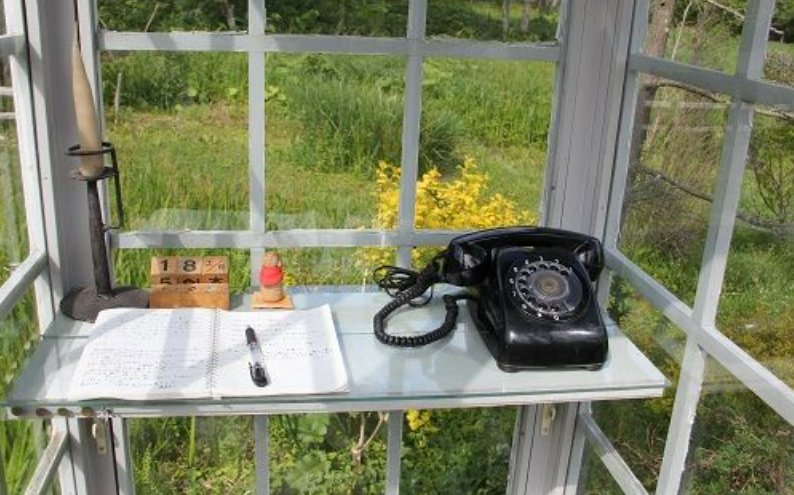
There is a special place in northeast Japan, in Iwate Prefecture, where a man named Sasaki Itaru created something called the “wind phone”. It’s a telephone box, and inside there is an old black telephone, which is not connected to anything.

Thousands of people travel there to use the phone to speak to those they have lost.

The Wind Phone was set up not far from one of the cities in Japan devastated by a terrible tsunami in 2011.

It’s set in a garden, in a remote area. It is not easy to get there. Once you find the location, there are no signs to guide you to the phone box.

“It’s in the very act of wandering—losing yourself in the landscape, uncertain of where you are and when you’ll arrive—that people end up thinking about many things, reformulating their memories of the person they have lost. And it’s in this mood, a sort of meditation, that they encounter the Wind Phone. They get here in a fuller and more aware state. They are ready.”

“You need to get your own feelings in order before you can talk to someone else. You need to emerge from the tragedy, from the shell of pain you’ve been encased in. Those who come to the Wind Phone are already halfway there. They are ready to create a new relationship with the dead.”

I wonder if that’s one way to think about the work of grief- that we are creating a new relationship with the person who has died.

The quoted paragraphs are from this article: